
Not having a university degree does not automatically rule out every EB-3 direction, but it does not establish eligibility for a particular job either. Start with the actual position's education, training, experience and working conditions. Skilled-worker and other-worker requirements differ, and “entry level” is not an immigration decision. This guide helps candidates without a degree build a practical job shortlist, identify missing facts and ask employers useful questions before committing to an application or relocation plan.
- 1. Separate the degree question from the actual job requirements
- 2. Read an entry-level advertisement as a description of work
- 3. Check that the opportunity is identifiable and has the right job nature
- 4. Build a six-field shortlist before ordering an application package
- 5. Turn existing experience and training gaps into practical preparation
- 6. Compare employment conditions and immigration stages before committing
- 7. Questions about looking for EB-3 jobs without a degree
1. Separate the degree question from the actual job requirements
A degree is one part of a job requirement, not a universal test for every EB-3 branch. The qualification provisions in 8 CFR 204.5(l) distinguish professionals, skilled workers and other workers. The professional branch has its degree requirements; the skilled-worker definition concerns work requiring at least two years of training or experience. An applicant without a degree should not automatically be directed to the other-worker branch without checking the real job.
The other-worker definition concerns work requiring less than two years of training or experience and excludes temporary or seasonal work. It does not remove the position's actual requirements. The same regulation requires evidence that an other-worker beneficiary meets the education, training, experience and other conditions of the labor certification. A headline saying “no degree” therefore cannot answer every qualification question.
Begin with a written job description, not a list headed “easy green-card jobs.” Ask which requirements are mandatory and which are preferred. Do not assume a degree described as preferred can be ignored in the actual case, or that a required qualification will be waived because an advertisement is short. Clarify the current version with the appropriate contact.
For a broader comparison of the branches, see our EB-3 category guide. Here, the practical task is to decide which opportunities deserve further questions. This is not a decision that a reader qualifies for a category simply because they do not hold a degree.
2. Read an entry-level advertisement as a description of work
Look for the actual tasks, supervision, training, schedule, worksite and any stated certificate or licence. “No experience necessary” may describe an employer's initial advertisement, but the work can still require careful instruction-following, safe equipment use, reliability and communication. Ask what must already be demonstrated and what training is genuinely provided.
The Bureau of Labor Statistics profile of hand laborers and material movers describes work that commonly has no formal educational entry requirement and uses on-the-job training. It also describes physical demands, varied schedules and some roles with specific licensing needs. That occupational profile is useful context; it is not a list of sponsoring employers or proof that a particular warehouse job fits EB-3.
Use occupational research to form questions rather than to replace an employer's description. For a packing role, ask about the items handled, equipment, instruction and shift arrangements. For a hotel-related role, ask about the actual department, duties and work organisation. These are examples of questions, not current vacancies or claims that every employer in those sectors sponsors overseas candidates.
Do not infer that “entry level” means light work, no communication needs or no standards. Equally, do not decide suitability from a stereotype about age, nationality or education. Compare the described job with your own experience and the conditions you can realistically accept, and seek appropriate clarification where a requirement is unclear.
3. Check that the opportunity is identifiable and has the right job nature
Record the employing entity, worksite, job title, contact and source of the description. If an agency introduced the role, ask how it is connected to the employer and who can confirm the actual vacancy and requirements. A picture of a hotel or a generic occupation list is not confirmation that an employer has a job available for you.
For the PERM context, 20 CFR 656.3 defines employment as permanent, full-time work for an employer other than oneself. A short holiday-season assignment or a self-employed arrangement should not be relabelled as a suitable permanent role merely because the work appears accessible without a degree. The applicable route and actual employment facts need review.
Ask whether the discussion concerns a real ongoing role, a general expression of interest or an agency's future candidate list. These are different states. Keep the answer in your shortlist so a promising contact does not silently become a “confirmed sponsor.” Where you cannot establish the employer or job, the next step is verification, not sending increasingly sensitive documents.
Our employer-verification guide addresses the deeper checks. This page uses a lighter first screening: enough to identify the role and the question still needing an answer. It does not reproduce the group site's recruitment-fee article or treat a payment as evidence that a vacancy exists.
4. Build a six-field shortlist before ordering an application package
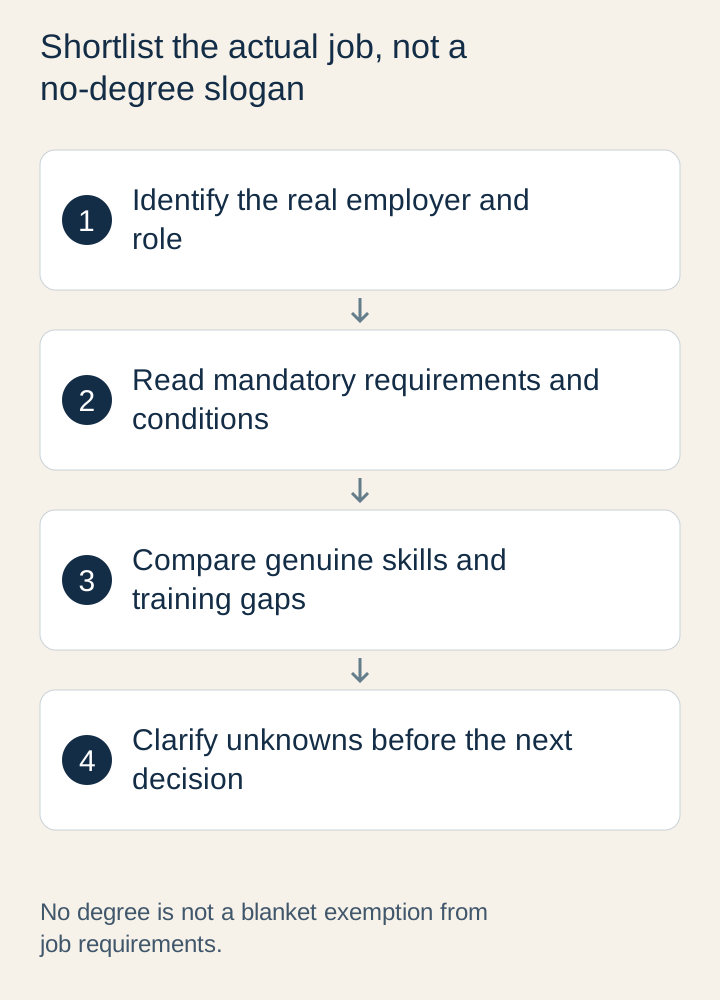
Use six fields: job reference and actual employer; mandatory education and training requirements; duties and working conditions; your relevant facts; unanswered question and responsible contact; and the shortlist decision with the next action. The decision can be “ask for clarification,” “prepare for a relevant discussion” or “not suitable on the information available.” It is not an immigration approval score.
| What the description says | What still needs checking | A useful shortlist response |
|---|---|---|
| No university degree stated | Exact mandatory education and other requirements | Obtain the current written requirements |
| Training is provided | What is taught, by whom and what must already be known | Ask for the practical training arrangements |
| Entry-level logistics work | Actual tasks, equipment, schedule and worksite | Compare conditions with your own background |
| Hotel-related opportunity | Department, employing entity and ongoing job nature | Request a specific role description |
| Sponsorship may be considered | Who assesses the route and what has actually been agreed | Keep the claim unconfirmed until clarified |
In an invented teaching example, two advertisements both say “no degree.” One identifies a permanent role, duties and a contact; the other only names an industry and requests a deposit. The first may justify further questions, while the second lacks basic information. Neither is a verified sponsor or an approved case. The difference is the evidence available for the next action.
Keep the original advertisement or message and its observation date. If a condition changes, preserve the earlier version and ask which one is current. Do not combine the most attractive pay from one advertisement with the easiest requirements from another and present them as a single opportunity. Each row should describe one actual discussion.
For support organising a realistic shortlist and presenting your experience, submit your career background. HKJobHunt can discuss resume preparation, interviews and employer-contact directions within a confirmed service scope. Individual immigration matters require separate case assessment; a shortlist is not a promise of placement.
5. Turn existing experience and training gaps into practical preparation
List tasks you have actually performed, even if the job title differs from the advertised one. Describe the setting, your responsibility and how you followed instructions or checked work. A service, production or stock-handling example can be useful when it demonstrates a relevant task, but do not claim that any experience automatically satisfies a particular immigration requirement.
Distinguish evidence of completed experience from a plan to learn something. A training brochure or intention to take a course does not prove the qualification has been obtained. Before paying for training, ask which real job requirement it addresses, who issues the record and whether the appropriate reviewer considers it relevant. A course advertised alongside a recruitment package does not establish that relevance by itself.
An original question to an employer is: “Could you confirm the mandatory requirements, the tasks I would perform and the training available? My relevant experience is this actual work. I have not yet demonstrated this other item. Which information would help you assess whether a discussion is worthwhile?” This gives a clear account without claiming qualifications you lack.
If a role becomes sufficiently specific for document assessment, move to the separate qualification-evidence guide. That guide deals with linking requirements to records. The shortlist comes earlier: it helps avoid ordering a generic document package for a role whose actual requirements or employer have not been identified.
6. Compare employment conditions and immigration stages before committing
Request clear pay currency and basis, proposed working hours, schedule, worksite and any stated accommodation or transport arrangement. Compare gross figures with gross figures and keep any deductions or living-cost assumptions separate. This article does not quote a market wage, promise free housing or calculate an individual's take-home pay. A national occupational statistic is not the offered wage for your job.
Ask how the employer expects to communicate about a potential start and who will assess the immigration route. The Department of State employment-based overview separates the employer's immigrant petition from later visa stages. Interest in a candidate without a degree is not permission to start work, and a completed shortlist does not establish visa availability or approval.
Use conditional language when discussing notice and relocation. Identify what must be confirmed before a working start, and keep your present commitments separate from an unverified date. If an employer cannot yet answer a question, record the uncertainty and agree the next contact. Do not turn silence into confirmation or use another applicant's successful case as your own outcome forecast.
For the later handover between recruitment, PERM and I-140, see our employer-process guide. Broader immigration background is available through PremierVisa Group's U.S. information, with individual advice and services arranged under a separately confirmed scope.
To prepare a focused discussion, submit your background and the job questions still unresolved. State your actual education, experience, target duties and the conditions you need to clarify. That gives the consultant a practical starting point without assuming that a no-degree opportunity is already a suitable or available sponsored job.
7. Questions about looking for EB-3 jobs without a degree
Does no university degree mean I can only consider other-worker jobs?
No. The skilled-worker and professional branches have different requirements, and the actual job matters. Relevant training or experience may be central to a skilled role. Your lack of a degree alone does not determine the right category or establish eligibility.
Does other worker mean no education, experience or training can be required?
No. The regulation requires the beneficiary to meet the labor certification's actual education, training, experience and other requirements. Read the specific job rather than converting a category label into a blanket waiver.
Is every hotel or warehouse role suitable for EB-3?
No. An occupational example does not establish a permanent full-time opportunity, an employer's support or a person's eligibility. Confirm the actual entity, duties, requirements and applicable process before treating it as a potential route.
Should I buy a course before contacting employers?
First identify the requirement the course would address and how the resulting evidence would be assessed. Completed relevant training and a future intention are different. Do not buy a generic course merely because it is marketed as a route to sponsorship.
Can a promising shortlist give me an immediate U.S. start date?
No. A shortlist organises questions and practical choices. Work permission, employer arrangements and later immigration decisions need their own confirmation. Keep any proposed start conditional on the actual requirements being met.