
After identifying a prospective EB-3 employer, confirm the real job, the applicable immigration route and who owns each next action. An interview, offer, labor certification, immigrant petition and permission to work are separate milestones. This guide helps candidates organise the handover between recruitment and case preparation, using a six-field stage record. It focuses on the ordinary PERM-based route and explains where a different procedure needs individual review; it does not promise an approval date or an immediate U.S. start.
- 1. Turn the employer's interest into an identifiable next action
- 2. Understand what the employer's PERM preparation involves
- 3. Keep labor certification and the I-140 petition distinct
- 4. Separate visa availability, consular processing and work permission
- 5. Use a six-field stage-and-handover record
- 6. Agree a useful update routine without committing to an unverified start
- 7. Questions candidates ask after finding an EB-3 employer
1. Turn the employer's interest into an identifiable next action
First establish the employing entity, job title, worksite, actual duties, requirements and contact authorised to discuss the role. Keep the written offer or proposal and its version. A recruitment agency's introduction is useful information, but it does not establish that the employer has agreed to every immigration step or that a government filing exists.
Ask what has actually happened: a hiring manager's discussion, a written employment proposal, the employer's decision to assess sponsorship, or a submitted application. These descriptions should not be used interchangeably. Record the evidence for the current description and the person who can confirm it. If the only information is a verbal promise, the next action is clarification rather than marking a filing as completed.
The Department of State employment-based immigrant visa overview describes labor certification where required, an employer-filed I-140 and later immigrant-visa processing. That sequence helps identify different decision makers; a commercial agreement does not replace their decisions. Confirm the applicable route before arranging documents around a generic flowchart.
If you still need to establish who is offering the job, use our EB-3 employer-search guide. If the question is whether your background meets the actual requirements, use the separate qualification-evidence guide. Here, the central question is what the next owner needs to receive and what evidence will confirm progress.
2. Understand what the employer's PERM preparation involves
For an ordinary PERM-based case, the employer's labor-certification preparation includes the genuine job, applicable wage and recruitment requirements. The DOL process in 20 CFR 656.17 distinguishes recruitment requirements and requires an employer recruitment report describing actual steps and results. Professional and nonprofessional recruitment procedures are not identical, and specified exceptions use different procedures.
A candidate should not manufacture advertisements, invent unsuccessful applicants or supply rejection reasons to make an application appear ready. The employer and the people properly handling its process must work with truthful recruitment records. Your useful contribution is accurate personal evidence and a clear response to legitimate questions about your own history, not control over how U.S. applicants are assessed.
Ask the employer's designated contact which preparation step is underway, who owns it and what information is genuinely needed from you. A sensible answer might identify an unresolved job requirement or a request for an institution record. It should not ask you to sign blank documents or confirm events you did not witness. Read any statement about your own qualifications carefully before confirming it.
This article does not reproduce an advertisement calendar for every occupation. The rule contains different recruitment steps and timing conditions; the people responsible for the actual case need to check the applicable version and procedure. A Schedule A or other special procedure should be identified expressly rather than forced into the ordinary PERM checklist. The presence of a job offer alone does not settle that route question.
3. Keep labor certification and the I-140 petition distinct
Once the required labor-certification basis is in place, the ordinary route moves to the employer's immigrant petition. An approved labor certification and an I-140 receipt answer different questions. Neither should be relabelled as the final immigrant visa. When someone says a case is “approved,” ask which agency, document, date and stage they mean.
Use a document index rather than circulating a complete case file to everyone. The index can identify the record type, date, responsible contact and secure location. Ask the appropriate case contact what confirmation can be shared with you and what personal information should be masked. Do not request other applicants' records or an employer's confidential material simply to fill your own progress spreadsheet.
Your personal preparation may include accurate education, training and employment records, consistent names and a truthful chronology. The exact requested documents depend on the case. If a previous employer cannot confirm a duty, record the gap and ask how it should be reviewed. Do not convert a resume summary into a supposedly issued employment letter or edit an institution's award title to fit the job.
A useful question is: “Which filing or decision are we waiting for, who will receive the notice, and what will be the next action after it arrives?” This invites an operational answer without asking anyone to guarantee the outcome. Also ask who checks any document validity or filing deadline. A general article cannot calculate those dates from an undated verbal update.
4. Separate visa availability, consular processing and work permission
The Visa Bulletin index separates the current bulletin from an upcoming month. Visa availability is a different issue from whether an employer has prepared a petition or whether a case has received a positive decision. Use the actual case details and applicable month, not another applicant's screenshot, when asking for an update.
For candidates outside the United States using consular processing, later steps can involve National Visa Center instructions, required civil documents, an immigrant-visa application, medical examination and consular interview. Follow the instructions for the actual case and post. The Department of State overview explains that an issued visa permits travel to request admission; it does not guarantee entry at the port of entry.
Some people already in the United States may be assessing adjustment of status. Being physically present does not establish eligibility for that route, and this guide does not decide it. Do not swap consular and adjustment documents because a friend used a different route. Confirm which process applies and who will check the relevant conditions before making a filing or travel decision.
Work authorization needs its own basis. 8 CFR 274a.12 distinguishes employment authorised through particular statuses from categories requiring an employment-authorization application. A pending or approved I-140 is not, by itself, permission to begin the offered job. Anyone relying on an existing U.S. permission needs its actual scope and continuing validity checked separately.
For a closer explanation of bulletin-reading and conditional start planning, see our EB-3 timeline and Visa Bulletin guide. This page supplies the handover record that sits alongside it; it does not forecast how quickly any cutoff will move.
5. Use a six-field stage-and-handover record
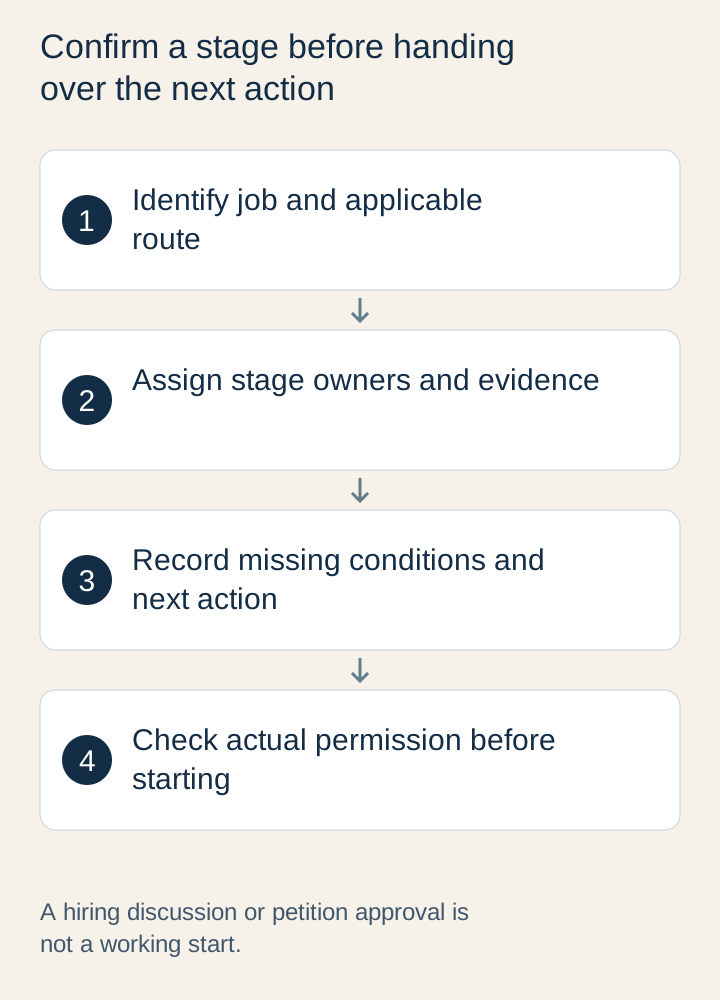
Create a private working record with six fields: stage and applicable route; responsible person and contact role; evidence actually received and date; missing information or unresolved condition; next action and owner; and the event that triggers the next review. Use document references rather than passport numbers or complete personal files. Unknown information stays unconfirmed.
| Stage being discussed | Confirmation to request | Candidate's useful next action |
|---|---|---|
| Employer's hiring interest | Identified entity, actual role and written next step | Check duties and requirements against your background |
| PERM preparation, where applicable | Current preparation stage and responsible contact | Supply accurate requested personal evidence |
| Immigrant petition | Actual filing or decision confirmation and stage | Reconcile personal-document discrepancies |
| Later immigration processing | Instructions for the actual route and case | Prepare the specifically requested documents |
| Proposed employment start | Verified permission covering the actual work | Reconfirm job details and practical arrangements |
As an invented teaching example, a recruiter writes “paperwork ready,” while the employer's contact says that a job requirement still needs clarification. The record should say “requirement clarification pending,” with the employer contact owning that action. It should not say “PERM approved.” When the clarification arrives, record the new evidence and move only the relevant field forward.
The practical advantage is a smaller, clearer update request. You can ask whether a specific missing item has arrived instead of repeatedly asking whether “the whole immigration” is finished. Keep older versions so a later change is visible. If the role, worksite or employer changes, flag the change for appropriate review rather than silently substituting a new name throughout the record.
If you need help organising your work history, resume and interview questions, submit your career background. HKJobHunt can discuss practical preparation and employer-contact directions within an agreed scope. Immigration questions can be referred to PremierVisa Group for individual assessment under a separately confirmed arrangement.
6. Agree a useful update routine without committing to an unverified start
Ask how the designated contact prefers updates and which events should prompt a message. An original template is: “Our record currently shows this stage, based on this dated document. We understand that this item remains unresolved. Could you confirm the responsible contact, the next action and the event after which we should review the position?” Add only information relevant to your own case.
A date for the next conversation is not a promised approval date. Label the two differently. If you agree to check back after a particular event or on an administrative review date, record that it is a coordination arrangement. Do not publish it as an official processing time or make it the basis for a non-refundable relocation commitment.
Before resigning, booking travel or accepting a start date, review the actual immigration position and the employer's continuing job arrangements. Ask what happens if the role changes, the employer's needs change or a document request arrives. Keep communication factual and dated. A delay or missing update needs clarification, not a fabricated success story to reassure family members.
Prepare a small handover pack: the job version, your truthful qualification summary, requested supporting-record index, the current-stage record and a short question list. Keep confidential records in an appropriate secure channel. If a request is unclear, ask who needs the document and why before sending a full identity or employment file through an ordinary chat.
For individual help with this preparation, submit your background and questions. Explain the job you are discussing, the last stage you can evidence and what remains unclear. The next conversation can then focus on practical support and the appropriate referral instead of assuming a job, sponsorship or visa is already secured.
Broader immigration background is available through PremierVisa Group’s U.S. information; individual advice and services require a separately confirmed scope.
7. Questions candidates ask after finding an EB-3 employer
Does an employer interview mean the PERM application has started?
No. It establishes that an interview occurred. Ask whether the employer has agreed to assess the relevant route, who owns the next step and what documentary stage actually exists. Keep recruitment discussions separate from government filings and decisions.
Does every EB-3 case use exactly the same recruitment checklist?
No. The ordinary PERM rule contains different requirements and specified exceptions. Ask the people handling the actual case which procedure applies. A candidate's generic checklist should not replace an employer's route-specific preparation.
Can an approved I-140 be used as permission to start work?
Not by itself. Employment needs a valid basis covering the actual work. The later immigration route, any existing permission and its conditions must be assessed separately; a petition decision is not an automatic start authorisation.
What should I do if an update only says “approved”?
Ask for the stage, issuing agency, document type and date, through the appropriate contact. Record what can actually be confirmed and what remains unknown. Do not fill the gap with another person's approval notice or an assumed final outcome.
Should I collect every possible document immediately?
Start with an accurate index and the case-specific request list. Different stages need different records. Keep originals safe, address genuine inconsistencies early and follow the responsible contact's current instructions before commissioning time-sensitive documents or assessments.