
An EB-3 offer does not provide a reliable date to leave your current job or begin work in the United States. Employer preparation, petition decisions, visa-number availability, processing and actual work authorization are separate conditions. The Visa Bulletin helps assess one part of that sequence; it is not an individual countdown. Overseas applicants can use a monthly bulletin-and-hiring decision sheet to record their verified category, priority date, chargeability and next required step, while keeping tentative employer planning separate from permission to start.
- 1. Build a sequence of conditions rather than one promised arrival date
- 2. Confirm the priority date from the case, not from the sales contract
- 3. Check chargeability separately from passport and current residence
- 4. Read the correct month, row, column and chart
- 5. Use a monthly bulletin-and-hiring decision sheet
- 6. Agree conditional hiring plans and protect current commitments
- 7. Frequently asked questions
1. Build a sequence of conditions rather than one promised arrival date
Start by asking what has actually happened. Is there only a recruitment conversation, a written employment proposal, a labor-certification filing, an employer petition or a later visa-stage instruction? The Department of State employment-based guide describes different steps and says individual timing cannot be predicted accurately. A seller's single “total duration” may conceal several decisions and changing conditions.
For many EB-3 cases the employer must obtain labor certification before filing the immigration petition, while the applicable route and exceptions require appropriate review. DOL's PERM overview separates the genuine job, prevailing-wage and recruitment steps from the labor-certification filing. The time spent finding a role or preparing recruitment is not the same as a visa-number wait.
Write a sequence with evidence beside each stage. Mark a stage pending when no relevant document has been obtained. If a service provider says something was submitted, ask which filing, by whom and when, and what evidence can be appropriately supplied. Do not use an invoice date, contract signature or internal customer reference as proof of a government filing.
Recruitment needs can also change while immigration steps continue. Ask how the employer will communicate about the intended role, location and anticipated availability, and who will assess a material change. This is not an invitation to assume any replacement job works. A new offer or changed duties may raise case-specific questions that belong with the responsible employer and appropriately qualified professional.
2. Confirm the priority date from the case, not from the sales contract
8 CFR 204.5(d) provides the priority-date rules. For a petition accompanied by an individual DOL labor certification, the relevant date is when DOL accepted the labor-certification application for processing. Cases not requiring that certification and Schedule A cases have different petition-filing rules. Have the date and route confirmed from the applicable records.
The day you first contacted an agency or paid a deposit is not automatically the priority date. Nor does the calendar date printed on an employer's marketing brochure establish a place in the visa queue. Ask the responsible representative to identify the actual document and date being used. If they have not been obtained, write priority date unconfirmed rather than choosing an optimistic date.
Keep the category alongside the date. The bulletin's employment “3rd” and “Other Workers” rows are separate; choosing the wrong row can produce a misleading conclusion. Use the category-and-evidence guide to prepare questions, while leaving the actual case classification to proper assessment. A personal degree does not let you choose whichever row moves faster.
Store the case evidence securely and record only the minimum necessary information on a planning sheet. Do not publish receipt numbers, birth records or family details in a public spreadsheet. The worksheet is for your own decisions and professional discussions, not a public eligibility calculator. A missing or disputed date is a specific question to resolve before drawing a chart conclusion.
3. Check chargeability separately from passport and current residence
22 CFR 42.12 generally connects numerical chargeability to the foreign state or dependent area of birth, with defined exceptions. Current residence or a recently obtained passport does not by itself establish a different column. People living in the same city can therefore need different case assessments.
For an overseas applicant, write the actual place of birth and ask which bulletin chargeability column applies under the current rules. Do not let a website's language selector or your preferred nationality description make that determination. Where a spouse, parent or other relevant circumstance may engage an exception, obtain appropriate assessment rather than assuming cross-chargeability is automatic.
An original hypothetical example is a couple with different birthplaces who ask whether a spouse-related exception is available. The useful next action is to identify the relevant facts and supporting documents for review. The example does not establish that any real couple qualifies or that selecting a more favorable country in an online calculator makes it valid.
Record the basis of the conclusion, who confirmed it and when. If the answer remains provisional, the resulting timetable must remain provisional too. Avoid comparing yourself with a social-media case unless the relevant category, chargeability, priority date and route are actually comparable. Even matching those fields would not prove the same processing or interview outcome.
4. Read the correct month, row, column and chart
Open the Department of State Visa Bulletin index and check the month before copying a date. On 25 October 2026, the index labels October as current and November as upcoming. The November bulletin is already published but applies to November; its availability online does not turn it into the October bulletin. Keep the check date and bulletin month in separate fields.
The November 2026 bulletin explains Final Action Dates and Dates for Filing. Final Action Dates concern visa-number availability for qualified cases; Dates for Filing concern an earlier document-submission stage under the stated instructions. For consular processing, follow NVC notification and instructions. A filing-chart result is not a visa issuance decision.
| Check | What to record | What the result does not establish |
|---|---|---|
| Bulletin period | Month and year, plus date checked | A rule for every later month |
| Category and chargeability | Verified row and column | Permission to choose a faster category |
| Chart type | Final Action or Dates for Filing | The same outcome under both charts |
| Priority-date comparison | Earlier, equal, later, or relevant C/U notation | An interview appointment or lawful start date |
Where a cutoff date is listed, the bulletin requires a priority date earlier than that date; the same date is not earlier. “C” means current under the chart's instructions and “U” means unavailable for the relevant final-action notation. These are not individual approvals. Read the full notes, because a cropped social-media table may omit conditions and the separate other-worker row.
For adjustment of status inside the United States, USCIS determines the applicable filing chart each month. The bulletin directs readers to that separate determination. Do not assume the consular filing instructions or last month's USCIS choice apply to your filing. If the current USCIS determination cannot be read and confirmed, obtain it through an appropriate official route before acting; this draft does not claim that month's selection is verified.
5. Use a monthly bulletin-and-hiring decision sheet
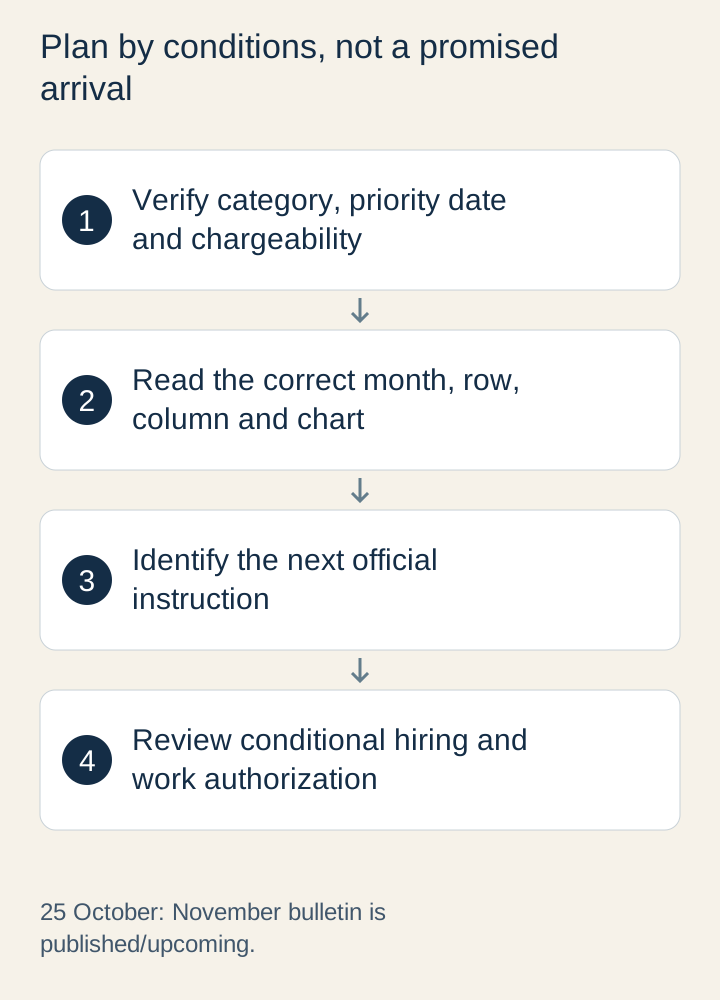
Create six columns: month and official URL, verified case inputs, chart and comparison, next official instruction, employer planning question, and action owner with review date. This original asset connects immigration information to employment decisions without calculating an invented arrival date. Use a new row for each month and retain the earlier entry so that changes are visible.
An original hypothetical entry might say: correct row and column checked; priority date is earlier than the filing cutoff but not the final-action cutoff; follow the applicable document instructions; do not treat this as a confirmed start. Another might say the priority date is current for final action but an interview or final decision is still pending. These are teaching situations, not current personal case results.
The bulletin explains that dates may retrogress and categories may become unavailable when limits are reached. A month of movement does not guarantee the same movement next month. Do not subtract the cutoff date from today's date and call the result the remaining wait, or project a fixed number of months forward from one favorable change. Demand and allocation are not a regular conveyor belt.
If you want help translating your work history into employer questions while that uncertainty remains, submit your candidate background. Confirm the scope and terms of support. A career-preparation discussion does not predict a government decision or promise continued availability of a particular vacancy.
6. Agree conditional hiring plans and protect current commitments
Ask the employer: “Which conditions must be satisfied before we agree a start date, and when should we review the plan?” Separate online interview availability, your current notice obligations, relocation preparation and the actual right to work. An employer can discuss a tentative window without having the power to issue a visa or reserve an individual visa number.
Keep two planning lists. The first contains reversible preparation: keeping experience records accurate, discussing duties, improving interview explanations and researching general living arrangements. The second contains commitments that need stronger evidence: resignation, irreversible travel purchases, housing contracts and a firm start date. Your personal circumstances and contract obligations still need assessment; a checklist does not decide those consequences for you.
The Department of State employment guide advises against final travel arrangements, disposing of property or giving up jobs until visas are issued. Even issuance is distinct from admission: a visa permits travel to seek entry, while border officials determine admission. For the overseas immigrant route, ask the responsible professional and employer which documents and actual status support onboarding after lawful admission; do not confuse waiting for a physical card with every question about employment eligibility.
The visitor-visa guide does not permit employment on visitor status. A delayed immigrant process is not solved by arriving as a tourist to start the role. Anyone already in the United States needs individual advice on current status and actual employment authorization; a pending petition or a chart comparison alone is not a work permit.
If the role changes or the employer cannot maintain its plan, document the change and obtain case-specific advice before assuming the existing process transfers. For checking whether the original employment representations are consistent, use the advertisement-to-offer verification guide. Keep a job-search contingency, but do not present a new lead as an approved replacement sponsor or government outcome.
For broader route details, read the PremierVisa Group U.S. overview; individual legal advice and representation require appropriately qualified professionals.
7. Frequently asked questions
Does an approved I-140 mean I can start work immediately?
No. Petition approval is a separate stage from visa-number availability, visa processing and actual work authorization. Ask what legal status or authorization would permit the specific employment, rather than treating an approval notice as a start-date instruction.
Can I use November's bulletin as soon as it appears in October?
Record it as the published upcoming November bulletin. Apply the appropriate month's rules and the relevant processing instructions. Planning for an upcoming month is different from claiming the future period is already in effect.
Is my passport country always the right column?
No. Chargeability generally depends on birthplace, with defined exceptions requiring assessment. Residence, language and passport alone should not be used to select a favorable column. Confirm the basis from the case facts and applicable rules.
If my date equals the cutoff, is it early enough?
For a listed cutoff, the bulletin uses an earlier-than requirement. Equality is not earlier. Confirm the precise category, chart and month as well; a correct date comparison on the wrong row still gives the wrong planning result.
Can anyone promise a fixed number of years from today's bulletin?
The bulletin does not support an individual countdown. Dates can change, and processing has other conditions. Ask for the assumptions, stage evidence and review points behind any estimate, and keep employment commitments conditional where appropriate.
Start with one verified case-input sheet and one question for the employer about conditional timing. Submit your background if you need help preparing your work history and interview plan while qualified professionals handle individual immigration questions.
Prepared with AI assistance. General career information; no named professional review has been confirmed. AI cover illustration does not depict our staff, clients or partner employers.