
For an EB-3-related job, start with the employer’s actual requirements and compare them with evidence of your own education, training and experience. A degree, a familiar title or a total number of working years does not establish that you qualify for every position. This guide helps candidates prepare a requirement-to-evidence matrix and precise review questions. It does not decide a petition, certify a foreign qualification or turn an offer into permission to work in the United States.
- 1. Obtain the actual job requirements before assessing your background
- 2. Use the category distinctions to ask better questions
- 3. Turn experience claims into records an issuer can confirm
- 4. Build a six-field requirement-to-evidence matrix
- 5. Read education and training records carefully
- 6. Raise evidence gaps before making application or travel commitments
- 7. Candidate questions about EB-3 qualification evidence
1. Obtain the actual job requirements before assessing your background
Ask which employing entity, position and worksite the discussion concerns, and obtain the current written duties and requirements. Identify the document version and who can confirm it. A recruiter’s short advertisement may be a starting point, but it is not a substitute for the actual proposed employment and relevant application documents.
For a PERM-based role, also confirm that the proposed employment is permanent and full-time. That is part of the employment definition in 20 CFR 656.3; a brief placement or seasonal assignment does not become suitable merely by using an EB-3 label.
Separate the job’s requirements from the applicant’s strongest qualifications. A candidate with extensive experience is not automatically a match for a job requiring a particular degree, skill or other condition. Equally, a degree alone does not demonstrate experience performing a specific task. The comparison must refer to the real role rather than a general description of EB-3.
The Department of Labor rule in 20 CFR 656.17 addresses job duties and actual minimum requirements in the PERM process. Do not ask an employer to retrofit requirements around a preferred person or change a qualification description merely to create an apparent match. Appropriate review is needed where the real requirements or supporting history are unclear.
If you have not established which employer and position are involved, first use our EB-3 employer-search guide. This article assumes a role can be identified and concentrates on documentary readiness. It does not repeat the group site’s recruitment-fee discussion or claim that a possible role is a verified vacancy.
2. Use the category distinctions to ask better questions
The Department of State’s employment-based immigrant visa overview distinguishes skilled workers, professionals and other workers within the third preference. Skilled-worker jobs involve at least two years of training or experience; other-worker jobs involve less than two years and are not temporary or seasonal. The professional branch involves the relevant degree requirements. These distinctions do not eliminate the actual position’s conditions.
The qualification provisions in 8 CFR 204.5(l) tie skilled versus other-worker classification to the training or experience requirements placed on the job as certified by the Department of Labor. Choosing a label from your own resume is therefore not enough. Ask what job requirements and classification are actually being assessed.
Relevant post-secondary education may be considered as training in the skilled-worker provision, but that is not a promise that any course replaces the necessary experience. Professional evidence includes a U.S. baccalaureate degree or foreign equivalent degree and the relevant professional basis. Do not assume that an informal combination of certificates and employment has already been accepted as an equivalent degree.
For a fuller category comparison, see our three-branch EB-3 guide. Here, the useful next step is a list of the actual requirements and their supporting records, not an automatic eligibility conclusion based on “two years” or “has a bachelor’s degree.”
3. Turn experience claims into records an issuer can confirm
Make a chronology of relevant employment and training. Record the employer or training provider, role, actual period, duties and the source of each claim. Explain gaps or overlapping periods accurately rather than adding overlapping calendar periods as though they were sequential years. Ask an appropriate reviewer how the experience is relevant and counted for the actual case.
The evidence provisions in 8 CFR 204.5(l)(3) describe letters from trainers or employers supporting required training or experience, including the issuer’s name, address and title and a description of the training or experience. A polished resume is not the same document. Identify who can truthfully confirm the relevant facts and what their records actually show.
For practical review, ask the issuer to clarify the relevant period and duties where they can verify them. Do not request a statement that they supervised work they did not observe or a description borrowed from a vacancy you never performed. If a job title changed or a company used several names, explain the relationship with records rather than silently standardising every document.
An original request could read: “I am organising evidence of my actual employment. Could you confirm the role, period and relevant duties that your records support, identify your position and contact details, and tell me if any item cannot be verified? Please do not include duties I did not perform.” This is a request for truthful information, not a government form or a pre-approved reference letter.
4. Build a six-field requirement-to-evidence matrix
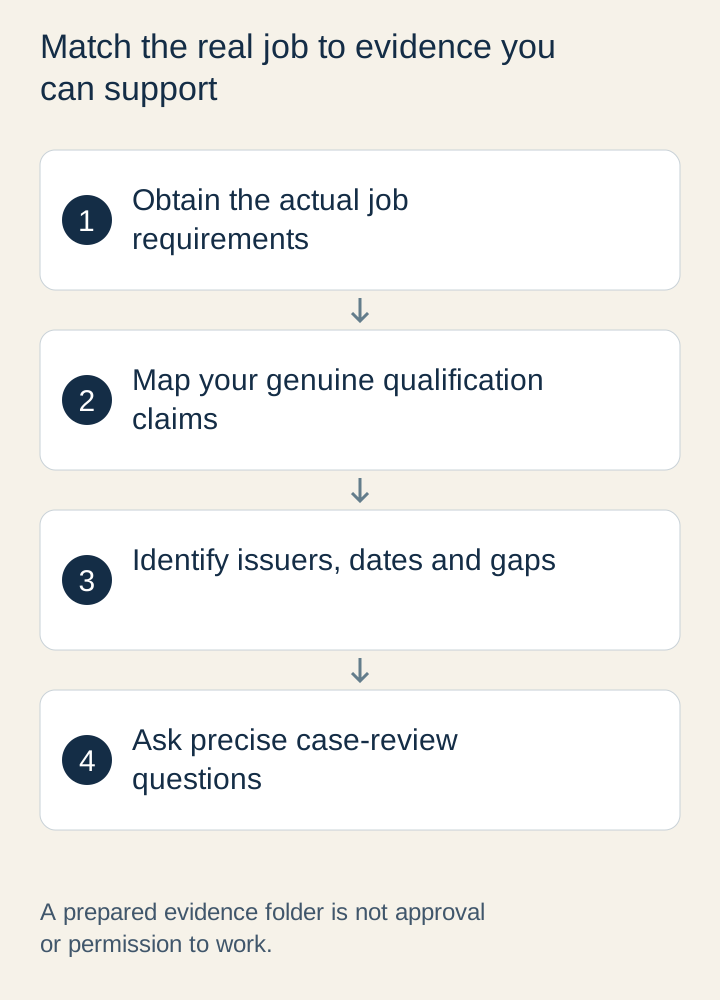
The original six fields are: exact job requirement and document version; your corresponding education, training or experience claim; supporting record and issuer; relevant dates and scope; inconsistency or missing evidence; and the review question, responsible contact and next action. Keep sensitive originals separately and use document references in the working table.
| Requirement or claim | Evidence to organise | Question still needing review |
|---|---|---|
| A specified degree | Official institution record, award date and field of study | Does it meet this job and category’s requirement? |
| Relevant training or experience | Issuer-supported description and genuine chronology | Which parts are relevant and how are they counted? |
| A particular practical duty | Evidence of the work actually performed | Does it support the duty rather than only a similar title? |
| A stated professional condition | The actual requirement and appropriate supporting record | Is any separate professional permission needed? |
| A missing or inconsistent document | Original record, explanation and a request to the issuer | What evidence can properly address this gap? |
For an invented teaching example, suppose an applicant lists several years under a broad technical title, while the proposed role requires a specific type of work. The matrix separates the title from the actual tasks and asks the former employer what it can confirm. It remains unresolved if the records do not show the relevant activity. This is not a real client or an example of petition approval.
Use the table to identify the smallest useful next request. You may need a clearer job requirement, an institution record or a precise question for the reviewer. Do not order a generic “eligibility package” before knowing what the job actually requires and what the available records already establish.
If you need help explaining your experience in a resume or interview, submit your career background. HKJobHunt can discuss practical preparation and employer-contact directions within an agreed service scope. Individual immigration and qualification questions require separate assessment; recruitment support cannot certify eligibility or guarantee an employer.
5. Read education and training records carefully
For the professional branch, 8 CFR 204.5(l)(3)(ii)(C) describes an official college or university record showing the degree’s award date and area of concentration. The job and professional requirements also matter. Retain the original name of the award and institution; do not translate a diploma or certificate into a bachelor’s degree merely because that wording looks stronger.
Keep degree evidence, transcripts, training records and employment evidence identifiable. They may support different questions. A course’s existence does not automatically prove mastery of every duty in the job, and time spent employed does not by itself establish a particular academic award. An evaluator’s task and an immigration decision are also different matters.
Record when each qualification was actually earned and ask the appropriate reviewer which date is relevant to the proposed filing. A promise to finish a course later is not evidence it has already been completed. This guide does not select a legal qualification deadline for an individual case or treat a future document as an existing one.
If documents require translation or further assessment, confirm the applicable instructions and service scope before commissioning work. Preserve the source document and a clear link to any translated or assessed version. Do not describe an assessment that has not been obtained as verified equivalence, or assume every foreign qualification will receive the same treatment.
6. Raise evidence gaps before making application or travel commitments
Write a short gap list with the actual job requirement, what you have, what is missing and who may be able to provide it. If a former company has closed or its records cannot be obtained, tell the appropriate reviewer. Ask what other evidence may properly be considered rather than creating a letter, inventing an issuer or assuming an unrelated payslip automatically replaces the required proof.
Employment with the proposed sponsoring employer, alternative requirements and employer-funded training can raise particular issues under the DOL actual-minimum-requirements rule. Put the genuine history before an appropriate reviewer; do not hide it or assume all such experience is automatically accepted or automatically excluded. This article does not resolve those case-specific questions.
An original review question is: “Please compare this dated job requirement with these actual records. Which claim is supported, what remains uncertain, which timing question matters and what further evidence should we request?” Keep the answer tied to the document version. If the position changes, revisit the comparison rather than reusing an old eligibility summary.
Separate a candidate’s preparation from the employer’s petition and later immigration stages. The Department of State overview describes an employer-filed I-140 and subsequent immigrant-visa processing; an offer or evidence folder is not a visa decision. Do not book a working start in the United States on the assumption that document readiness creates immediate work authorization.
For the different timing question, use our EB-3 timeline and Visa Bulletin guide. Broader immigration background is available through PremierVisa Group’s U.S. information, with any individual service arranged separately. This page stays focused on matching actual requirements to truthful records.
7. Candidate questions about EB-3 qualification evidence
Do two years in any job make me a skilled-worker match?
No. The job’s actual requirements and relevant evidence matter, and the skilled-worker provision concerns the necessary training or experience. A total of unrelated working years is not an automatic match for a particular role.
Does holding a bachelor’s degree make every role a professional case?
No. The job and professional requirements must also fit, and the degree evidence needs appropriate review. Do not choose a category solely because one qualification appears on your resume.
Do other-worker positions have no requirements?
No. The regulations still require evidence that the person meets the education, training, experience and other requirements of the relevant labor certification. A lower training threshold is not a promise of no qualifications, no screening or guaranteed selection.
Can I write my own former-employer letter and sign it for them?
Do not impersonate an issuer or claim confirmation that was never given. You can ask the actual employer or trainer for truthful supported information. If evidence is unavailable, disclose the gap and seek appropriate guidance rather than fabricating a record.
If the matrix has no gaps, is approval guaranteed?
No. It is an organising tool and does not determine the employer’s petition or later immigration outcome. Qualification evidence, a genuine job, the relevant application requirements and actual permission to work are separate matters.
Prepare the matrix, then choose the next document or question that will clarify a real requirement. Submit your career background to discuss your resume, interviews and practical employer directions. Work and immigration outcomes remain subject to their own conditions and decisions.