
EB-3 classification depends on the real job requirements and the applicant's supporting qualifications, not simply a job title, highest degree or a seller's package label. Skilled-worker roles involve at least two years of training or experience; professional classification requires the relevant bachelor's-level degree and professional criteria; other-worker roles involve less than two years and are not temporary or seasonal. All require a proper assessment of the actual position. Use a job-requirement and evidence crosswalk before deciding which description fits the proposed employment.
- 1. Start with the official categories, then examine the position
- 2. Skilled workers: explain the required training or experience precisely
- 3. Professionals: check the degree and the occupation separately
- 4. Other workers: lower training requirements do not mean no requirements
- 5. Build a job-requirement and evidence crosswalk
- 6. Supporting letters and resumes serve different purposes
- 7. Frequently asked questions
1. Start with the official categories, then examine the position
The Department of State's employment-based immigrant-visa guide identifies three EB-3 subgroups: skilled workers, professionals and other workers. Commercial labels such as EB-3A, EB-3B or EB-3C are not a safe substitute for these definitions; different sellers may attach letters differently. Ask which official classification is proposed and why the job supports it.
The governing 8 CFR 204.5(l) connects the skilled-versus-other-worker distinction to the employer's training or experience requirements as certified in the applicable process. Your personal background matters, but it does not independently rewrite what the job requires. An impressive resume cannot turn a lower-requirement role into a different position.
| Official subgroup | Central question about the job and applicant | Evidence question to resolve |
|---|---|---|
| Skilled worker | Does the role require at least two years of training or experience, and can the person demonstrate the relevant requirements? | Which actual training or work supports the required capability? |
| Professional | Is the relevant professional and bachelor's-degree requirement established? | Does the person hold the required U.S. bachelor's or foreign equivalent degree, with appropriate records? |
| Other worker | Does the non-temporary, non-seasonal work require less than two years of training or experience? | Can the person meet the position's actual education, training, experience and other conditions? |
This comparison is an original preparation tool, not a category decision. It does not establish a vacancy, government approval or a processing-time advantage. The pictures accompanying this article show different workplaces and do not assign those occupations to legal categories.
2. Skilled workers: explain the required training or experience precisely
For skilled-worker classification, the regulation describes at least two years of training or experience and recognizes that relevant post-secondary education may be considered training. That does not mean every course automatically counts, or that any two years in any job meet a specific role. Relevance and the actual requirements must be assessed together.
Build a training-and-work chronology. Record the employer or training provider, dates, hours where known, duties or course content and available evidence. If work and study overlapped, show the overlap instead of adding periods mechanically. Do not turn a calendar gap into experience or assume a short attendance certificate proves complete occupational training.
For an original hypothetical example, a maintenance position may require specified prior training and diagnostic experience. The applicant should identify which components they actually inspected, which procedures they used and who can confirm that work. The example does not classify all maintenance jobs or state that a person with a particular title qualifies.
Ask the employer for the genuine minimum requirements, not a description rewritten around your resume. DOL's PERM overview on FLAG says the employer determines actual job duties and minimum requirements for a permanent full-time opportunity. An applicant should not invent tasks, backdate employment or ask that genuine recruitment be treated as a formality to achieve a preferred label.
3. Professionals: check the degree and the occupation separately
Professional classification involves a U.S. baccalaureate degree or a foreign equivalent degree and membership of the professions as defined in the applicable rules. The regulation calls for official academic evidence showing the award date and field of study, and evidence of the degree requirement for entry into the occupation. A title containing “professional” is not enough.
Keep the actual degree name, institution, award date and subject clear. An English translation should explain the credential without upgrading it. A diploma, vocational certificate or a collection of short courses should not be relabelled a bachelor's degree because a resume template has a degree field. Ask an appropriate reviewer to assess foreign equivalence and the job's specific requirements.
An original hypothetical office-analyst role might require a relevant degree. A candidate may have strong related experience while the degree evidence remains unresolved. The useful next step is to identify the academic records and obtain the necessary assessment, not to insert “U.S. equivalent” without support. A private evaluation also needs to be understood for its scope; it is not itself a government approval.
Professional registration is a separate question where the occupation is regulated. A degree can support education but does not automatically authorize practice in every state or setting. Likewise, a licence or industry membership does not by itself resolve the degree requirement for this immigration classification. Keep each requirement visible rather than using one certificate as a universal answer.
4. Other workers: lower training requirements do not mean no requirements
The other-worker definition concerns qualifying non-temporary, non-seasonal work requiring less than two years of training or experience. The applicant must still meet the actual requirements of the position. “Unskilled” in this category is not a statement that the work has no safety procedures, physical tasks, communication needs or employer standards.
Ask what a normal shift involves, which tasks require training and which qualifications must already be held. A packaging role, for example, may involve following handling procedures and recording exceptions. This is a teaching example, not a live job, a finding of category eligibility or a promise that English is unnecessary.
A person with a bachelor's degree or a long career does not automatically move a lower-requirement job into the professional or skilled-worker subgroup. Start with the work and the proposed employer's actual requirements. Conversely, not holding a degree does not establish that the person satisfies every other-worker position. Category comparison cannot replace individual job-fit research.
If you need to organize that research, submit your candidate background to discuss duties, resume evidence and employer questions. Service scope, fees and appropriately qualified professional involvement must be confirmed; a discussion does not assign a category or guarantee employment or immigration approval.
5. Build a job-requirement and evidence crosswalk
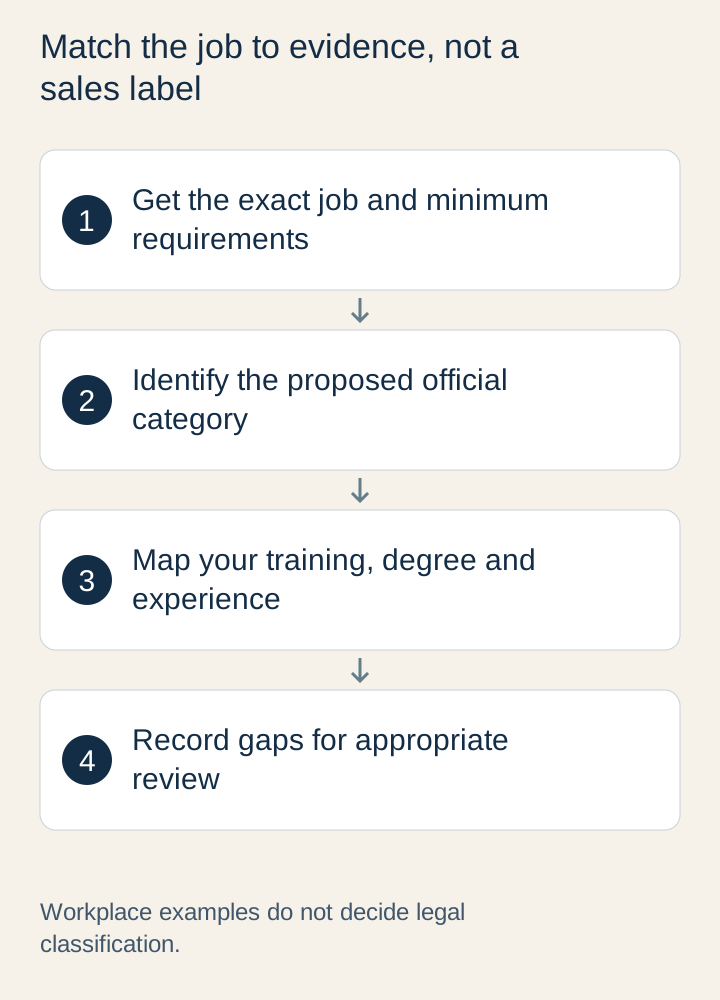
Create a private worksheet with the proposed official subgroup, employer and vacancy reference, exact job requirement, your corresponding evidence, unresolved gap and the next review question. Separate the employer's facts from your facts. You can describe your own employment history, but should not certify an employer's recruitment or business facts you have never checked.
An original hypothetical crosswalk might have three entries. For a technical role, the unresolved question may be whether the documented training and experience match its minimum. For a professional role, it may be foreign-degree equivalence and the occupation's degree requirement. For a lower-training role, it may be whether the work is genuinely long-term and whether you can carry out the stated tasks. None of the entries should be marked approved simply because a brochure uses a category name.
Keep the original wording of the requirement beside a plain-language explanation. This helps reveal a difference between “preferred experience” in an advertisement and a genuine minimum used in the relevant process. Ask the responsible employer or professional to resolve the distinction. Do not choose whichever version appears easier and silently disregard the other.
Use simple internal statuses such as evidence available, clarification requested, evidence missing and professional review pending. They are not legal findings or government stages. If a requirement changes, save the version and date and obtain an explanation of the effect. Altering a document yourself is not an acceptable way to make the crosswalk match.
Before comparing any proposed pathway, check that you can explain every important row. What work was done, who can confirm it, when was training received, and what does the degree actually say? A useful worksheet may reveal that you need a different vacancy or more preparation. That is more valuable than a tidy category label with unsupported evidence underneath.
6. Supporting letters and resumes serve different purposes
8 CFR 204.5(g) and (l) describes evidence from employers or trainers, including the writer's identification and descriptions of duties or training. A resume is your concise presentation; it is not a replacement for all required supporting evidence. Make the two consistent without rewriting the underlying facts.
Request accurate records from someone able to confirm the work. Explain the actual purpose and ask the writer to check the content before signing. Do not ask a friend to issue a letter for nonexistent employment or a supervisor to confirm duties they did not observe. If records are unavailable, tell the responsible professional what is missing and what genuine alternatives exist. The regulation provides for consideration of other documentation in relevant circumstances, not guaranteed acceptance of any substitute.
For the recruitment resume, use the overseas-experience writing guide. For finding a real position before comparing categories, use the employer research guide. Keep sensitive originals in secure storage and share only necessary material with a verified recipient; a checklist is not a reason to circulate all personal or employer records.
Classification, employer petition, visa availability and permission to start are separate matters. The Department of State visitor guide does not permit employment on a visitor visa. A category discussion or pending EB-3 preparation cannot authorize productive work. Broader route comparisons are available through the PremierVisa Group U.S. overview, with individual legal questions assessed by appropriately qualified professionals.
Keep the vacancy version alongside the comparison. A revised job description, a different worksite or a new set of minimum requirements can change which evidence needs review. Save the original advertisement and later written clarification separately, rather than silently replacing the earlier text. Mark the person who will resolve each discrepancy and the document they need. This makes the worksheet useful in a real conversation without presenting an internal judgment as a government decision. Do not mark a missing condition as satisfied because someone expects it to be easy to resolve.
7. Frequently asked questions
Are EB-3A, EB-3B and EB-3C reliable official definitions?
Use the official skilled-worker, professional and other-worker names and requirements. Commercial letter labels can be inconsistent. Ask for the proposed classification and its evidence instead of relying on a package title.
I have many years of experience. Does every job become a skilled-worker case?
No. The actual job requirements matter alongside your qualifications. More personal experience does not automatically change a position requiring less training. A proper assessment must connect the role and the evidence.
Can experience be written as a bachelor's degree?
No resume wording can create a degree. Professional classification requires the appropriate degree evidence and occupational criteria. Present what you actually hold and obtain a proper assessment of any foreign credential.
Does other-worker classification guarantee no English or training?
No. Read the employer's actual requirements and tasks, including safety and communication. The category's training threshold is not a universal promise about every workplace or applicant.
Can I start work while the category is being reviewed?
Not on that basis alone. Your actual authorization must permit the employment. Classification research, an offer or preparation for a petition is not permission to work.
Choose one real vacancy and complete the evidence crosswalk before paying attention to package labels. If you need employment preparation support, submit your background to discuss your experience, interview explanations and unresolved employer questions under confirmed arrangements.
Prepared with AI assistance. General career information; no named professional review has been confirmed. AI cover illustration does not depict our staff, clients or partner employers.
Sources: Department of State employment-based and visitor guides; current 8 CFR 204.5; DOL FLAG PERM. Full URLs and claim mapping are in sources.json.