
Start an EB-3 employer search with work you can genuinely perform, then identify a real vacancy, the actual employer and its willingness to discuss the relevant long-term employment process. A job-board label, an old filing record or a recruiter's list is not a verified sponsoring employer or an offer to you. EB-3 is an employment-based immigration category, not immediate work authorization. This guide shows how to build a short, evidence-based employer research list and make a useful first approach without buying a supposed job slot.
- 1. Match the actual job requirements before searching for an EB-3 label
- 2. Use recruitment channels as leads, then return to the original employer
- 3. Confirm who employs you and what work the business needs
- 4. Make the first approach about your contribution and the employer's actual process
- 5. Build a shortlist with evidence gates and a next question
- 6. When an employer is interested, separate employment and immigration milestones
- 7. Frequently asked questions
1. Match the actual job requirements before searching for an EB-3 label
The Department of State's employment-based immigrant-visa guidance describes EB-3's skilled-worker, professional and other-worker subgroups. Skilled-worker jobs require at least two years of training or experience; professional jobs require the relevant bachelor's-level degree; other-worker positions involve less than two years of training or experience and are not temporary or seasonal. These distinctions do not mean that every advertised job or every applicant qualifies.
Write your own employment profile first: principal duties, relevant training, qualifications, evidence you can obtain, practical language ability, work locations you can consider and your present U.S. work-right position. If you are outside the United States, say so. Do not write “authorized to work” because you hope an employer will eventually support an immigration process.
Use the actual minimum requirements of a vacancy to decide whether it is worth pursuing. “Other worker” does not mean that the employer needs no skills, that English is unnecessary for every job or that you may invent experience. If the work involves safety instructions, customer contact or regulated tasks, ask about the real requirements rather than relying on a category's marketing description.
Avoid treating commercial labels such as EB-3A, EB-3B and EB-3C as a substitute for the official subgroup and job requirements. Sellers may use labels differently. Record the official category being considered and ask the appropriate professional to assess it; changing a letter in a package name cannot solve a mismatch between the job and your evidence.
2. Use recruitment channels as leads, then return to the original employer
Look at employers' own careers pages, credible recruitment platforms, professional or industry networks and relevant recruiter introductions. Search by duties, occupation and realistic worksite, not only by “EB3 visa jobs”. Each channel can reveal a lead, but none automatically establishes that the employer will consider your circumstances or sponsor a permanent-worker case.
Find the original vacancy where possible and preserve its reference, date, duties and application method. Check whether the employing entity and worksite are identified, whether the role is current and whether the posting addresses work authorization. A reposted advertisement can be old or incomplete. Several copies of one advertisement should remain one lead, not several apparent opportunities.
Historical labor-certification or immigration-filing information, if you use it, is background research. It is not a current vacancy, an approval for your case or a guarantee of future participation. Do not turn a historic business name into a “government-approved sponsor list” or assume that a recruiter owns a transferable place with that business.
Use this original channel comparison to choose your next check.
| Lead source | Useful information | What remains to verify |
|---|---|---|
| Employer careers page | Current advertised duties and application route | Whether it accepts your work-right situation and discusses EB-3 |
| Recruitment platform | Searchable role, location and employer clues | Original posting, genuine contact and present availability |
| Recruiter introduction | A possible connection to a hiring team | Recruiter's relationship with the actual employer |
| Historical filing record | A business to research further | Current job, current willingness and your own eligibility |
Do not assume that a public recruitment notice reserves a position for overseas applicants. Employer recruitment serves its actual hiring and legal purposes. The right response is to follow genuine application instructions, not to ask for an artificial process that excludes qualified U.S. workers.
3. Confirm who employs you and what work the business needs
Ask for the legal employing entity, main business, worksite, department, reporting line, duties, hours and terms. A brand name or recruiter registration does not establish who will employ and pay you. If several companies are involved, record which provides recruitment coordination and which is the proposed employer.
DOL's official FLAG PERM explanation identifies a permanent full-time job opportunity, actual minimum requirements and employer steps including prevailing-wage and recruitment work. A vague promise of “factory work” does not provide enough information to compare your experience with a real role. This guide does not decide whether a particular labor-certification route or special procedure applies.
Check employer information through a business channel obtained independently of the introduction. Ask the company to confirm the named recruitment contact and vacancy reference. A company can be real while an impersonator uses its name. Conversely, an incomplete first reply is a question to clarify, not proof of a crime.
Treat the worksite as a separate fact. Headquarters may be in one city while the job is elsewhere, and a remote interview does not mean remote employment. Use the existing work-location and work-rights guide before comparing housing or travel. Record pay in U.S. dollars with its stated unit, hours and conditions; do not turn a wage-related administrative step into a promise of take-home income.
4. Make the first approach about your contribution and the employer's actual process
Send a relevant resume through the genuine advertised channel. Identify the role and briefly connect your experience to its main tasks. Then state your present situation and ask whether the employer considers the relevant employment and immigration support. Do not ask to purchase a labor certification or to replace somebody in a supposed ready-made case.
An original teaching message is: “I am interested in the advertised production role. My experience includes checking packing records, following documented procedures and reporting exceptions to a supervisor. I am currently outside the United States and do not have U.S. work authorization. Does this vacancy consider applicants in my position, and is a permanent-worker sponsorship discussion relevant to your recruitment process?” Replace the tasks with your own; this is not a live vacancy or a statement of eligibility.
Ask one useful question at a time. “We accept applications” is earlier than “we are considering sponsorship for this role”. Ask who can answer the sponsorship question and whether an interview is appropriate. Do not interpret a friendly recruiter reply, an application receipt or a resume review as an employer commitment.
Arrange interviews with the correct time zone and keep a copy of the resume submitted. Share only necessary information through a verified channel. Early applications do not justify sending unrelated family records, banking credentials or other people's approval documents. If you cannot explain a line in your resume, correct it before the conversation progresses.
If you need help preparing this approach, submit your candidate background to discuss experience, interviews and realistic employer-search directions. Service scope, fees and responsible professionals require confirmation; no existing partner employer, vacancy or outcome is implied.
5. Build a shortlist with evidence gates and a next question
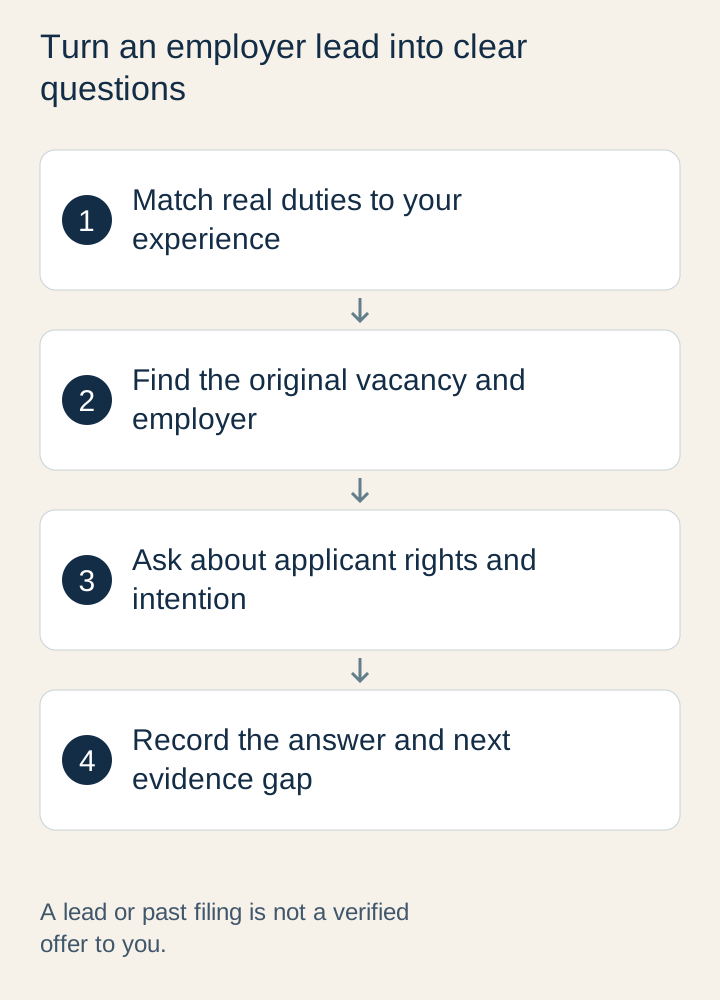
Keep one research card per original vacancy. Include the employer, vacancy reference and source, duties and actual minimum requirements, your relevant evidence, worksite and terms, applicant/work-right conditions, the employer's exact sponsorship response and a dated next question. An entry with missing information remains a lead, not a verified sponsor.
Use practical internal stages: research lead, contact confirmed, role discussed, employer intention clarified and professional review needed. These are editorial tracking labels, not government approval stages. Do not advance a card because a salesman says the process is certain. Save the source of the answer and who supplied it.
An original hypothetical card might read: “Employer A, production role, relevant record-checking experience; worksite confirmed; accepts overseas applications; permanent-worker support not yet discussed; ask the hiring contact who can address this.” It must not say “EB-3 approved employer” or “job secured”. The example does not identify a real business, client or available job.
Use a fit question during interview: “Which tasks would I perform during a normal shift, what training is provided, and which requirements must I already meet?” Explain your actual experience in response. If a requirement is missing, record the gap rather than requesting a backdated certificate or a job description rewritten solely to fit you.
Review why leads stop. Some employers may need immediate authorization, some roles may be temporary, and others may require a licence or experience you do not hold. Close unsuitable leads accurately and refine the search. Counting names on a list is less useful than knowing which real questions have been answered and which matches remain plausible.
6. When an employer is interested, separate employment and immigration milestones
USAGov's permanent-worker guide distinguishes the employer's labor-certification and petition steps from later immigrant-visa requirements. The Department of State describes employer-filed I-140 petitions for EB-3 and the general labor-certification requirement. Applicable exceptions and individual circumstances require proper assessment; an expression of interest is not evidence that those steps have occurred.
Ask what is actually being proposed, who handles each stage and how the employer will communicate changes. An offer is not a PERM decision, a labor-certification result is not an immigrant visa, and an application receipt does not establish a lawful start date. Visa availability and individual processing also remain separate from the employer's preferred timetable. This guide gives no waiting-time prediction.
For work before permanent residence, obtain an individual assessment of your actual authorization. The Department of State's visitor-visa guidance lists employment among activities not permitted on a visitor visa. Do not use a recruitment conversation or pending EB-3 process as permission to travel and start productive work.
If money is requested for a supposed job slot or existing certification, pause. 20 CFR 656.12 prohibits commerce in labor certifications and restricts employer recovery of certification-related costs, with specific boundaries for personal representation and other arrangements. A qualified reviewer should examine the actual payment; this brief caution is not a claim that all personal immigration costs are prohibited.
For broader route comparison, use the verified PremierVisa Group U.S. overview. Immigration advice and representation require appropriately qualified professionals for the relevant work. Employer-search preparation does not establish legal representation, a guaranteed offer or permanent-residence approval.
7. Frequently asked questions
Is there an official list guaranteeing employers will sponsor me?
This guide establishes no such list. A business name, past filing or advertising label is a research lead. Verify the present role, employer intention and your circumstances directly; historical activity is not a commitment to you.
Should I search only for the words “EB3 jobs”?
No. Search realistic duties and locations, then ask about applicant conditions and the employer's actual process. A label can help discovery but cannot replace job-fit and employer checks.
Does other-worker classification mean no experience or English is needed?
It does not establish that conclusion for every role. Read the actual minimum requirements and practical duties. Safety, communication and any necessary credentials still matter, and no qualification should be invented.
Can I pay to use someone else's approved labor certification?
Do not treat certification as a transferable product to buy. The regulation prohibits its sale, barter or purchase. Obtain appropriate professional advice if a service is framed around a ready-made document or slot.
Can I start while the employer prepares the process?
Not on that basis alone. Your actual work authorization must permit the employment. An offer, preparation work or a visitor visa does not establish permission to begin the job.
Start with a small set of genuine vacancies and one research card for each. If you need individual preparation support, submit your background to discuss resume evidence, interviews and realistic employer-search directions under confirmed arrangements.
Prepared with AI assistance. General career information; no named professional review has been confirmed. AI cover illustration does not depict our staff, clients or partner employers.
Sources: Department of State employment-based and visitor-visa guides; DOL FLAG PERM; USAGov immigrant work visas; eCFR 20 CFR 656.12. URLs, source limits and claim mapping are in sources.json.