
An EB-3 advertisement needs separate checks on who is recruiting, whether the employer confirms the specific vacancy, and whether the interview and written terms describe the same job. A genuine company name, polished letter or video call does not establish all three. For overseas applicants, the practical next step is an advertisement-to-offer evidence log: record the claim, the independent check and the unresolved difference before sharing sensitive records or making commitments. Job verification also does not establish immigration approval or permission to work.
- 1. Preserve the original advertisement before investigating
- 2. Verify the communication through an independent employer channel
- 3. Use the interview to test the actual work, not just the immigration story
- 4. Compare the written offer with the advertisement and interview
- 5. Keep an advertisement-to-offer evidence log
- 6. Handle money, documents and reporting without losing the evidence
- 7. Frequently asked questions
1. Preserve the original advertisement before investigating
Save the vacancy title, employer name, worksite, source URL and observation date. Keep a copy of the duties, applicant conditions and contact instructions as they appeared when you applied. If a recruiter later changes a material detail, you need both versions to understand what changed. An edited screenshot without its source is weaker than a traceable record of the original posting.
The FBI's recruitment impersonation warning describes scammers copying real postings and changing contact details, as well as impersonating actual employees. This explains why recognizing a business name is only the start. The business may be real while the advertisement or person contacting you is unrelated to it. A profile on a familiar platform can also be misused.
Extract the employment facts before reading the immigration promise. What would you do, at which location, for which employing entity, on what schedule? Does the posting distinguish a current vacancy from an expression of interest or a future recruitment pool? If it does not, record that question. Do not silently turn a reference occupation, a past placement or an illustrative role into a live opening.
Create a private folder for each opportunity rather than mixing documents from several employers. Use a neutral reference and avoid putting passport numbers or other sensitive identifiers in filenames. The aim is to organize facts, not to assemble a public accusation file. At this point you have a lead to investigate, not a confirmed sponsor or a finding of fraud.
2. Verify the communication through an independent employer channel
Find the employer's public website independently of the advertisement link. Compare the domain carefully and locate a published recruitment or general contact route. Use that route to ask whether the vacancy reference and named recruiter are recognized. Do not rely solely on the telephone number supplied by the person whose authority you are trying to check; that number may lead back to the same person.
An original enquiry could say: “I saw a vacancy under your company name for this role and location. Could you confirm whether it is your current recruitment and whether this contact is authorized to discuss it?” Include the public vacancy reference, not your identity documents. Ask for an appropriate recruitment contact rather than pressuring an unrelated employee to disclose confidential information.
The FTC's job-recruiter warning highlights unusual sender addresses, early requests for financial information and pressure before job questions are answered. These are reasons to investigate. A corporate-looking address alone is not a pass, and an unfamiliar communication arrangement should be clarified rather than immediately treated as conclusive proof of deception.
If an agency is involved, record the agency, the proposed employing company and the relationship being claimed. Ask who will interview, who would issue the offer and who can confirm that authority. A plausible explanation should connect the parties; it should not require you to pretend the agency and employer are the same legal entity. Unknown relationships remain unconfirmed until the relevant people clarify them.
3. Use the interview to test the actual work, not just the immigration story
Prepare questions about a normal shift, supervision, location, training, minimum qualifications and how performance is assessed. Ask for the interviewer's role and how later questions should be directed. A real conversation about duties gives useful information, but interviews can also be impersonated. Treat the meeting as another evidence source and compare it with independently confirmed employer details.
For an original hypothetical example, an advertisement describes one worksite while the interviewer describes a different state and a different employing company. Do not choose the version you prefer. Ask whether the vacancy changed, whether a different position is being discussed and whether revised written information will be provided. The example is a teaching scenario, not a report about a real employer or client.
Distinguish the employer's recruitment interview from a future government interview. Passing an employer's assessment is not approval of a petition or immigrant visa. DOL's PERM overview describes a permanent full-time opportunity with actual duties and minimum requirements. The employer's relevant recruitment and certification responsibilities are not replaced by selling an applicant a meeting or a job title.
Make a short meeting note promptly: date and time zone, participants and stated roles, duties discussed, changed terms and promised follow-up. Ask permission before making any recording and consider applicable rules; ordinary written notes often suffice. Never manufacture an interview record, rehearse false experience or describe a staged conversation as independent employer confirmation.
4. Compare the written offer with the advertisement and interview
Use a three-way comparison rather than checking whether the letter merely looks professional. Identify the employing entity, role, worksite, duties, pay basis, hours, conditions and proposed start arrangements. A recruiter may be unable to answer every contractual detail immediately, but a material gap should remain visible. A signature image or company logo cannot resolve an unexplained conflict.
| Evidence item | What it can help establish | What still needs a separate check |
|---|---|---|
| Original advertisement | What was represented when you applied | Whether the employer authorized it and it remains current |
| Independent employer response | Recognition of the vacancy or contact | Full terms, qualification fit and immigration stage |
| Interview note | Work and conditions discussed | Accuracy, authority and consistency with written terms |
| Written offer | Proposed employment terms and conditions | Legal review, ongoing job availability and work authorization |
This original comparison table is not a list of approved employers. Do not mark a document verified because it contains an application number or a government-style heading. Ask the responsible representative what the document actually is, whose case it concerns and what status it demonstrates. A receipt, certification, petition decision and visa are different documents with different implications.
For category-specific requirements, use the EB-3 job-and-evidence comparison. Keep a true account of your experience when discussing a role; a request to alter dates or invent qualifications is a reason to stop and obtain appropriate advice. A genuine vacancy does not make every applicant eligible for it, and a genuine applicant does not validate every advertisement.
If you need help organizing your experience and employer questions, submit your candidate background. Confirm the actual service scope, arrangements and appropriate professional involvement. A preparation discussion is not a promise of a job, an employer relationship or immigration approval.
5. Keep an advertisement-to-offer evidence log
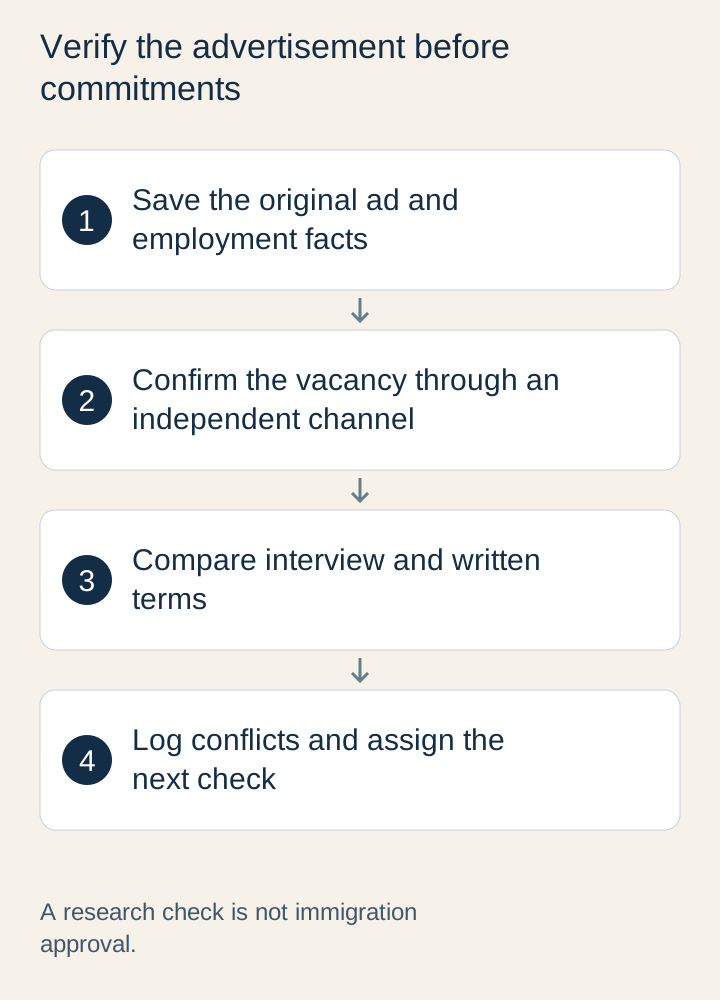
Use six fields: exact claim and source, independent check attempted, response and date, conflicting detail, evidence still required, and next action with its owner. Keep “not obtained” distinct from “confirmed false.” A company that has not yet replied has not confirmed the role, but silence alone is not a reliable fraud determination. Your decision may be to pause without making a public allegation.
An original example row could read: advertisement says one location; independently contacted recruitment team has not confirmed it; interview mentions another location; written clarification requested. The appropriate internal status is clarification pending. Do not write verified, approved or guaranteed. This status describes your research, not the employer's legal position or a government processing stage.
Use a simple decision sequence. Continue preparation when the key employment details are consistent and appropriately confirmed. Pause commitments when authority or material terms remain unresolved. Stop sharing further information and seek help when impersonation, fabricated documents or pressure to misrepresent facts becomes apparent. These are practical research decisions, not a scoring formula that certifies safety after a certain number of ticks.
Assign each question to the right person. Employer recruitment can explain duties and contact authority; a service provider can explain its contract and deliverables; an appropriately qualified immigration professional can assess legal documents and case consequences. Sending every issue to a salesperson may produce confident answers without the evidence needed. Record what was actually answered, not what you hoped the answer meant.
6. Handle money, documents and reporting without losing the evidence
Keep the payment question precise. 20 CFR 656.12 prohibits sale, barter or purchase of permanent labor certification applications and approvals and restricts employer recovery of related costs. It also has specific rules concerning a worker's own representation and shared counsel. Do not reduce these provisions to a blanket claim that every conceivable service fee is lawful or unlawful.
Before any disputed payment, obtain the itemized purpose, recipient, contract and responsibility allocation for appropriate review. Changing a prohibited recovery into a “training” or “document” label does not answer what the payment actually funds. This article's main task is employment verification; broader fee and legal questions need a separate assessment rather than a quick tick in the vacancy log.
Share supporting records only after checking the recipient, purpose and secure route. Early recruitment usually begins with relevant experience and contact details, not a demand for bank access or identity credentials. If you already disclosed sensitive information, stop unnecessary further disclosure, preserve the messages and contact the appropriate institution or local reporting channel for your situation. Do not send more money to a claimed recovery agent merely because they promise to fix the first problem.
The Department of State employment guide separates employer petition and visa stages and warns about misrepresentation. The visitor-visa guide does not permit employment on visitor status. Even a well-verified offer cannot make a tourist arrival a lawful shortcut to starting work.
For a wider search workflow, read finding potential employers. For timing questions after a credible role is identified, use the bulletin and start-date planning guide. Keep recruitment preparation and legal assessment distinct, and retain your evidence log when an opportunity changes or closes so that old information is not reused as current confirmation.
For broader route details, read the PremierVisa Group U.S. overview; individual legal advice and representation require appropriately qualified professionals.
7. Frequently asked questions
Is a company registration or recognizable brand enough?
No. It may support limited identity information, but an impersonator can use a real company's name. Confirm the specific vacancy and contact authority through an independently found employer route, then compare the employment terms.
Does a video interview prove the job is genuine?
It provides information to check, not a complete guarantee. Ask substantive work questions and compare the participants and follow-up with the employer's independent confirmation. Do not treat a face on a screen as proof of sponsorship or approval.
Should I send my passport to obtain a vacancy description?
Ask why sensitive information is needed at that stage and verify the recipient first. A request for a general role description should not require unnecessary identity disclosure. Actual later case documentation has different purposes and should use confirmed secure arrangements.
Can a receipt number confirm everything is approved?
No. Identify the document, applicant, petition or application and the exact status. A receipt can show a filing step without showing approval, visa availability or permission to start work. Have significant legal documents reviewed appropriately.
If details conflict, must I accuse the employer of fraud?
No. Preserve the difference, request clarification and pause commitments where necessary. A research gap is not a proven allegation. Where there is evidence of impersonation or deception, preserve it and use suitable reporting and professional support channels.
Choose one advertisement and complete the evidence log before moving to commitments. Submit your background if you need support preparing your resume, interview questions and a clear account of the unresolved employment facts.
Prepared with AI assistance. General career information; no named professional review has been confirmed. AI cover illustration does not depict our staff, clients or partner employers.