When Hong Kong job applications receive no reply, check the original vacancy, your evidence, language tasks, current work permission and submission route before sending more copies of the same CV. Silence does not reveal an employer's reason or prove an automated rejection. This guide helps professional candidates identify a specific gap, make a truthful change and track what actually happens, without inventing response rates or promising that a revised CV will secure an interview.
- 1. Separate what you observed from what you suspect
- 2. Reconcile the vacancy with your actual evidence
- 3. Make language ability and availability specific
- 4. Explain work permission without overstating eligibility
- 5. Use a no-response review log instead of mass resending
- 6. Follow up through the stated channel and keep moving
- 7. Questions candidates ask when applications stay quiet
1. Separate what you observed from what you suspect
Start with a record of the application: employer and job reference, original instructions, date, channel and the document version you sent. Record any acknowledgement separately from an invitation or rejection. “Submitted” means something different from “received by a named recruiter,” and neither means someone has assessed your experience.
Write the actual observation before your explanation. “No decision received by the review date I set” is an observation. “Rejected because I need sponsorship” is a hypothesis unless the employer has said so. Other possibilities may exist, but listing them does not prove any one. Avoid turning an unread status, an old advert or a missing email into a confirmed hiring decision.
Group applications by comparable work rather than combining every job into a single result. A reporting role, a sales role and a regulated profession may require very different evidence. Your record can reveal that you have been applying across incompatible requirements without telling you exactly why an employer remained silent.
Decide which question you can investigate next. It might be whether the attachment opened, whether your relevant experience is visible or whether the language requirement describes a task you can actually perform. Do not claim a scientific test from a handful of unrelated applications. This is a practical review method, not a prediction of hiring outcomes.
2. Reconcile the vacancy with your actual evidence
Return to the employer's own current instructions where available. Separate necessary requirements from preferences and identify the work output behind each. Do not assume that matching a job title means matching the job. A broad title can cover very different responsibilities, locations and professional authority.
For each material requirement, write the evidence you genuinely have and the limitation. If the job needs preparation of management reports, show the report's purpose, your own action and who used the output. A list of software names does not explain whether you selected inputs, investigated differences or only entered information supplied by someone else.
An original CV rewrite might change “Responsible for operations” to “Reconciled departmental inputs for the weekly operations summary, flagged inconsistent entries and recorded questions for the manager's review.” Use that wording only if it describes your real work. It demonstrates a method without inventing a percentage improvement, budget or authority you did not hold.
Keep unresolved requirements visible. If a professional registration or a particular task is essential, ask an appropriate question or apply to a better-matched position. Do not add a qualification to get through a filter. For a fuller evidence-focused CV discussion, use the Hong Kong work-visa CV guide.
3. Make language ability and availability specific
Replace a vague language label with a truthful description of tasks. Can you read a technical brief, write a client email, discuss a change in a meeting or answer a telephone enquiry in the required language? Different activities may involve different confidence and accuracy. State limitations rather than using “fluent” as a substitute for evidence.
Ask which language tasks are necessary for the role when the advert is unclear. Do not assume every Hong Kong job requires Cantonese, or that English alone will suit every employer. Use the language-requirements guide for a focused assessment of the actual work context.
The Labour Department's Find Jobs page describes its employment-service scope and application channels. Check whether you can use a service before relying on it; a public vacancy list is not a promise to arrange sponsorship for an overseas applicant. Its instructions also distinguish direct employer contact, referral and supported online applications.
Availability should describe interview scheduling and proposed starting conditions separately. Someone based overseas may be available for an online interview while still needing arrangements checked before work begins. Do not write immediate availability merely because you can travel, and do not assume that adding a local telephone number resolves a genuine permission question.
4. Explain work permission without overstating eligibility
Identify the permission you actually hold, if any, and the matter needing employer discussion. A concise factual statement is more useful than “visa no problem.” Keep an existing permission, a proposed route and an application still under consideration distinct. Do not put passport numbers or complete identity records into an ordinary introductory message.
The official GEP guidance and ASMTP guidance have different applicant scopes and professional-employment criteria. Mainland candidates should not copy a GEP statement from another CV, and Taiwan candidates should not assume ASMTP applies because their application is in Chinese. The route guide helps organise the initial questions.
Ask whether the employer will consider the relevant employment arrangement for this particular position. Do not infer either willingness or refusal from silence. A question could be: “My current status is as described, and I would need the applicable permission assessed before starting. Is the company considering candidates in that situation for this role?” It is an original prompt, not an approval statement.
The visitor conditions prohibit paid and unpaid employment by visitors. Do not offer productive unpaid work as a way to overcome a lack of replies. A pending application or a possible interview does not itself authorise work; the actual activity and conditions need to be checked.
If you need help turning uncertainty into concrete questions, submit your job-search background to HKJobHunt. A consultant can discuss your CV, interviews and realistic employer-contact direction. Immigration matters can be referred within PremierVisa Group according to your circumstances and the agreed service scope.
5. Use a no-response review log instead of mass resending
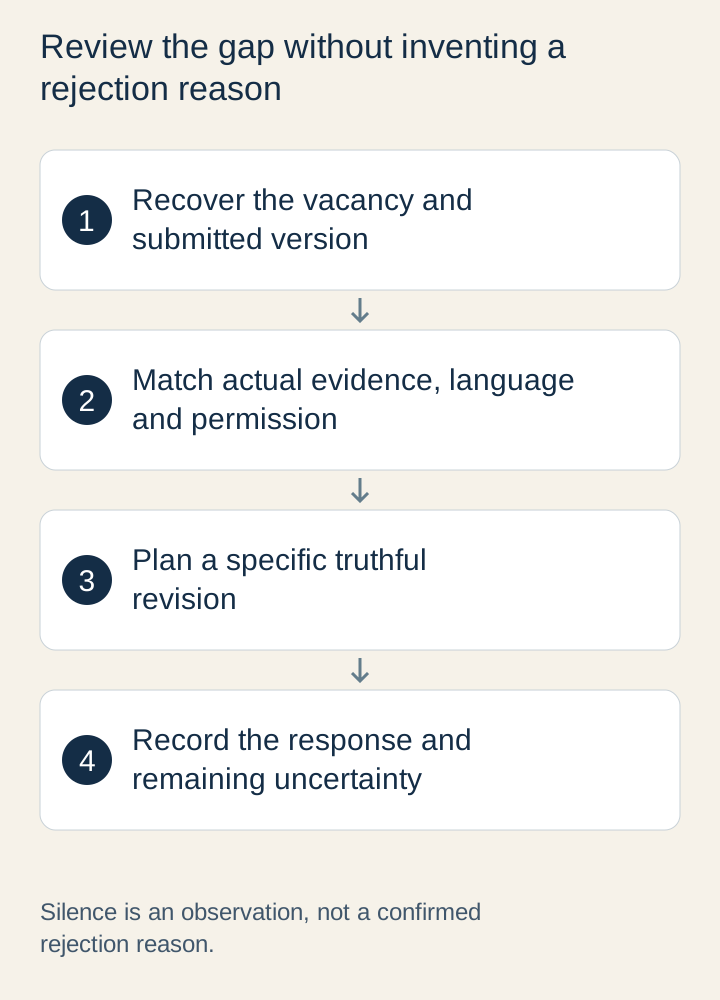
Create a row for each application you review. This original six-field tool connects the vacancy, your actual evidence and a limited next action. It is not an automated scoring system or a reason to manufacture numbers from missing data. Leave an employer's reason unknown if you have not received one.
| Field | Record | Review question |
|---|---|---|
| Vacancy and channel | Employer, job reference, date and instructions | Did I use the specified route? |
| Requirement and evidence | Material task, own example and limitation | Is the relevant experience visible? |
| Language and permission | Actual task ability and current status | What needs clarification? |
| One planned change | Specific revision and its purpose | What am I changing this time? |
| Submission and follow-up | Version, confirmation and appropriate contact | What actually happened? |
| Observation and next step | Reply, no reply or known reason | What remains a hypothesis? |
A useful entry says: “The opening CV summary omits the reporting experience requested; revise that paragraph using a truthful example for the next suitable application.” A weak entry says: “All employers dislike overseas applicants.” The first leads to a defensible change. The second attributes a shared motive without evidence and gives you nothing precise to improve.
Set a review event for your own work, such as completing a revision or receiving the employer's stated update. That event organises your activity; it is not a deadline imposed on the employer. If you later compare responses, note that vacancies, timing and applicant pools may differ. A reply after a change can be useful feedback without proving that your revision caused it.
Keep materially different changes separate. If you switch industry, seniority, language claims and submission channel at once, a later reply cannot establish which change mattered. You may still choose a different direction, but record that it is a broader change rather than a controlled comparison.
The Labour Department's FAQ describes application-history and referral-record functions for its service. Such records can help you recover what you submitted; they are not an employer's private assessment. The same distinction matters on commercial platforms: a status label should not be given a meaning the platform has not established.
6. Follow up through the stated channel and keep moving
Use the vacancy's instructions and any timeline the employer actually gave you. If follow-up is permitted and appropriate, identify the role and submission date, state one relevant clarification and ask whether anything further is needed. Do not repeatedly send a new attachment without explaining which version it replaces.
An original message could read: “I applied for the reporting role using the specified channel. My experience reconciling departmental inputs is described in the attached current CV. Could you let me know whether further information is needed or whether there is an updated recruitment timetable?” Adapt it to the facts and omit an attachment if the channel does not call for one.
Do not invent a universal deadline after which every employer must reply, and do not contact unrelated employees to pressure a response. If there is no usable contact or no reply after an appropriate follow-up, preserve the record and continue suitable applications. Silence can remain unresolved while you improve work that is within your control.
If a response introduces a genuine offer or asks for further material, verify the employing entity and recipient before sharing sensitive evidence. Use the employer-check guide. For detailed immigration background, see PremierVisa Group's professional-employment information; do not treat payment for a guarantee as a remedy for a quiet job search.
7. Questions candidates ask when applications stay quiet
Does no reply prove that an applicant-tracking system rejected me?
No. You may not know what system was used or how the application was assessed. Check the employer's file instructions and the readability of your own document, but do not diagnose a hidden process or quote an unsupported rejection percentage.
Should I send the same CV again to every employer?
Review the original instructions first. Correct a specific problem or provide information requested through the appropriate channel. Repeated copies without a reason can obscure the current version and do not establish that the underlying role is a better match.
Should I hide the need for permission until an offer?
Describe your status truthfully and proportionately when relevant to the discussion. Do not claim unrestricted work rights you do not have. Ask the employer a scoped question about the particular role rather than presenting a proposed visa route as already approved.
Can I guarantee more replies by adding achievements with numbers?
No. Quantify only where the figures are real, supportable and appropriate to disclose. A clear account of your own action and output can be useful without a fabricated percentage. A stronger presentation is not a guarantee of an employer response.
What should I prepare for a CV or job-search discussion?
Bring a factual CV, a small set of relevant vacancy instructions and your review log. Separate observations from assumptions and identify the decision you need help making. Remove unrelated confidential material so the discussion stays focused on practical improvements.
To discuss your CV, interview preparation and realistic employer-contact direction, submit your job-search background. HKJobHunt, 卓越國際職涯, is within the PremierVisa Group service system. Individual support depends on your background and the agreed engagement, without guaranteed interviews, jobs or immigration outcomes.