
You can consider Hong Kong roles without Cantonese when your skills and working languages fit the actual duties. Start with the employer's requirements for speaking, listening, reading and writing, then ask about unclear tasks before applying. An English advertisement does not establish an English-only workplace, and Mandarin does not automatically replace Cantonese. This guide helps international and cross-border candidates build a language-task evidence sheet, prepare an honest CV and discuss gaps without promising employment or work permission.
- 1. Start with the task, not a list of supposedly easy industries
- 2. Decode the advertisement with a language-task comparison
- 3. Build a language-task evidence sheet before editing your CV
- 4. Prepare an interview that demonstrates ability without hiding limits
- 5. Make a focused learning plan and a realistic application decision
- 6. Keep language fit separate from immigration and the offer
- 7. Questions about applying without Cantonese
1. Start with the task, not a list of supposedly easy industries
A sector name is a search direction rather than a language assessment. A software role could involve English documentation but Cantonese support calls. A finance role could involve international analysis, local customer conversations or both. These are illustrative task combinations, not measured statements about how frequently each sector uses a language. Read the particular vacancy instead of assuming that a job title settles the question.
Save the original advertisement and date. Underline each audience the employee will communicate with: customers, suppliers, colleagues, regulators or users. Then identify the communication channel. A planned presentation with slides, an unscripted telephone complaint and a written handover make different demands. Even if all three are described as communication skills, your evidence for one may not establish readiness for the others.
There are employer-specific examples of opportunities that do not name Cantonese as the basic language. Cathay's early-careers language FAQ describes English as the basic requirement for the programmes in that context, with Putonghua required for Greater Bay Area programmes. That page concerns those programmes; it is not evidence for every Cathay job, a currently open place or an HKJobHunt partnership. Check the particular programme and intake again before relying on it.
Keep an equally clear boundary around your own search. Finding one suitable example shows that a question can be investigated. It does not establish your chances across Hong Kong or justify a claim that all international businesses hire without Cantonese. Build a shortlist from identifiable duties and a genuine hiring channel rather than a broad reassurance.
2. Decode the advertisement with a language-task comparison
Treat phrases such as fluent Chinese, bilingual and good communication as incomplete information until the required activities are clear. Written Chinese, spoken Cantonese and spoken Mandarin should have separate entries. Ask whether a requirement is essential on appointment, desirable, or potentially supported during training. Do not quietly downgrade an essential requirement because you want to apply.
The following original comparison is a reading aid, not a government standard or a quotation from an actual employer.
| Wording or situation | What remains unclear | Useful question | Evidence you might offer |
|---|---|---|---|
| English advertisement | Daily working language | Which tasks use which language? | Relevant meeting or writing example |
| Fluent Chinese | Spoken language and writing needs | Does this mean Cantonese, Mandarin, written Chinese or a combination? | Separate examples for each ability |
| Cantonese preferred | Weight in the selection | Is it desirable or essential for the customer-facing duties? | Honest present level and task readiness |
| Regional coordination | Actual counterparties | What language is used for live calls and handovers? | A comparable coordination example |
| Training available | Scope and starting capability | What support is available, and what must I do independently from day one? | Current skills and a realistic learning plan |
Use the response to decide what to do next. If Cantonese is essential for immediate unsupervised calls and you cannot perform them, record that mismatch. If the employer says it is desirable and confirms that the core duties can be performed in your working languages, prepare evidence for those duties. If the reply is vague, keep the uncertainty rather than recording the role as suitable.
A recruiter may give a general description while the team manager knows the practical workflow. Ask the hiring contact to confirm the relevant details with that manager when appropriate. You do not need to contact every employee independently, and an informal comment from someone outside the hiring process should not overrule the written role requirements.
3. Build a language-task evidence sheet before editing your CV
Use the accompanying six-field language-task worksheet for each serious application. It is designed for this language-requirement decision, rather than serving as a general application tracker. A blank or unresolved field is useful information: it identifies the next question instead of concealing a weakness.
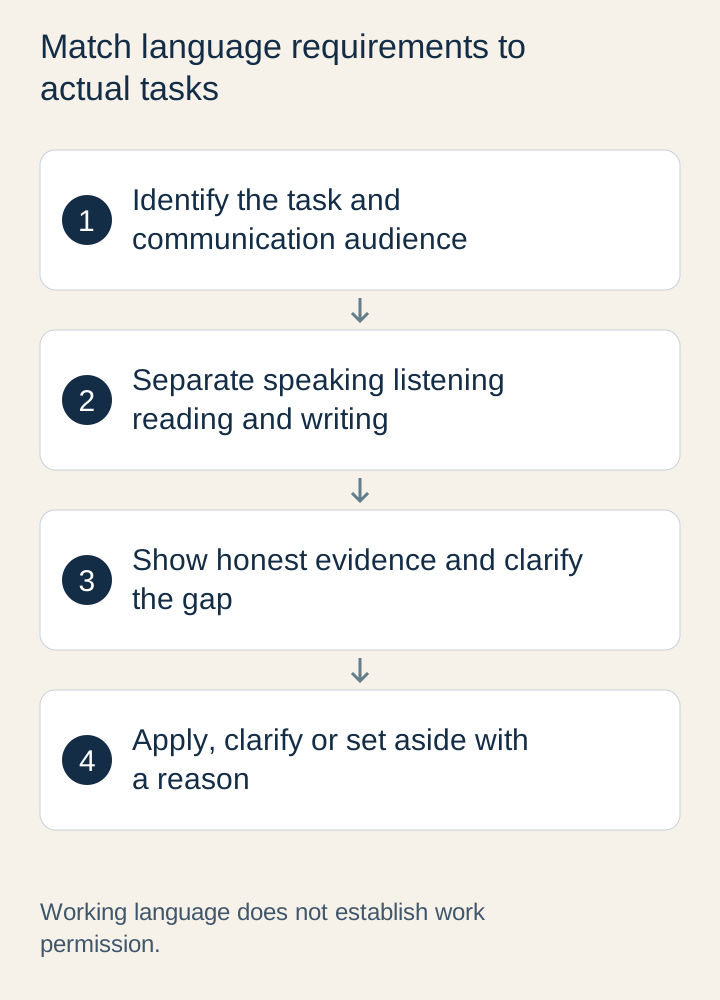
Record the vacancy source, version and date first. Next write the actual task, audience and communication channel. In the third field, separate the required language and skill from your current ability. In the fourth, identify one relevant piece of evidence and its disclosure limits. In the fifth, record the employer's exact clarification and who gave it. End with your decision, remaining gap and next action.
For example, imagine a fictional analyst vacancy that mentions English reports and Chinese client discussions. Your English report sample may demonstrate concise written analysis, but it does not answer the spoken-language question. Keep the client-discussion row unresolved until the employer clarifies it. Do not translate the report into Chinese and label that as proof of independent Cantonese discussion.
An honest CV description could read: “English: prepared project summaries and presented findings to an international team. Mandarin: conducted supplier follow-ups. Cantonese: beginner; not yet able to handle independent customer calls.” Use this only where it matches your actual experience. If your language ability is stronger or narrower, describe that difference instead of copying a convenient label.
Choose evidence proportionately. A redacted document you are permitted to share, a description of your own contribution or a self-created practice exercise may be enough for an early discussion. Do not disclose confidential customer records or colleagues' personal information to make a language claim look more convincing. Mark practice work as practice and distinguish your contribution from a team's result.
If you want help turning experience into clear CV statements, share your job-search background with HKJobHunt. Bring the original role wording and the unresolved language task so a discussion can address a specific gap. This is preparation support, not an assurance that an employer will waive its requirements.
4. Prepare an interview that demonstrates ability without hiding limits
Ask about interview language and format when arranging the meeting. Confirm whether there will be a written exercise, a presentation or a conversation with a particular team. These questions help you prepare appropriately; they do not entitle you to change the employer's selection process. If a task requires a language you cannot use, say so before the exercise rather than pretending a connection problem prevented your answer.
An original clarification message is: “I can explain the project in English and discuss supplier follow-ups in Mandarin. My Cantonese is currently beginner level. Which parts of this role require independent Cantonese communication, and could you confirm the interview languages?” Adapt the message to your real abilities and the vacancy. Do not claim fluency merely to obtain a first interview.
Prepare one project explanation with a clear problem, your action, a result you can support and a limitation. Rehearse follow-up questions in the languages you say you use professionally. A memorised introduction alone may not show that you can clarify a misunderstanding, respond to an unfamiliar question or document an agreed action. Practise those transitions as well as the opening speech.
During the interview, distinguish understanding from independent production. You might understand a routine question but need English to give a detailed answer. Explain that accurately and ask whether an appropriate alternative is possible. Do not allow a friend, undisclosed translation tool or rehearsed recording to create a false impression of independent capability in an assessment.
Afterward, update the sheet with what was actually tested and what remains unknown. If the interviewer used English throughout, that is evidence about that interview, not necessarily about customer calls after appointment. A helpful follow-up asks about the remaining work task, rather than declaring that an English interview has removed all language requirements.
5. Make a focused learning plan and a realistic application decision
A useful learning plan names the task you want to improve. Examples include understanding a routine meeting introduction, reading a role-specific notice or handling a familiar appointment conversation. These are self-directed practice goals, not a promise that a short course will make you ready for every Cantonese-speaking workplace. Choose a goal that corresponds to a genuine duty or a clearly identified future need.
Keep separate records of course attendance and demonstrated ability. Completing lessons can show effort, but the employer still needs to assess whether you can perform the work. If you add learning to your CV, describe the current level and relevant activity without presenting attendance as professional fluency. Revisit the claim when your actual capability changes.
Use three practical decisions for a shortlist: apply with supporting evidence, clarify before committing more time, or set aside because an essential duty is beyond your present ability. These are your decisions, not a ranking or an automatic eligibility score. A role can move between them when the employer provides new information, so retain the date and reason for each change.
Review response patterns without inventing causes. Repeated rejection could reflect experience, timing, permission requirements or other factors as well as language. If no reason is given, record “reason not provided”. Compare a small set of genuine applications for recurring requirements, then improve the evidence or targeting you control. Do not conclude that every rejection proves a citywide barrier or that learning one language guarantees the next offer.
6. Keep language fit separate from immigration and the offer
Being able to do the work does not itself grant permission to take employment. The General Employment Policy and Admission Scheme for Mainland Talents and Professionals have distinct scopes and consider the genuine role, relevant background, employment offer and other applicable conditions. The language of the advertisement does not choose a route.
For an international or Taiwan candidate, do not copy a Mainland colleague's ASMTP label simply because both of you use Chinese. A Mainland candidate should not assume an English interview automatically makes GEP applicable. Existing permission and qualifying graduate circumstances also need their own examination. Describe your actual background and ask what assessment is needed rather than making a confident but unsupported route claim.
The official visitor guidance prohibits visitors from paid or unpaid employment. Do not interpret a language assessment, a proposed trial shift or an application in progress as general permission to work. Where an assessment involves productive activity or a cross-border arrangement, clarify the specific circumstances before agreeing to it; this guide does not classify every interview exercise.
Use the Hong Kong route guide and PremierVisa Group's professional-employment background for the separate immigration discussion. Before accepting an offer, compare the written duties with the language tasks you clarified. A customer-facing duty added late in the process deserves a fresh question, even if the earlier interview went well.
7. Questions about applying without Cantonese
Does an English advertisement mean Cantonese is unnecessary?
No. The advertisement's publication language does not answer how the work is performed. Ask about speaking, listening, reading and writing for the actual tasks. Preserve the response and compare it with the eventual role and offer rather than relying on the heading alone.
Can Mandarin replace Cantonese in every Chinese-language role?
Do not assume that. Ask which spoken language the task requires and whether written Chinese is a separate requirement. Your Mandarin experience can be valuable evidence for a relevant task, but it does not establish independent Cantonese capability or a general employer concession.
Should I leave Cantonese off my CV if I am a beginner?
Where language capability is relevant, give an accurate description instead of implying proficiency through silence or a vague bilingual label. You can state beginner level and explain what you can currently do. Avoid listing a course as though it proves professional fluency.
Can I apply when Cantonese is described as preferred?
You can investigate whether your present skills fit the essential duties. Ask how the preference is used and provide relevant evidence. The employer makes its selection, and a preference is not a guarantee that another strength will compensate or that the role supports an employment application.
Will HKJobHunt guarantee an English-only role?
No. You can discuss your background, CV evidence, interview preparation and practical hiring channels. No employer partnership, current vacancy or language waiver should be inferred from this guide. Recruitment suitability and immigration decisions remain separate assessments.
Submit your job-search background to discuss your CV, interviews and practical employer-contact directions. Include the role wording, your language-task sheet and one question you need answered; do not send confidential work samples through an unverified channel.