
For a Hong Kong job application, start with your actual residence and immigration history, then identify the professional-employment route and who must verify each document. GEP and ASMTP are not interchangeable labels chosen by the employer's location or the language of your CV. This guide uses a background-to-document handoff sheet to help candidates ask HR focused questions. It distinguishes graduate and technical arrangements without deciding individual eligibility, and separates a confirmed offer from permission to begin the job.
- 1. Give HR a factual background summary before a route label
- 2. Keep the professional comparison narrow and job-specific
- 3. Screen separately for IANG, technical and imported-labour arrangements
- 4. Divide candidate and employer documents without inventing a complete checklist
- 5. Use a background-to-document handoff sheet with HR
- 6. Agree who will confirm timing and employment conditions
- 7. Frequently asked questions
1. Give HR a factual background summary before a route label
Prepare a short private summary of nationality or relevant travel-document position, present residence, any Hong Kong permission and conditions, education history and the proposed role. The employer does not need you to guess a legal conclusion in the first message. It needs enough accurate context to direct the question to the appropriate person and understand whether a new entry or employment-change assessment may be needed.
The Immigration Department describes GEP as the professional-employment arrangement that does not apply to Chinese residents of the Mainland, with the stated nationality exclusions and special overseas-Chinese provisions. ASMTP addresses Chinese residents of the Mainland with relevant skills, knowledge or experience. Neither route is established merely because you speak Mandarin or an employer calls everyone a talent applicant.
A Taiwan resident should not be assigned ASMTP simply because a Chinese-language recruiter uses the expression mainland talent. The GEP document list specifically includes Taiwan-resident evidence. Conversely, a Chinese resident of the Mainland should not select GEP just because the hiring company operates internationally. Use the official scope and actual facts rather than a convenient marketing name.
An applicant's circumstances can contain exceptions. Overseas Chinese nationals holding PRC passports may apply under GEP if they meet the route and normal requirements and have overseas permanent residence, or have resided overseas for at least one year immediately before application and apply from overseas. The specified overseas definition excludes the Mainland, Hong Kong, Macao and Taiwan. A brief trip or temporary address is not a substitute for those conditions.
2. Keep the professional comparison narrow and job-specific
The professional GEP and ASMTP pages share important job-related criteria: a genuine vacancy, confirmed employment, relevant background, work not readily taken up by the local workforce and remuneration broadly consistent with the prevailing professional market. Normal immigration requirements also apply. A letter saying “we support the applicant” does not by itself demonstrate all of these facts.
Education is normally a relevant first degree, while the official pages allow documented technical qualifications, proven professional abilities and/or relevant experience and achievements in special circumstances. Do not turn this wording into either “no degree means impossible” or “experience guarantees acceptance.” Identify the actual evidence and unresolved assessment question rather than promoting a universal waiver.
| Planning question | GEP professional arrangement | ASMTP professional arrangement |
|---|---|---|
| Who is being assessed? | Applicant within GEP scope and applicable provisions | Chinese resident of the Mainland within ASMTP scope |
| What employment facts matter? | Genuine relevant job, offer and market-level package | Genuine relevant job, offer and market-level package |
| Who verifies the records? | Applicant and employer each verify their own facts | Applicant and employer each verify their own facts |
| Can an informal label decide it? | No; check actual background and conditions | No; check actual background and conditions |
The professional arrangements are quota-free and non-sector specific, but that does not describe every stream using the GEP or ASMTP name. The comparison is an original planning aid, not an eligibility decision, vacancy list or invitation to choose the easier-looking column. Do not use a supposed universal minimum salary from an advertisement as the entire assessment.
3. Screen separately for IANG, technical and imported-labour arrangements
IANG has its own qualifying education and application conditions for eligible non-local and specified GBA-campus graduates. It is not for every person with a degree. The official page distinguishes recent from non-recent graduates and their offer requirements. Record the actual institution, programme, graduation date and existing permission for the appropriate review instead of assuming all graduates must use GEP or ASMTP.
The Technical Professionals Stream under GEP and ASMTP is a separate arrangement for specified skilled trades and is subject to quota and its own conditions. A technical-sounding professional title does not automatically place the role in it. Its rules should not be mixed with the special-circumstances education provision in the ordinary professional route.
The Labour Department's Enhanced Supplementary Labour Scheme concerns a different employer-led importation framework, with its own local recruitment, contract and other conditions. Do not rename an imported-labour position a professional job to simplify the conversation, or assume every reference to employer support means the same programme. Ask the recruiter to give the exact official name.
For an original hypothetical example, an advertisement says only technical talent and the recruiter sends a professional-employment checklist. The next action is to clarify which specific arrangement is intended and whether the role and applicant evidence fit it. It is not to combine favorable conditions from several schemes. A missing route answer is a reason to pause the handoff until the responsible person explains it.
4. Divide candidate and employer documents without inventing a complete checklist
The official GEP and ASMTP pages separate applicant records from employing-company records. Applicants commonly need to organize genuine travel/status documents, qualifications and relevant experience; route-specific documents differ. The GEP page includes Taiwan household-registration and identity evidence for Taiwan residents. The ASMTP list includes a consent letter from the present working unit or relevant Mainland authorities for Mainland residents, under the specified instructions.
Company records include the appointment or employment contract, role, salary, benefits and employment period, plus applicable business registration, financial and business-background information. Newly established companies can have additional business-plan requirements. Official facilitation measures can affect specified documents, so this paragraph is not a declaration that every company must send the same bundle in every case.
The candidate should not invent company accounts or sign as an employer simply because a form has an empty field. Ask the employer to identify the authorized person who can verify its records and the secure submission route. Equally, the employer should not change the applicant's degree title, work dates or residence history to make a preferred category appear suitable.
Use a working document list with the fact supported, issuing source, responsible person, current version and unresolved issue. Request records only for a legitimate purpose at the appropriate stage. A first recruitment conversation can use summaries, with sensitive originals provided later through confirmed arrangements. More uploaded material is not automatically better evidence, and a generic online template is not the authority's case-specific instruction.
If you need help organizing the recruitment side, submit your candidate background. Discuss your CV, interview explanation and the questions HR needs to answer. Confirm service scope and professional involvement; this discussion does not assign a visa category or guarantee an employer's participation.
5. Use a background-to-document handoff sheet with HR
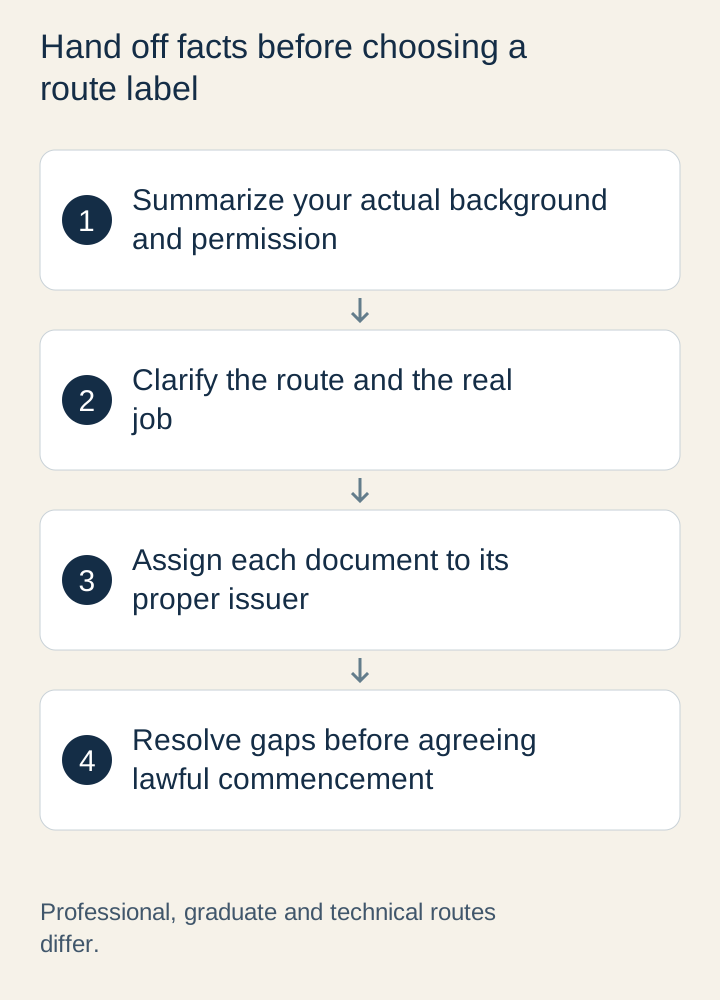
Use six fields: background fact, proposed route question, relevant job fact, evidence and issuing source, responsible reviewer, and next action or unresolved condition. This original asset links the candidate's background to the actual vacancy without reproducing a visa-service overview. Its value is making the handoff clear: what do I know, what can the employer confirm, and what still needs an appropriate assessment?
An original Taiwan example might record Taiwan residence, a proposed GEP scope question, a relevant offer, and the need to confirm the route-specific identity records. An original Mainland example might record Mainland residence, a proposed ASMTP assessment, relevant employment evidence and the consent-letter question. Neither example is a real applicant or a conclusion that nationality alone establishes eligibility.
Use separate statuses for fact supplied, document requested, employer confirmation pending and professional review pending. They are internal preparation labels, not government application stages. A complete handoff sheet may show that the job or a document is unsuitable. Do not mark approval merely because every field contains text, and do not copy someone else's private records as examples of an accepted file.
When two records conflict, retain both versions and ask the proper issuer to explain or correct the error. A CV and employer letter may use different translations of the same title, or they may describe genuinely different responsibilities. The answer must come from the underlying facts. Do not make them appear consistent by silently changing official records or upgrading a role for immigration purposes.
6. Agree who will confirm timing and employment conditions
Ask HR which records it will provide, who coordinates the application question, what remains conditional and when you should next review the plan. A useful question is: “Before a start date is agreed, which permission and employer steps must be completed for my actual situation?” Keep interview availability, notice obligations, approval and lawful commencement separate.
The visitor-activity rules prohibit employment as a visitor whether paid or unpaid. An application, an employer's willingness or a training label does not automatically authorize work. Mainland residents visiting Hong Kong also cannot assume an ASMTP submission extends their permitted visit; the official ASMTP page states that they may not request an extension on that basis.
People already in Hong Kong should check their actual current permission. GEP professionals on employment conditions need prior approval for an employment change; other specifically approved conditions may have different requirements. Do not use a general identity-card statement or an old entry-route name as the answer. Have the relevant conditions and any change assessed before moving into the new role.
For the broader immigration assessment, read the PremierVisa Group professional-employment guide. For building an employer shortlist and making the first approach, use the Hong Kong employer-search guide. The existing work-preparation summary remains useful for the initial factual note; this article adds the route-to-document responsibility handoff.
Keep a dated final handoff record and an owner for every unanswered question. If the job, employer or residence facts change, reopen the relevant row rather than relying on the earlier conclusion. Obtaining employment, receiving permission and any later permanent-residence question remain separate outcomes. A clear preparation record supports review; it cannot promise approval or remove continuing conditions.
7. Frequently asked questions
Does a Hong Kong employer choose GEP or ASMTP for any applicant?
The employer's location does not make the routes interchangeable. Applicant scope, actual background and relevant provisions matter. Give HR a truthful factual summary and ask the appropriate person to confirm the route and outstanding conditions.
Does a Taiwan applicant automatically use ASMTP because the CV is in Chinese?
No. Language is not the route rule. GEP has Taiwan-specific applicant documents, while ASMTP concerns Chinese residents of the Mainland. Existing permission, graduate eligibility and other circumstances still need assessment.
Do all GEP and ASMTP streams have no quota?
No. The professional arrangements described here are quota-free, but the separate Technical Professionals Stream has quota and designated-trade conditions. Ask for the exact stream instead of transferring a headline between arrangements.
Can the candidate prepare all company evidence independently?
The candidate can organize the request, but company facts need verification by the relevant employer and issuers. Do not fabricate business, finance or appointment documents. Confirm the responsible person and any applicable facilitation before submitting.
Does a complete document list mean I can begin the job?
No. Evidence preparation and lawful commencement are different. Check the actual decision, entry and employment-change conditions that apply. A receipt or an employer's expectation does not itself provide permission to work.
Complete one handoff row for your own background and one for the proposed role. Submit your background if you need support presenting experience and preparing employer questions while individual immigration matters receive appropriate assessment.
Prepared with AI assistance. General career information; no named professional review has been confirmed. AI cover illustration does not depict our staff, clients or partner employers.