
A Hong Kong job-search CV should explain the work you can perform and describe your current work-right position accurately. It should not turn overseas experience into invented qualifications or an existing identity card into unrestricted permission. This guide gives candidates an original CV–evidence–work-rights check, with practical English rewrites and status wording to adapt to their actual circumstances. A clearer CV supports recruitment discussion; it does not establish a visa route, employer support or permission to start a new job.
- 1. Read the vacancy before choosing what the CV should emphasize
- 2. Build a readable English CV with traceable names and dates
- 3. Rewrite responsibilities as your action, context and contribution
- 4. State current permission and future needs as separate facts
- 5. Use a CV–evidence–work-rights application check
- 6. Check the exported file and prepare for the interview
- 7. Frequently asked questions
1. Read the vacancy before choosing what the CV should emphasize
Extract the actual duties, required qualifications, language tasks, work location and applicant-rights wording. Put each important requirement beside a genuine example from your background. If the employer asks for supplier coordination, explain that work rather than filling the opening paragraph with unrelated senior-sounding titles. A targeted CV selects relevant facts; it does not change the facts to fit the advertisement.
The Immigration Department's GEP professional-employment page connects the proposed job with the applicant's qualifications or experience and other requirements. The ASMTP page has its own applicant scope and comparable job-related criteria. A resume editor cannot settle those legal questions merely by changing a heading to professional or talent.
Start with a working copy of your complete employment history. Preserve original job titles, employer names, locations and dates, then create a shorter application version for the real vacancy. This prevents selective editing from turning into an inconsistent history. If two jobs overlapped or a role was part-time, explain the actual arrangement rather than presenting an uninterrupted full-time career you did not have.
For finding a suitable vacancy and asking about employer support, use the Hong Kong employer-search guide. This article focuses on what the application says once you have a role to examine. There is no need to promise immediate relocation, universal language ability or a visa outcome to make a CV relevant.
2. Build a readable English CV with traceable names and dates
Use clear sections for contact details, a short relevant profile, employment, education, skills and any genuinely relevant professional registration. This is an original editorial structure, not an official immigration form or a compulsory format for every Hong Kong industry. Follow the employer's submission instructions and check whether it requests a particular file type or additional application form.
Keep contact details limited to what is useful for recruitment. Do not put passport numbers, bank credentials or an entire immigration file in a general CV. Later status or application checks can require actual documents, but their purpose, recipient and secure sharing route should be confirmed. This is a practical disclosure approach; it is not a claim that employers never need identity evidence at any stage.
Where an overseas employer has an official English name, use it accurately. If no confirmed English name is available, retain the original name with a plain explanation rather than inventing a registered entity. A translated job title should help the reader understand the work without promoting an assistant into a department head or a coordination role into a licensed profession.
Use a consistent month-and-year presentation where the dates are known, and retain the supporting record privately. If a record has an error, seek a proper correction or explanation from its issuer. Do not silently alter certificates or letters to match the CV. A well-spaced page can still contain an inaccurate claim, so content and presentation need separate checks.
3. Rewrite responsibilities as your action, context and contribution
Use concrete verbs and explain your own scope. An original hypothetical rewrite changes “Responsible for customers” to “Answered written customer enquiries, checked order details with the operations team and escalated pricing exceptions to the supervisor.” It tells the employer what the person actually did and where their authority stopped. It is a teaching example, not a real applicant's achievement.
A second original example changes “Managed regional projects” to “Maintained the delivery tracker for a regional project and prepared exception updates for the project lead,” if that is the true contribution. The second sentence may sound less grand, but it is more useful than implying responsibility for budget, staffing and final decisions that belonged to someone else. Do not confuse participation with ownership.
Add a number only when its meaning and source are reliable. Was the figure a personal result, a team result, a sales target or an observed workload? Keep units, period and responsibility clear. If the source is unavailable or confidential, use a truthful qualitative description rather than inventing a percentage. A CV does not become stronger simply because every bullet contains a number.
| Original wording | Original teaching revision | Evidence question |
|---|---|---|
| Responsible for orders | Checked order details and coordinated exceptions with operations | Which records or colleague can confirm the tasks? |
| Led the whole project | Maintained the tracker and prepared updates for the project lead | Did you actually hold final responsibility? |
| Improved results significantly | Describe the documented process change and your contribution | Is an outcome figure known, attributable and shareable? |
Do not copy these sentences into your history unless they are true. Use the pattern to identify your own action and limits. For language-task descriptions, link to the existing Mandarin-background CV guide, which covers practical language examples. The new task here is connecting the vacancy, claim, record and work-right statement in one application check.
4. State current permission and future needs as separate facts
Write what is true now, then identify what needs confirmation for the proposed job. Someone applying from outside Hong Kong without the relevant permission can say: “Currently based outside Hong Kong; appropriate permission would be required before starting employment.” This original example does not decide whether GEP, ASMTP or another route applies. The employer still needs the accurate background and role information.
For someone already in Hong Kong on employment conditions, a truthful summary might say that the person holds current permission and that approval for the proposed employment change needs confirmation before commencement. Do not replace that with “unrestricted right to work” because the current document has not expired. The GEP and ASMTP pages distinguish employment conditions from specifically approved time-limitation-only arrangements.
An applicant with genuinely applicable unrestricted work rights should describe that actual position accurately instead of copying the overseas-needs wording. A qualifying IANG situation or another category needs its own review; a past graduation or an old route name is not enough to establish present conditions. The route and document-handoff guide helps organize the relevant questions.
Keep interview availability, contractual notice, willingness to relocate and lawful start separate. Do not write available immediately if the statement would mislead the employer about permission or current commitments. The visitor-activity rules prohibit visitor employment whether paid or unpaid. A CV promise cannot make a trial shift lawful while permission is unresolved.
If you need help presenting your experience and these questions, submit your candidate background. Discuss CV positioning and interview preparation under confirmed arrangements. An enquiry does not establish an employer relationship, a professional qualification or a guaranteed work-visa result.
5. Use a CV–evidence–work-rights application check
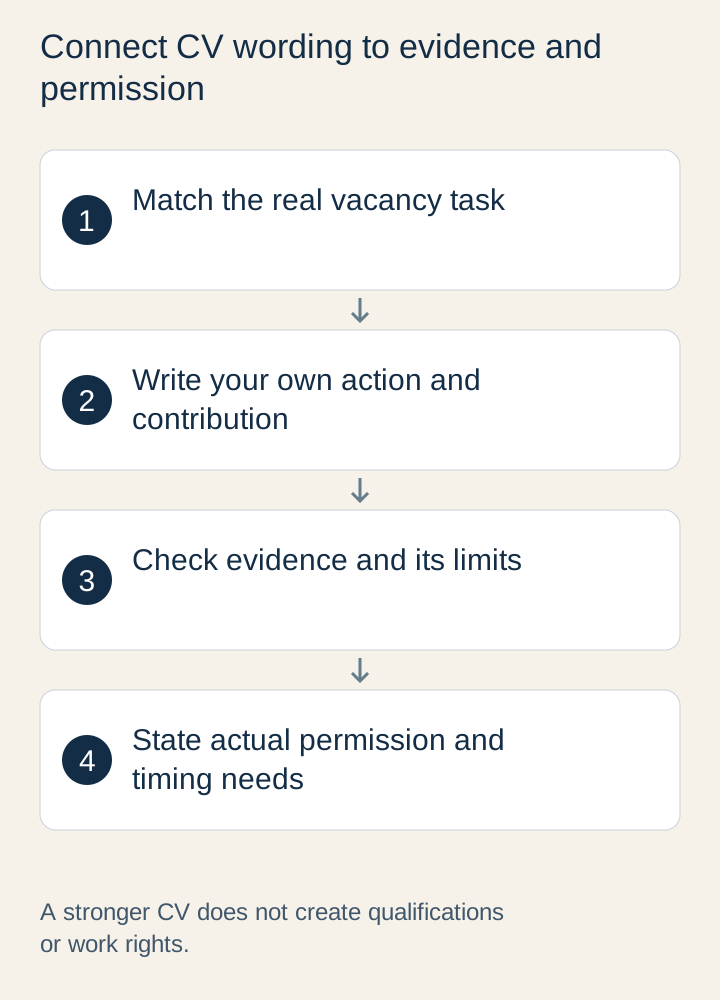
For each important statement, record six fields: vacancy requirement, exact CV wording, underlying record and period, what it does not establish, work-right or availability implication, and the correction or question owner. This original asset helps you find a sentence that is true about experience but misleading about authority or timing. It is a private preparation tool, not an eligibility score.
An original hypothetical row might pair a coordination requirement with a genuine task description and an employer letter. The evidence supports past coordination; it does not establish authority to practise a regulated occupation or work for the new employer. The next question may therefore concern registration or employment permission rather than another round of stronger-sounding CV wording.
Another row might flag “available immediately” against a still-unresolved employment-change question. The correction is to state the real interview availability and make commencement conditional on the applicable steps. Do not invent an approval date to remove the discrepancy. When a question remains open, label it open and identify who can resolve it instead of marking the whole application ready.
Keep source records secure and refer to their location without embedding confidential material in the worksheet. You can note that an accurate employment letter exists without attaching a former employer's client list or internal reports. Use only evidence you are entitled to share. If you cannot disclose a detail, explain the limitation and consider an appropriate alternative with the responsible reviewer.
6. Check the exported file and prepare for the interview
Read the final file as a recruiter would. Is the target role clear, are dates and names consistent, and can every main sentence be explained aloud? Check ordinary spelling, visible text, working contact details and the intended file version. Use a descriptive filename that does not expose identity numbers. A layout check is useful, but it cannot certify that an employer will shortlist you or that an automated system will rank you highly.
Prepare an interview note for each chosen achievement: the situation, your action, scope, result if known and a person or record that can support it. If a claim belongs to a team, say so. If the interviewer asks a question outside your knowledge, do not improvise a qualification or visa assurance. Offer to confirm the relevant fact through the appropriate channel.
The Labour Department's employment-service FAQ advises applicants to obtain detailed duties, entry requirements and employment terms from the employer. Use the interview to resolve those matters, including whether the rights wording matches your actual situation. Its service eligibility is separate; citing the FAQ does not mean every overseas reader is eligible to register for the service.
Keep a private revision log of what you sent, to whom and when. If you correct a material date or status statement, consider the appropriate way to tell the recipient instead of leaving contradictory versions unexplained. For a new employer, change the relevant emphasis and examples, not the underlying history. An application should remain consistent with later employer and qualification records.
For broader visa details, read the PremierVisa Group Hong Kong professional-employment guide. If the application is for a change of employer, use the transition and start-work checklist before agreeing an unconditional start. Career writing and individual immigration assessment have different purposes and should be handled under confirmed service and professional arrangements.
7. Frequently asked questions
Is there one official CV format that guarantees a Hong Kong work visa?
No format can establish the actual employment and applicant conditions. Follow the employer's application instructions and use accurate, relevant content. The structure in this article is an original writing aid, not a government-approved template.
Can I translate a title into a more senior English job name?
Explain the work without upgrading responsibility. Keep the original title or an accurate functional explanation where needed. If two records differ, clarify the facts rather than choosing the version that sounds most impressive.
Must every achievement include a percentage or money figure?
No. Use figures only when the period, units, source and your contribution are reliable. A clear account of a genuine task is better than an invented metric or an unsupported claim to a team result.
Does a Hong Kong identity card justify saying unrestricted work rights?
Not by itself. Check the actual current permission and whether it covers the proposed role. A valid document and permission for a different employment are separate questions; obtain the appropriate confirmation before making a stronger statement.
Should I attach every supporting record to the first CV?
Use the employer's legitimate instructions and an agreed secure route. Initial recruitment can start with relevant facts; formal checks may need additional evidence later. Do not circulate identity, banking or former-employer confidential material without a clear purpose.
Choose one real vacancy, check the important CV statements against evidence and correct the work-right wording. Submit your background if you need support explaining experience and preparing the next employer questions.
Prepared with AI assistance. General career information; no named professional review has been confirmed. AI cover illustration does not depict our staff, clients or partner employers.