When a Hong Kong employer agrees to support your employment visa application, verify the employing entity, genuine role, document responsibilities and unresolved conditions before making relocation commitments. A registration record or a helpful recruiter does not establish that the application will succeed. This guide helps professional candidates turn a verbal promise into a traceable preparation plan, while keeping confidential company evidence with the people authorised to handle it.
- 1. Define what the employer has actually agreed to do
- 2. Match the legal entity across independent records
- 3. Connect the vacancy to the company's real operations
- 4. Assign evidence without demanding confidential company files
- 5. Use a company-evidence responsibility board
- 6. Respond to gaps with a precise question and a limit
- 7. Questions candidates ask before sharing documents
1. Define what the employer has actually agreed to do
“We can sponsor” is useful only after both sides explain what it means. It could mean that a hiring manager is willing to ask HR about an application. It could mean an offer has been authorised and someone has been assigned to provide company evidence. It could also be an intermediary speaking before the employing company has made any decision. These situations require different next steps, even when the conversation sounds equally positive.
Ask for the proposed employing company's exact name, the role and the contact responsible for application coordination. Record whether the offer is draft, approved internally or issued to you. Then ask which actions the company expects you to take and which it will handle. Do not turn an enthusiastic conversation into a statement that documents have been submitted or permission has been granted.
Keep recruitment and immigration decisions separate in your notes. A manager can assess whether your experience fits the position; that does not make the manager the decision-maker on admission. Your own explanation of immigration status should distinguish an existing permission, a proposed application and an outstanding question. State the facts you can evidence rather than using “eligible” as a substitute for an assessment.
This article concerns employer checks after initial interest. For finding relevant employers, use the Hong Kong employer-search guide. For applicant scope, consult the GEP and ASMTP employment guide. The routes are not interchangeable: Mainland professional applicants and other candidates need their own applicable arrangement checked.
2. Match the legal entity across independent records
Start with the name on the offer, not only the brand on the vacancy. Compare its spelling with the company details supplied by HR, the organisation's own contact channels and relevant public records. If a group uses several entities, ask which one employs you, which team you join and who is authorised to explain the relationship. A familiar group logo does not answer those questions.
The Companies Registry's electronic-search guidance explains access to registered company data and filed document images. Use that official service to identify the relevant registered entity and interpret identifiers correctly. Its guidance explains the use of the Business Registration Number as the key identifier and the lookup relating former company numbers. Do not treat an old-format number alone as evidence of deception.
Registration information has a limited purpose. It is not a vacancy inspection, a financial health opinion or an approval of employment visa sponsorship. Your practical conclusion should be narrow: the named entity and a particular record match, conflict or remain unresolved. Keep the observation date and source. Avoid publishing personal details of directors or other individuals in a shared job-search spreadsheet.
Contact verification matters as much as the record. If someone requests documents from an unfamiliar address, confirm their involvement through a contact channel independently obtained from the organisation. A copied certificate or a professional-looking message is not independent confirmation. Where a recruiter is involved, ask the employer to identify that recruiter's role rather than assuming the recruiter can bind the company.
3. Connect the vacancy to the company's real operations
Ask what work creates the need for the position: a reporting cycle, a service line, a project interface or another identifiable responsibility. The answer should connect the role to the company's actual activity and explain the contribution expected from your background. You do not need confidential customer names to understand who uses your output and who supervises it.
Read the official General Employment Policy guidance alongside the relevant applicant route. Genuine employment and fit matter; a company's willingness alone is insufficient. For Mainland professional candidates, use the ASMTP guidance. Neither a registration record nor an impressive job title substitutes for the applicable assessment.
Prepare a short role-to-evidence note in your own words. Identify the output, the relevant experience you actually have and a document that can support that experience. If the offer says operations analyst while the interview describes sales management, ask which version is current. Do not quietly combine both into a more impressive job description. Resolve the difference before anyone relies on it.
For example, a fictional applicant might ask: “The interview discussed internal reporting, while the draft lists client acquisition. Which responsibility is primary, who reviews it, and will the offer be revised?” This is an original teaching example, not a real vacancy or client story. Its value is the precise question, not an invented success rate.
4. Assign evidence without demanding confidential company files
Use the official application page to separate applicant evidence from employer evidence. Make an index showing what is requested, who owns it and how its status will be confirmed. The company should explain how its authorised contact handles company-side material. You should understand the coordination without collecting internal financial files merely to feel reassured.
Ask HR to check the current supporting-document section, including its footnotes, against the company's circumstances. Do not create an unofficial minimum turnover, bank balance or staff count. Do not tell a newly established employer that it is automatically ineligible. If additional business information is relevant, identify the official requirement and the responsible company contact rather than guessing what would satisfy it.
The official GEP and ASMTP facilitation measures apply to specified evidence in specified circumstances. A claim that a company has employed non-local staff before needs a scope check. Ask which measure is being relied on and which documents it affects; relevant evidence can still be requested in an individual case. A facilitation is not a guarantee of approval.
Keep your personal document index equally disciplined: document purpose, current version, owner, confirmed recipient and outstanding issue. Use truthful employment and qualification evidence. If a recipient or transmission method remains unclear, settle that question before sending identity documents. Avoid putting document contents, identification numbers or application credentials into an ordinary tracking sheet shared with multiple recruiters.
If coordination is becoming difficult, submit your background to HKJobHunt. A consultant can discuss your experience, CV, interview preparation and practical employer-contact direction. Immigration questions can be referred within PremierVisa Group for individual assessment; the agreed service scope should be confirmed for your case.
5. Use a company-evidence responsibility board
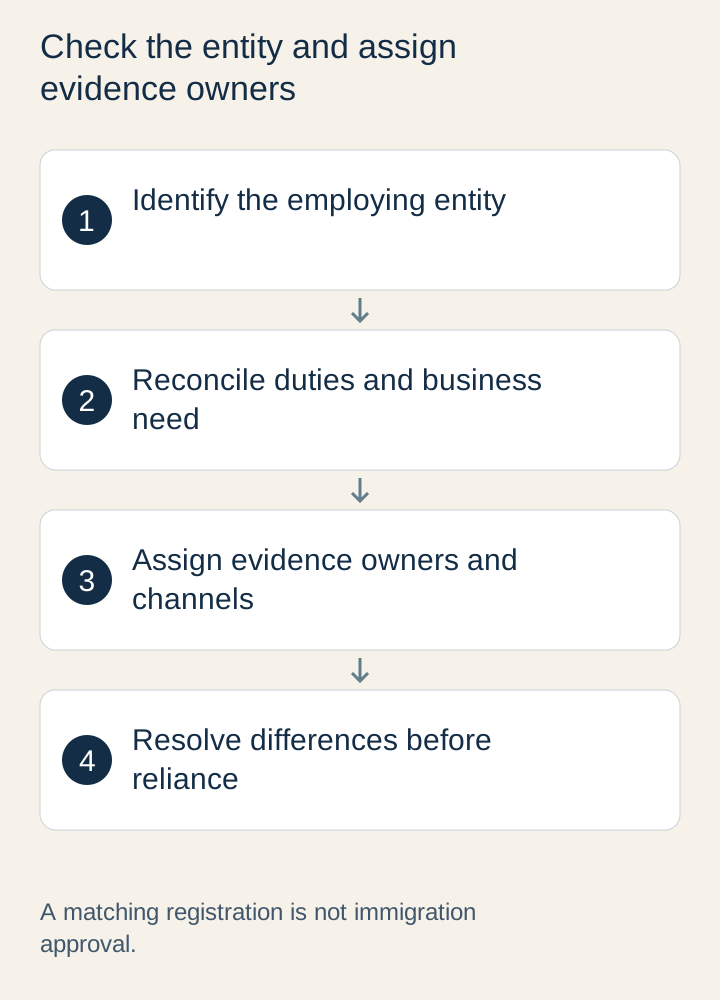
Create one board per proposed employing entity. The six fields below help you distinguish something observed from something promised. “Pending” should name the unanswered question and its owner. It should not become a hidden assumption in a green status cell. Keep sensitive underlying evidence in its proper channel, not inside this board.
| Field | Record in your own words | Question to resolve |
|---|---|---|
| Entity and version | Offer name, document date, independently checked source | Is this the entity employing me? |
| Genuine role | Output, business context, supervisor | Do the interview and written duties agree? |
| Applicant evidence | Evidence category, owner, readiness | What can I truthfully support? |
| Company evidence | Authorised contact, category, confirmed channel | Who prepares and handles this material? |
| Facilitation claim | Official measure and its stated scope | Which evidence is affected in this case? |
| Difference and next step | Conflicting item, respondent, next review event | What must be answered before reliance? |
A useful entry reads: “Offer entity differs from recruitment brand; HR asked to identify employing entity and explain group relationship; awaiting written reply before personal documents are sent.” A weak entry reads: “Big company, should be fine.” The first produces an action and preserves uncertainty. The second disguises uncertainty as a conclusion.
Use a simple sequence: identify the entity, reconcile the role, assign evidence, resolve material differences, then review the remaining start conditions. The sequence is a preparation method, not an official application stage chart. A completed board does not mean the company has filed an application. Record a submission separately only when its actual status is confirmed through the proper process.
For a new version of an offer, retain the earlier date and describe what changed. Ask the relevant owner to confirm whether the change affects the application material. A forwarded message saying “all okay” is less useful than an answer identifying the changed entity, duties or terms. Clear version control reduces repeated requests without asking anyone to disclose unnecessary confidential information.
6. Respond to gaps with a precise question and a limit
Not every unanswered question means a bad employer. A small HR team may need to consult its adviser, and a business may have a legitimate reason to restrict financial documents. Ask for an owner and a next update rather than insisting that every file be delivered to you. At the same time, distinguish a clear confidentiality explanation from refusal to identify the employing entity.
For an entity mismatch, ask: “Could you confirm the company that will sign the employment contract and provide company-side support? Please explain its relationship to the advertised brand.” For an evidence gap, ask: “Which category is outstanding, who is responsible and what confirmation can you provide without sending me confidential records?” These questions are specific enough to answer and do not pretend you are conducting an audit.
If someone asks you to describe work you will not perform, invent experience or sign a blank declaration, do not incorporate it into your material. Preserve the request and seek an independent explanation through a verified channel. Money described as buying guaranteed sponsorship or guaranteed approval is not evidence of a genuine job. Do not recast such a promise as a normal application milestone.
Keep relocation and starting work as separate decisions. The Immigration Department's visitor guidance prohibits visitors from paid or unpaid employment. A pending application or company invitation does not remove that condition. For contract versions and an agreed start, continue with the employment-offer checklist; for immigration detail, see PremierVisa Group's professional-employment information.
7. Questions candidates ask before sharing documents
Does a successful company search prove the employer can obtain my visa?
No. It helps you check the registered entity and particular records. It does not establish the vacancy, your fit, the company's application evidence or the immigration decision. Record what you actually checked and leave the other issues open until the relevant person answers them.
Must I receive the company's accounts personally?
Your preparation board does not require that. Ask the authorised company contact to explain responsibility, the applicable evidence category and how coordination will work. A candidate's need for clarity can often be met without distributing confidential company records. Do not mark documents submitted just because someone says they are being prepared.
What if the recruiter and employment contract use different names?
Ask for the relationship and identify which entity will employ you. Recruitment agency, group brand, operating team and contracting entity can have different roles. Keep the written explanation with the correct offer version; do not infer either fraud or acceptability from a name difference alone.
Can I write the business explanation for the employer?
You can describe your own skills and ask how the role fits the business. Company representations should be checked and approved by the responsible company contact. Do not invent turnover, customers, headcount or business plans to fill a gap. A polished paragraph is not a substitute for accurate employer evidence.
What should I bring to a consultant discussion?
Bring a factual CV, the relevant offer version, your current status and the responsibility board with unanswered questions. Remove unrelated confidential information. Explain what the employer has actually confirmed, what remains a proposal and the decisions you are considering. That makes a discussion more useful without implying a promised job or immigration outcome.
To discuss your CV, interview preparation and realistic employer-contact direction, submit your job-search background. HKJobHunt, 卓越國際職涯, is within the PremierVisa Group service system; individual support and any immigration referral depend on your circumstances and the agreed engagement.