Before accepting a Hong Kong job offer that involves employment permission, reconcile the written pay, duties, probation, notice provisions and proposed start. Record which terms are agreed and which depend on a later confirmation. An accepted offer and permission to work are separate matters. This checklist helps candidates organise questions and revisions without assuming that a visa application, a visitor entry or a recruiter’s assurance makes the proposed first working day lawful.
- 1. Establish the offer version you are being asked to accept
- 2. Separate fixed terms from estimates and discretion
- 3. Read probation and notice as distinct questions
- 4. Agree a start process that respects actual permission
- 5. Build an offer revision and start-dependency sheet
- 6. Negotiate changes before irreversible commitments
- 7. Questions before accepting and fixing a start
1. Establish the offer version you are being asked to accept
Begin with the document, its date and the employing entity. An attractive message about a job is not enough to explain the complete arrangement. Identify whether the attachment is an offer, a contract draft or a summary referring to another document. Check which policies are incorporated and request the relevant version if a term depends on a handbook you have not seen.
Make a comparison against the interview discussion and recruitment correspondence. Note each substantive difference in a neutral way: “Interview described a reporting role; document adds business development,” or “Allowance described orally is absent from this version.” Ask the employer to resolve differences rather than editing the document yourself and assuming your interpretation has been accepted.
Keep related correspondence together, with the sender and the item they are confirming. A revised attachment should have an identifiable date or version. Do not delete an earlier document merely because a newer one looks more favourable. If another entity replaces the named employer, check the relationship and its implications through the employer-verification guide.
The Labour Department's contract guidance explains that employment agreements can be oral or written. It identifies conditions to be clearly communicated before employment, including wages, the wage period, termination notice and applicable end-of-year payment arrangements. Written records are useful for clarity; do not claim that an oral agreement is automatically invalid or that clicking acceptance has no possible consequences.
2. Separate fixed terms from estimates and discretion
Read each pay item independently. Identify the currency, amount or stated calculation basis, payment period and conditions. Distinguish fixed salary from a variable incentive, an expense reimbursement and a benefit subject to policy. If a recruiter describes a total package, ask which items are contractual, which require expenses and which depend on performance or discretion.
An original question could be: “The summary combines salary and an incentive. Could you identify the fixed component, the incentive conditions and the policy version that applies?” This seeks an answer without assuming a market salary or inventing a legal entitlement. The salary-and-offer guide covers detailed comparison of remuneration and duties; this checklist concentrates on agreement, version changes and starting dependencies.
Check the role's actual output, reporting line, work location and expected hours. Ask how travel, shifts, remote arrangements or a variable workplace are described where relevant. A vague job title can hide a substantial difference in responsibility. A verbal reassurance that “everyone works flexibly” does not explain a written requirement you are expected to follow.
Do not copy an overseas employment template into the Hong Kong offer. Candidates coming from Taiwan, the Mainland or another jurisdiction should check the applicable Hong Kong terms and their actual circumstances. Familiar wording may carry a different context. Where a term about deductions, restrictive obligations or repayment has material consequences, seek an appropriate individual explanation instead of accepting a generic internet answer.
3. Read probation and notice as distinct questions
Record whether probation is specified, how its review is arranged and which notice clause applies at each stage. Ask what happens if the employer changes the review date or duties. A probation review and an immigration decision answer different questions; neither should silently replace the other in your proposed start plan.
The Labour Department's termination FAQ distinguishes the first probation month, later probation and continuous employment without or after probation. Later probation generally requires at least seven days' notice; for continuous employment without or after probation, an agreed period must meet that minimum, while no stated period means at least one month. Check the full official table and your circumstances.
Do not turn the first-month probation rule into a general claim that every signed offer can be abandoned without consequence before employment starts. Likewise, do not assume every post-probation contract requires exactly one month. Read the stage, contractual wording and applicable employment context together. The official guidance also addresses exceptions; a short checklist cannot decide a disputed termination.
If payment in lieu is relevant, use the official calculation guidance and obtain help for the actual facts. Do not assume a monthly salary divided by an arbitrary number gives the correct result. Avoid treating unused leave as automatically cancelling notice. First ask which obligation applies and who will confirm the calculation, then record the answer and its basis.
4. Agree a start process that respects actual permission
Put the proposed first working day beside the conditions that remain unresolved. Record your current immigration status accurately and identify who will check whether the intended work is permitted. The GEP guidance and ASMTP guidance concern different applicant scopes. A Mainland professional candidate should not choose GEP simply because the employer uses that acronym informally.
Ask who coordinates any application, what is genuinely ready and how a change in role, employer or terms will be checked. Do not assume that filing an application creates permission to begin, or that a predicted processing time guarantees a date. Existing holders also need their actual conditions considered; “I already have a Hong Kong visa” does not describe every possible work restriction.
The Immigration Department's visitor guidance prohibits paid and unpaid employment by visitors. Calling productive work “training,” “a trial” or “unpaid help” does not establish permission. If an employer proposes attendance before the intended employment arrangements are settled, ask what the activity entails and obtain an appropriate assessment. Do not make a blanket claim that every interview exercise is employment either.
A useful negotiation question is: “Can we record the intended start as subject to the necessary permission and final written confirmation, identify the person checking those conditions, and agree how we will revise the date if they remain outstanding?” This is a discussion prompt, not a model clause guaranteed to resolve legal obligations. Keep any agreed wording with the correct offer version.
If you need help organising the discussion, submit your job-search background to HKJobHunt. A consultant can discuss your CV, interview preparation and realistic employer-contact direction; immigration questions can be referred within PremierVisa Group according to your case and the agreed service scope.
5. Build an offer revision and start-dependency sheet
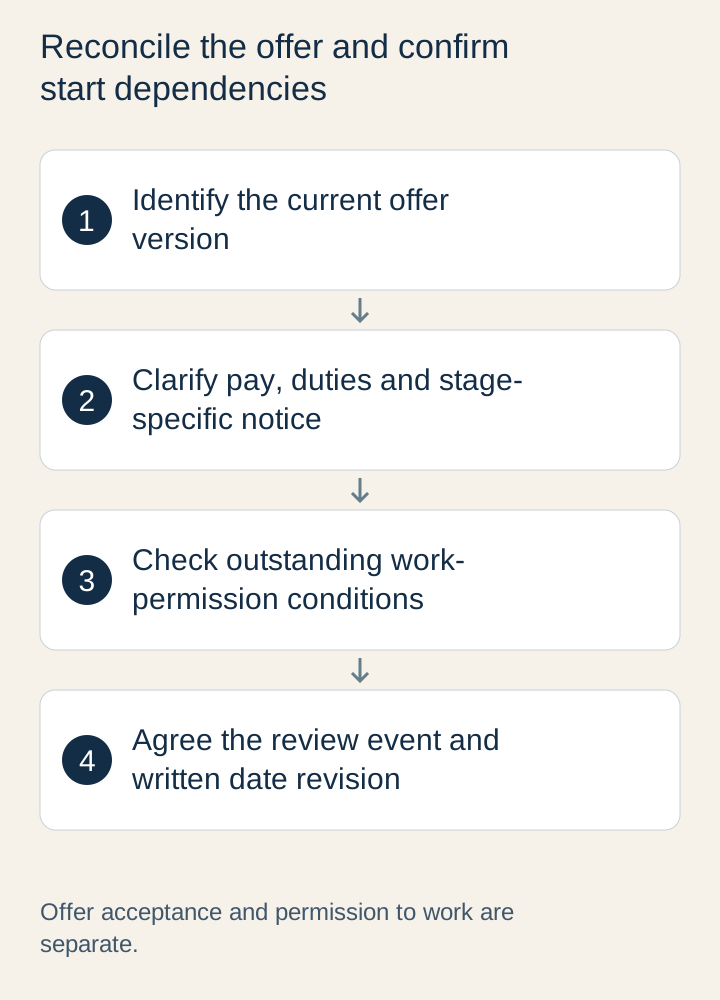
Use one sheet to connect terms to evidence and the next action. This is an original planning tool, not a reproduction of an employer's contract or a legal template. Keep identity documents, passwords and confidential attachments out of the shared sheet. A link or internal reference to an authorised copy is more useful than circulating the entire file unnecessarily.
| Record | What to capture | Confirmation needed |
|---|---|---|
| Offer identity | Employing entity, document version and date | Which document is current? |
| Pay and period | Fixed/variable items, currency and payment basis | What is agreed and what is conditional? |
| Work and review | Duties, location, hours and probation review | Does the written role match the discussion? |
| Notice | Clause and the stage it addresses | Which provision applies to the relevant situation? |
| Permission dependency | Current status, outstanding question and owner | Who checks whether the intended work may begin? |
| Start and revision | Intended date, review event and written change | What happens if a prerequisite remains open? |
For each open item, record the question sent, responsible respondent and next review event. Use “not yet confirmed” rather than filling a blank with an assumed answer. The sheet should make an unfinished decision visible. It should not create an appearance of approval because every row has a colour or a tick.
Consider a fictional candidate whose interview focused on internal analysis, whose draft adds sales targets, and whose employer asks for a start while permission remains unresolved. The next action is not to select the best-looking salary number. The candidate asks for the duties to be reconciled, the applicable incentive terms explained and the start conditions confirmed separately. No employer, salary level or successful outcome is implied by this example.
When a reply arrives, quote only the relevant point in your private note and identify the document affected. If the company revises the offer, confirm that earlier questions have been answered in the new version. A reply about pay does not automatically settle the employer identity or permission question. Close items individually, based on what was actually confirmed.
6. Negotiate changes before irreversible commitments
Group questions into a concise message rather than sending an unexplained marked-up contract. Lead with the items that affect your ability to accept or start. For example: “Please confirm the employing entity, clarify the variable-pay conditions and explain how we will agree the start if permission remains outstanding.” Then attach the relevant version reference and the particular duty or clause you mean.
Avoid ultimatums disguised as legal conclusions. A request for written clarity is usually more productive than saying an unfamiliar term is automatically unlawful. Where the employer cannot answer a material question immediately, ask for the responsible person and a next update. Do not translate “being checked” into “approved” when reporting progress to your current employer or family.
Keep your existing job's notice obligations separate from the proposed new job. A new employer's preferred start does not decide what you owe the existing employer. Likewise, an estimate of when documents might be ready does not establish an immigration outcome. Consider the consequences of resignation, non-refundable travel or housing commitments using the facts you actually have, rather than a promised timetable.
Before sending acceptance or signing a revision, read the whole current document and any incorporated material. If a consequential issue remains disputed, obtain appropriate individual advice. Do not assume that writing “subject to visa” in your own email necessarily overrides the employer's document. For immigration background, see PremierVisa Group's professional-employment information, and use the interview guide to prepare factual questions about role expectations.
7. Questions before accepting and fixing a start
Is a WhatsApp message enough to know the complete offer?
It can record part of the discussion, but you still need to identify the agreed terms and current documents. Ask about missing policies and differences rather than assuming a short message contains everything. The possible effect of an agreement depends on its actual circumstances; written does not mean complete, and oral does not mean automatically invalid.
Should every Hong Kong offer have one month's notice?
No single period covers every stage and circumstance. Check probation, the contractual provision and whether the relevant continuous-employment rules apply against the official FAQ. Do not import a period from an old employer or another jurisdiction simply because it is familiar.
Can I start because the employer has submitted the application?
Submission is not permission. Check the intended activity against your actual conditions and any required approval before working. Record the unresolved condition and who is checking it rather than treating a submission acknowledgement as a start authorisation.
What if the employer changes the duties after I agree?
Identify the new version, the substantive change and the affected terms. Ask who will confirm the agreed role and whether other employment or immigration material needs to be checked. Do not quietly update your CV to match duties you have never performed or assume an earlier response covers the change.
What should I prepare for help with the discussion?
Prepare your factual CV, current status, the relevant offer version and a short list of unanswered questions. Distinguish what you want to negotiate from what remains unknown. Remove unrelated confidential material so the discussion can focus on the decisions you actually need to make.
For support with your CV, interview preparation and practical employer-contact direction, submit your job-search background. HKJobHunt, 卓越國際職涯, is within the PremierVisa Group service system. Individual assistance depends on your background and the agreed engagement; no job, permission or admission outcome is guaranteed.