
When a Hong Kong employer asks whether you need visa sponsorship, explain your actual permission first, the action still needed second, and your relevant experience third. Being in Hong Kong, holding an identity card or having submitted an application does not by itself establish permission for the proposed job. This guide helps candidates prepare an accurate interview answer and a follow-up record. It does not decide your immigration category or promise a start date, employer support or approval.
- 1. Find out what the interviewer needs to decide
- 2. Prepare a fact sheet before practising English
- 3. Answer in three parts, then stop for the next question
- 4. Use an interview answer-to-action card
- 5. Bring the conversation back to skills and employer coordination
- 6. Confirm the answer without promising an early start
- 7. Questions candidates ask before the interview
1. Find out what the interviewer needs to decide
“Do you need sponsorship?” can mean several things. HR may be checking whether you can lawfully perform this particular job, whether an employer-supported application is needed, or whether the team must allow time before commencement. A hiring manager may simply want to know who will coordinate the next step. Ask a short clarifying question if the meaning is unclear rather than replying to an assumption.
A useful opening is: “Are you asking about my current permission to work, or whether this role would need an employer-supported application?” This is original teaching wording, not an official form. Follow it with the relevant fact. Avoid a long account of every scheme you have read about; that makes the actual hiring question harder to identify.
The Immigration Department's Hong Kong visa FAQ sets out the general requirement for an appropriate visa before employment, subject to the stated right-of-abode or right-to-land position. A job interview answer should therefore concern the actual permission and proposed activity, not a general claim that international candidates can always work once hired.
Keep the distinction between location and authorization visible. “I live nearby” answers a commuting question. “I have a Hong Kong identity card” identifies a document. Neither is a complete explanation of your employment conditions. If you do not know the conditions, say what you will verify and who will receive the update.
2. Prepare a fact sheet before practising English
Read your actual immigration records privately: category, permitted limit, conditions and any employment-specific decision. Check whether a new employer, a changed job or a pending application alters the question. Do not rely on a friend's permission or assume your previous employer's arrangement transfers automatically.
Under the professional employment conditions described in the GEP guidance, a change of employment requires prior approval. The page separately describes the notification arrangement for qualifying top-tier professionals remaining on time limitation only. The actual conditions matter; “GEP holder” alone is too broad to resolve every change-of-employer case.
The ASMTP guidance serves Chinese residents of the Mainland and has its own applicable requirements. GEP is not simply an English name for ASMTP. Overseas Chinese exceptions and graduate arrangements require their own checks. Do not select a route from the language spoken in the interview.
An effective IANG permission can have different employment flexibility: the IANG FAQ describes taking up and changing employment during permitted stay without prior approval. Eligibility for IANG or an application awaiting a decision is a different state. For that graduate comparison, read the IANG job-search checks.
Your preparation documents should include a current CV, the actual job description, the relevant status evidence kept securely, and a list of unresolved questions. Academic or professional evidence should match your claims. Do not send a full passport, family file or previous employer's confidential records with an initial interview enquiry merely to sound prepared.
3. Answer in three parts, then stop for the next question
Use a short structure: current fact, required next action, and role value. You can expand only if asked. A concise answer is easier for HR to record accurately than a speech mixing qualifications, immigration predictions and personal plans. The following examples are fictional and must be adapted to verified circumstances.
| Situation being explained | Original teaching answer | Important limit |
|---|---|---|
| No current permission for this job | “I would need the appropriate employment permission before starting. Could we confirm whether your team can consider the relevant employer-supported process?” | An offer or willingness to discuss does not establish approval |
| Employment-linked permission for a different employer | “My current permission relates to my existing employment. I need the applicable change reviewed before I can confirm a start with you.” | Do not promise the permission is transferable |
| Effective IANG permission, checked against current records | “I currently hold IANG permission within my permitted stay. I can provide the relevant evidence through your verification process.” | Explain the actual limit and any later question accurately |
| Conditions not yet verified | “I do not want to give you an inaccurate answer. I will check my current conditions and send a short written clarification.” | Give a realistic update commitment, not an invented outcome |
Do not use the IANG sentence merely because you graduated in Hong Kong. Similarly, do not say “no sponsorship required” when an employer change is unresolved. A simple application-form checkbox may not capture the distinction. Answer truthfully and use an available explanation field or contact HR for the specific scenario.
After stating the permission issue, connect to one genuine requirement: “For the reporting work you described, I can explain how I reconciled source records and documented exceptions in my previous role.” Follow with your own action and evidence. Do not fabricate results or claim a scarce skill just because a scheme refers to skills of value to Hong Kong.
If you want help making this answer concise, submit your job-search background to discuss CV preparation, interview practice and practical employer-contact directions with HKJobHunt. Any individual immigration assessment can be referred through the confirmed PremierVisa Group engagement arrangements; interview coaching is not a permission decision.
4. Use an interview answer-to-action card
Create a private card for each real interview. Its purpose is to prevent the spoken answer, HR's notes and a later application from drifting apart. It is not an official application, a list of verified sponsoring employers or evidence that a job exists. Keep unknown details marked unconfirmed.
| Card field | What to record |
|---|---|
| Actual status and evidence date | The permission checked, relevant conditions and where the evidence is held |
| Proposed job and employing entity | Exact role, company and material duties discussed |
| Question and answer actually given | Whether HR asked about present permission, future support or availability |
| Genuine skill example | Your contribution, context and appropriate supporting evidence |
| Unresolved action and owner | Who will verify the route, employer process or document question |
| Follow-up and commencement condition | What will be sent, to whom, and what must be confirmed before starting |
Suppose a candidate initially answers “I can start soon” because they are physically in Hong Kong. During the conversation it becomes clear that the proposed job needs a permission review. The useful correction is not to hide the earlier answer. Write: “To clarify my availability, my location is flexible, but commencement remains subject to confirmation of the applicable employment permission.” Record that clarification and the unresolved owner on the card.
Distinguish a reminder from an outcome. “HR will ask its case coordinator” means a question has an owner. It does not mean the company has agreed to sponsor, the application has been filed or a start is permitted. Update the card only when the corresponding evidence exists.
Keep the card proportionate. A brief reference to a securely held document is enough for your own preparation. It does not need government identifiers, family circumstances or a copy of every application attachment. Use a verified employer process for any necessary document exchange, and ask why a particular record is needed if the request is unclear.
5. Bring the conversation back to skills and employer coordination
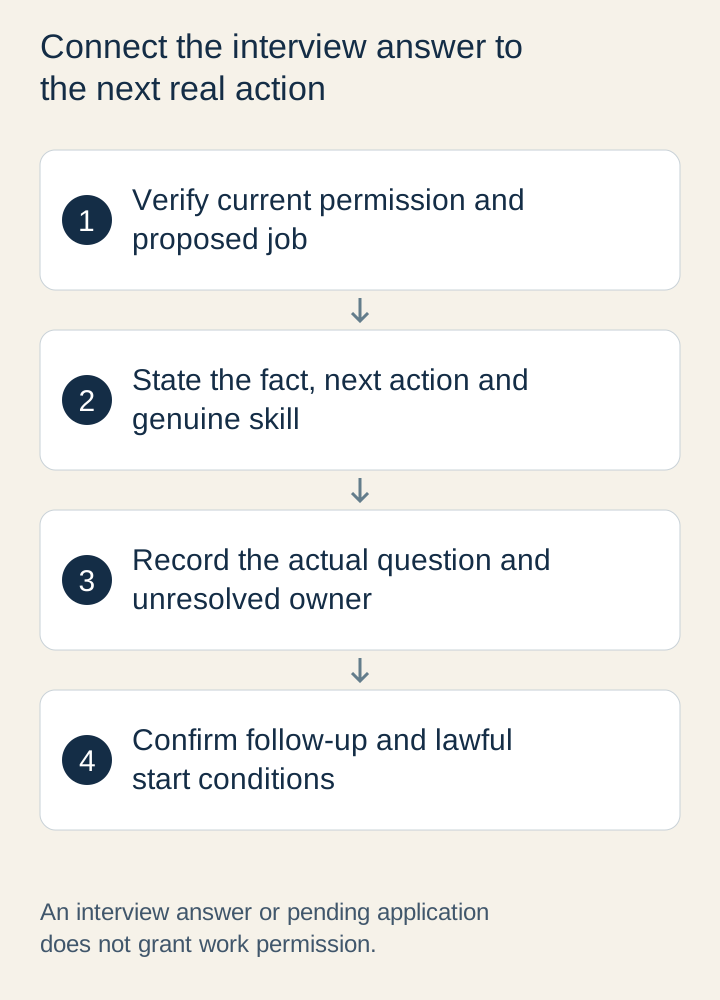
Prepare one role-specific example using the actual vacancy. For an operations role, explain the problem, your own action, the handover and how you checked the result. For an analytical role, explain the data source, your analysis and its limitation. If the outcome was shared, say what you contributed rather than taking credit for the team's entire result.
An original answer might be: “The vacancy mentions reconciling customer requests across teams. In my previous role, I maintained a shared exception log, identified the responsible owner and checked the response before closing the item. I can discuss a redacted example of the workflow.” This is a teaching example, not a customer success story or a claim about a real applicant.
Then ask an operational question: “If the interview progresses, who coordinates employment-permission questions and which role details would they need confirmed?” This helps identify the responsible HR or professional contact without demanding company financial records in a first interview. Supporting evidence is a later verified process, not a test you should improvise for the interviewer.
Do not promise to write employer evidence yourself or change duties to fit a route. The GEP supporting-document section distinguishes applicant and employer information and notes facilitation measures. Ask how the actual employer will manage its responsibilities; do not describe every listed document as mandatory for every company or request confidential financial information through an informal chat.
If the employer says it cannot consider the required process, ask whether that applies to this vacancy and record the answer. Do not pressure the recruiter by saying payment can purchase a sponsorship place. Nor should you remove the permission issue from later forms in the hope it will be overlooked. Accurate targeting saves time for both sides.
6. Confirm the answer without promising an early start
Send a short follow-up through the channel the employer has actually provided. A teaching example is: “Thank you for discussing the role. My current position is as explained in the interview; the remaining question is the applicable permission for this employment. Please confirm the appropriate contact for the next review. I will not treat the proposed availability date as a confirmed commencement date.” Replace the general wording with your verified facts.
The official visitor guidance prohibits visitors from taking paid or unpaid employment. Calling productive activity a trial, training or helping out does not settle its legality. If an activity before commencement is unclear, obtain appropriate clarification before doing it. This article does not give a blanket conclusion about every interview exercise or remote activity.
Separate a notice period, relocation availability and immigration readiness in your diary. They can each be unresolved for different reasons. Do not resign, book a non-refundable move or commit to a fixed first day solely because the interview went well. Discuss the actual contractual and permission conditions with the responsible parties.
For more detailed background, use the GEP and ASMTP job guide, the change-of-employer guide and PremierVisa Group's Hong Kong professional-employment information. The Group page supplies immigration background; it does not establish your individual permission or replace the candidate's own skill evidence.
7. Questions candidates ask before the interview
Should I answer only yes or no about sponsorship?
Answer the actual question truthfully. If a binary answer hides a material distinction, add a short explanation or ask HR how to record the situation. Do not choose a convenient answer that contradicts your current permission or an unresolved employer change.
Does having a Hong Kong identity card mean I can start?
The card alone is not a full explanation of employment rights. Check the actual immigration position and conditions relevant to this job. Provide the necessary evidence through a verified process rather than asking the interviewer to infer permission from a document's name.
What if I cannot name the correct route yet?
Say what is known and what requires assessment. You can explain the genuine role and your background without inventing a route. Agree a specific clarification and responsible contact. Avoid turning an interview into a promise that GEP, ASMTP or IANG must apply.
Can I offer to work unpaid while the application is pending?
Do not assume that removing pay removes an employment restriction. The visitor guidance expressly includes unpaid employment. The actual activity and permission need checking before it begins; a pending application or an employer's reassurance alone does not establish authorization.
What should I practise before an English interview?
Practise the three-part answer aloud, one relevant skill example and one clear question for HR. Compare the wording with your current CV and private fact sheet. Remove any unverified dates, outcomes or inflated contributions, and prepare a concise correction if the facts change.
Submit your job-search background to discuss your CV, interview answer and practical employer-contact directions. Bring the answer-to-action card so the next discussion addresses a real gap, without guaranteeing a job, sponsorship, approval or permanent residence.