
Before telling a Hong Kong employer you need sponsorship, check whether you qualify for IANG, which graduate category applies and what permission you actually hold today. Eligible recent graduates do not need a job offer at the IANG application stage; non-recent applicants do. GEP and ASMTP professional-employment cases have different entry criteria and employer evidence. This guide uses a six-field graduate-to-employer brief to separate eligibility, application status and lawful commencement, without treating a pending application as work permission.
- 1. Check the qualifying programme, not just the university name
- 2. Separate recent and non-recent graduate applications
- 3. Understand what GEP and ASMTP mean for the conversation
- 4. Use the six-field graduate-to-employer brief
- 5. Describe permission accurately in a CV and interview
- 6. Check effective permission, changes and future review separately
- 7. Graduate questions before approaching an employer
1. Check the qualifying programme, not just the university name
IANG is the Immigration Arrangements for Non-local Graduates. Start with the actual institution, programme, qualification, study mode and relevant records. A Hong Kong university connection, an exchange visit or an attractive course title does not by itself establish that the programme meets the arrangement. The current Immigration Department page sets out qualifying Hong Kong programmes and a separate definition for eligible Greater Bay Area campus graduates. ImmD IANG
Read that definition carefully rather than reducing it to “any graduate.” The Hong Kong-programme definition includes specified degrees with at least one academic year of study, or a qualifying programme at QF Level 5 or above with at least 120 QF credits and at least one academic year. Other qualification and nationality-related restrictions also matter. If the programme is unusual, obtain its actual award and accreditation information and ask the responsible institution or appropriate adviser to clarify the unresolved point.
A degree earned solely at an unrelated overseas institution does not become an IANG qualification because the holder wants to work in Hong Kong. Equally, do not dismiss a potentially qualifying non-degree postgraduate qualification without checking the official definition and FAQ. The task is to match the real qualification with the published arrangement, not rewrite the award's name on a CV. ImmD IANG FAQ
For your own record, keep the exact award name, institution and completion or graduation evidence together. If documents use different dates or translations, note the difference and ask for clarification. Do not assume that a recruiter can establish eligibility from the phrase “Hong Kong graduate” in a profile headline. This is a job-search preparation guide, not a finding that your particular course qualifies.
2. Separate recent and non-recent graduate applications
The official recent-graduate distinction uses application within six months after the graduation date shown on the graduation certificate. Applications beyond that period fall into the non-recent category. It is not simply a label based on the calendar year in which you finished studying. Keep the relevant date and intended application timing visible rather than relying on a friend's graduation ceremony date.
At application, eligible recent graduates are not required to have secured employment. Non-recent applicants need an offer meeting the applicable job-level and market-remuneration conditions. The FAQ explains corresponding distinctions for eligible GBA campus graduates. Do not tell an employer that all IANG applicants can apply without a job. ImmD graduate-category FAQ
If a certificate has not yet been issued, check the official provisions on institutional proof and the actual stage of your results. Do not invent a graduation date to fit a category. A university document can help resolve an evidence question, but a job interview or a promising offer does not substitute for the relevant academic evidence.
A practical next step is to write down one precise uncertainty: the applicable programme, the certificate date or the need for an offer. Resolve that question before sending many applications with a vague statement that “my IANG is sorted.” That phrase could mean eligible, preparing, submitted or approved, and those states have different implications for an employer deciding when someone can start.
3. Understand what GEP and ASMTP mean for the conversation
The General Employment Policy, or GEP, and the Admission Scheme for Mainland Talents and Professionals, or ASMTP, are professional-employment arrangements with criteria concerning a genuine vacancy, a confirmed offer, relevant qualifications or experience and remuneration. GEP is not simply another name for the Mainland-talent arrangement. Check the applicable personal background and official requirements. ImmD GEP, ImmD ASMTP
For Chinese residents of the Mainland, ASMTP is generally the relevant professional-employment comparison when IANG does not apply; the official pages also explain specified overseas-Chinese provisions. A Taiwan applicant should not select ASMTP solely because they read Chinese or hold a Chinese-language degree. Qualifying graduates should first check IANG on its own conditions rather than assigning a route by language or current job-search location.
| Situation being checked | Offer question at application | Employer conversation |
|---|---|---|
| Qualifying recent IANG applicant | No offer required at that stage | Explain the actual application and current-permission status |
| Qualifying non-recent IANG applicant | Applicable offer required | Clarify role level, terms and supporting evidence |
| GEP professional-employment assessment | Confirmed offer and relevant criteria | Identify the genuine role and employer's document contact |
| ASMTP professional-employment assessment | Confirmed offer and relevant criteria | Check Mainland-background applicability and employer evidence |
The table is a preparation comparison, not a complete eligibility test. Technical-professionals streams and other admission arrangements are not covered by this brief. Do not replace a professional assessment with a recruiter choosing the route that sounds least demanding. For more about the employer-document handoff, see the GEP and ASMTP job guide.
4. Use the six-field graduate-to-employer brief
Create a private summary that makes the next recruitment conversation factual. You do not need to send every identity or academic document with the first message. The following original brief records where the evidence is kept and what remains unresolved; it is not an immigration application or confirmation of work rights.
| Brief field | Information to prepare |
|---|---|
| Qualification and programme | Exact award, institution, study mode and evidence question |
| Graduation and category | Certificate date, timing and recent/non-recent question |
| Current permission | Actual status, permitted limit and verification evidence |
| Offer or route assessment | What has been confirmed and what still needs review |
| Employer contact | Role details, appropriate HR contact and clarification required |
| Commencement condition | What must be confirmed before work and when to update |
Do not mark a field confirmed because a classmate obtained approval on another course. Likewise, a company saying it will consider your CV does not settle the offer condition for an application. Keep each claim tied to your own facts. Where you do not know, write “to be checked” and name the next source of clarification.
Original hypothetical example: a graduate has an institutional letter but is unsure which graduation date should be used. The employer is interested in an interview, not yet offering the role. The next step is to resolve the academic-date evidence and describe the application accurately, while progressing the interview on its own merits. Nothing in that example establishes permission to start.
HKJobHunt can discuss your job-search background, CV and interview preparation. Bring the short brief and the practical question you need help with. Immigration matters can be referred for individual assessment according to the confirmed service and engagement; no qualification or professional licence is invented here.
5. Describe permission accurately in a CV and interview
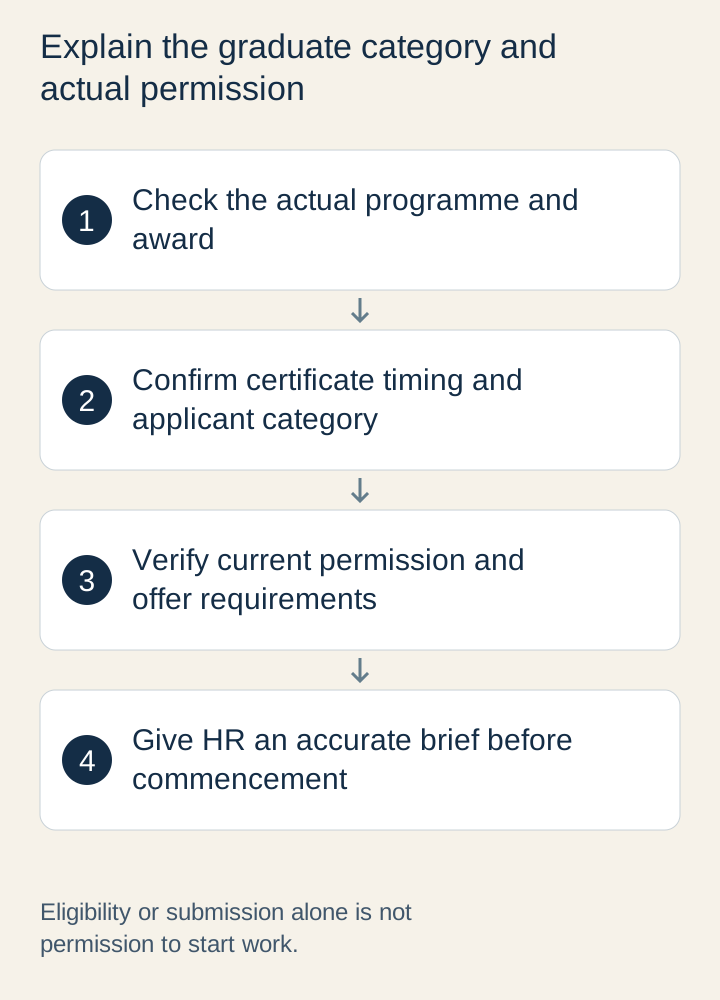
If you already hold effective IANG permission, state the true position and keep evidence ready through an appropriate verified channel. An original wording example is: “I currently hold IANG permission valid to the date shown in my records. I can provide the relevant verification to HR and will confirm the conditions for the proposed start.” Use it only when it is accurate, and insert no invented date.
If you are still checking or applying, use different wording: “I am checking my eligibility and application arrangements under IANG. I cannot yet confirm permission to commence this role. I can update HR when the relevant position is verified.” This is clearer than writing “no sponsorship needed” to avoid an application question while leaving the employer to discover the uncertainty later.
For an employer-related assessment, ask who will handle the role and company documents, what has been agreed and which start conditions remain outstanding. A willingness to discuss a process is not approval. Avoid circulating complete travel-document scans to an unverified recruiter simply to prove seriousness; establish the legitimate purpose and suitable channel for necessary evidence.
An interview should still demonstrate the work you can do. Bring a truthful example showing your own contribution, the context and how you handled a problem. Do not replace job evidence with a long immigration explanation, or imply that IANG eligibility compensates for a missing professional registration. Use the Hong Kong CV guide for detailed evidence writing.
6. Check effective permission, changes and future review separately
The IANG FAQ says admitted persons may take up and change employment during their permitted stay without prior ImmD approval. That statement concerns permission already granted and still valid; being eligible to apply is different. Before commencing, verify your actual permission and any necessary steps for it to be effective, rather than relying on a submission receipt. ImmD IANG conditions FAQ
GEP and ASMTP professionals on employment condition generally need prior approval for an employment change; the official pages also describe different requirements for qualifying top-tier persons on time limitation only. Read the conditions actually granted. Do not assume every holder of a Hong Kong identity card has the same employment rights. ImmD GEP conditions, ImmD ASMTP conditions
IANG's initial stay and later extension should not be confused. The official page describes a possible initial 24-month stay subject to normal immigration requirements, and separate extension criteria; the actual grant and limit must be checked. An early application without an offer does not promise indefinite job-free extensions, automatic permanent residence or unrestricted future admission. Keep the actual permitted limit and next assessment question in your private record.
For an employment change, consult the Hong Kong change-of-employer guide rather than treating this comparison as a transition instruction. For detailed immigration discussion, see PremierVisa Group's Hong Kong professional-employment information. That extension covers professional-employment background, not a finding that every graduate must apply through an employer-led route.
7. Graduate questions before approaching an employer
Does every Hong Kong graduate qualify for IANG?
No such conclusion follows from the institution's name alone. Check the actual programme, qualification, study mode and applicable restrictions against the official description. Keep the award evidence accurate, including any non-degree qualification question. Ask the institution or an appropriate adviser about an unresolved programme rather than upgrading it on your CV.
Does “recent graduate” mean graduating this calendar year?
The official distinction uses the six-month period tied to the certificate's graduation date and the application timing. Keep those facts separate from ceremonies or a friend's application. If a date is unclear or the certificate has not been issued, use the official evidence provisions and seek clarification instead of inventing a date.
Can I start because my IANG application has been submitted?
A submission alone does not prove permission for the proposed employment. Check what authorization you already hold and what is required before commencement. Students and visitors should not assume an application changes their existing conditions automatically; any separate permission must be assessed on its own facts.
Does IANG always require the employer to sponsor the initial application?
Eligible recent applicants do not need an offer at application, while non-recent applicants do. Do not turn that distinction into a blanket claim that no employer information or later evidence is ever needed. Explain your category and actual stage to HR, and keep eligibility separate from an approval decision.
What should my first employer enquiry include?
Provide the relevant job evidence, your true current status summary and the specific clarification needed for hiring. Keep the academic or immigration uncertainty concise. Ask who will verify the start conditions, and provide necessary documents only through an appropriate verified process rather than attaching an unrestricted personal archive.
Submit your job-search background to discuss CV preparation, interviews and practical employer-contact directions with HKJobHunt. Bring the graduate-to-employer brief so the next conversation can address the real question without guaranteeing a job, visa or permanent residence.