
A new offer does not by itself allow a Hong Kong work-visa holder to begin employment with another company. The decisive questions are the person's actual conditions of stay, the proposed work and any required approval or notification. This guide focuses on a practical transition record for candidates and new HR teams: identify the permission, compare the legal employers, assign documents and keep resignation, application, decision and lawful commencement dates separate. It does not decide an individual start date or promise approval.
- 1. Read the current permission before accepting a start-date assumption
- 2. Compare the legal employers and actual work
- 3. Separate the five dates that HR needs to understand
- 4. Assign the applicant and new employer documents correctly
- 5. Keep a transition-and-start record with three separate checks
- 6. Manage the waiting period and old-job handover without assumptions
- 7. Frequently asked questions
1. Read the current permission before accepting a start-date assumption
Gather the latest decision or permission documents, permitted limit of stay and the actual conditions attached to the current status. Use the current record rather than only the first entry visa or an old CV note. An identity card, a remaining period on a document and a general route name do not all answer the same question. If the conditions are unclear, ask for appropriate confirmation before promising a start.
The Immigration Department's GEP conditions say professionals on employment conditions may undertake only the approved employment and should seek prior approval for a change. The ASMTP conditions state the corresponding rule. The proposed new job must still fit the relevant criteria; a better salary or a similar title is not a substitute for that assessment.
The same official pages distinguish top-tier professionals already permitted to stay on time limitation only without other conditions. Their change-of-employment notification arrangement differs. High income, a senior title or an intention to apply for that arrangement does not mean it has already been granted. Check what the person has actually been approved for, rather than selecting the procedure that seems faster.
Other permissions, including IANG and the Technical Professionals Stream, need their own applicable rules. This article's main workflow concerns professional GEP/ASMTP transitions; it is not a universal transfer procedure for every Hong Kong entrant. The route and document-responsibility guide can help prepare a factual summary before individual assessment.
2. Compare the legal employers and actual work
Write the legal name of the present employer beside the proposed employer, not just the group brand or office address. Then compare role, duties, work location, remuneration components and employment period. A move within the same corporate group can still involve different employing entities. Conversely, an apparent name difference may require clarification of a genuine rename rather than an assumption about a new company.
Ask the new HR team who will confirm the employing entity and appointment terms. Do not let an internal payroll label or a familiar manager replace the actual contract and company facts. If the role is still being negotiated, mark the unsettled terms. An application based on an earlier version should not quietly be treated as covering later changes that have not been assessed.
For an original hypothetical example, the applicant would remain at the same desk but the new letter names a different group company and materially different duties. The next step is to document those differences and have the relevant arrangement assessed. It is not to say nothing changed because the building and manager are familiar. This example is not a real employer or a legal conclusion about a particular transfer.
The Technical Professionals Stream page has separate employment and trade conditions. Do not apply a professional-route paragraph to a technical-stream holder simply because both documents contain GEP or ASMTP. Identify the exact stream before deciding which job changes, documents or permissions need review; do not combine favorable rules from different arrangements.
3. Separate the five dates that HR needs to understand
Record the present permitted-stay expiry, contractual last day, proposed new start, actual application event and actual decision or permission event. They need not occur together. A target start can be discussed as conditional, while an application or decision date must reflect an event that really occurred. Never backdate employment or mark a filing as approved just to make a schedule look coherent.
| Record | What it answers | What it does not answer |
|---|---|---|
| Current permission and expiry | Existing conditions and time limit | Automatic coverage of new employment |
| Notice and last-day arrangement | Present contract and handover planning | Immigration permission for the new job |
| Application receipt | A submitted or acknowledged step | Approval or a guaranteed decision date |
| Actual decision and conditions | What has been decided and permitted | Every remaining onboarding requirement |
| Confirmed lawful commencement | Agreed work start after applicable checks | A retrospective cure for earlier work |
The Labour Department's termination FAQ distinguishes notice and payment-in-lieu requirements according to the employment situation. Check the contract and applicable rules rather than assuming everyone has one standard notice period. Resolving notice obligations and obtaining immigration permission are parallel tasks; completing one does not automatically complete the other.
Use neutral labels such as proposed, requested, submitted, awaiting decision and confirmed. They are internal planning statuses, not a substitute for the actual document. If the employer wants a firm date before a required decision, explain the unresolved condition and agree when to review it. Do not invent a processing-time guarantee or promise that the authority will prioritize the case.
4. Assign the applicant and new employer documents correctly
The official GEP and ASMTP pages distinguish applicant records from company evidence and refer change-related extension cases to the relevant professional-employment guide. The exact application route and checklist depend on the situation. A short same-employer support letter is not automatically the complete new-employer file, and an entry-application checklist is not a reason to ignore current-status instructions.
The candidate can organize actual travel/status documents, qualification and experience evidence, present and proposed employment facts and any relevant correspondence. The new employer should verify the appointment, duties, remuneration, period and applicable business information through an authorized person. Official facilitation can affect specified documents, so the aim is an accurate case-specific request, not an invented universal document bundle.
Keep confidential company and personal material in agreed secure channels. The candidate should not construct new company accounts, certify a business they do not know or sign as the employer without authority. HR should not revise the applicant's employment history to support a preferred job label. If an issuer's record is wrong, seek a genuine correction or explanation rather than privately editing it.
Ask the responsible case handler to identify who submits which part, what evidence of submission will be retained and who receives follow-up requests. Save the final version used. A draft handed to a consultant, a form completed by HR and an application actually submitted are different states. Only record the state supported by evidence, and keep any legal representation or regulated service scope explicit.
If you need help preparing the recruitment discussion, submit your candidate background. Discuss CV, interview and employment-term questions under confirmed arrangements. That preparation does not approve the transition or replace individual immigration and employment advice.
5. Keep a transition-and-start record with three separate checks
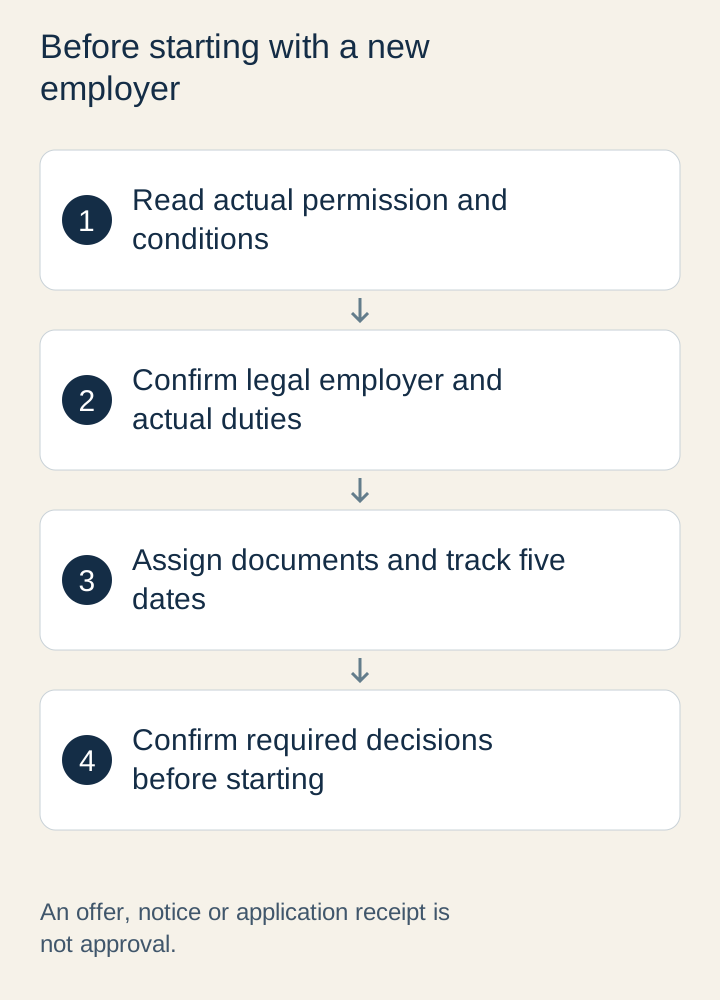
Use six fields: current permission and condition, present-to-new employer or duty change, required question or action, evidence and actual status, responsible person, and the effect on the proposed start. This original asset connects the status assessment with the employment handover. It is not a government checklist or a statement that a certain number of completed boxes makes the move lawful.
Use three checks before converting a tentative start into a confirmed plan. First, has the actual permission and applicable change procedure been identified? Second, are the employment facts and relevant documents confirmed by the right parties? Third, has every required decision or other step for commencing this specific work actually been completed? A gap at one check stays visible even if the other two look ready.
An original hypothetical entry might read: GEP employment conditions confirmed; proposed new legal employer identified; required prior-approval question being handled; receipt available but decision pending; HR must keep commencement conditional. Another entry might show an already approved time-limitation-only arrangement and the appropriate notification task. Neither is a real person's result, nor does the worksheet decide that an exception applies.
Keep the authority's actual wording with the decision record and ask about anything unclear, including what employment it covers and whether further formalities apply. A positive message from a recruiter is not the same source. If conditions or job facts change after a decision, seek review of the change rather than treating the earlier record as a permanent permission for any related role.
6. Manage the waiting period and old-job handover without assumptions
Check the current expiry independently of the transfer discussion. The GEP and ASMTP pages state that, unless exceptional approval is given, a person subject to a limit of stay must leave before expiry even if an extension application is pending. Do not assume a new-job application, receipt or employer request automatically extends the stay. If timing is tight, obtain prompt case-specific advice and an evidence-based plan.
Do not begin productive duties for the new employer where the necessary permission is unresolved. Calling the activity training, unpaid help or a trial does not by itself answer the immigration question. The visitor rules prohibit visitor employment whether paid or unpaid; a change in status also needs its own assessment. Ask about the actual proposed activity, not only the label.
For the old-job handover, agree the scope, responsible colleagues, return of equipment and appropriate records. Do not take confidential client information or internal files to demonstrate value to a new employer. Keep a personal record of your own contractual arrangements and authorized communications, rather than copying business material you are not entitled to retain. Resolve disputes through suitable employment or legal support channels.
Explain timing to the new team in factual terms: the offer is accepted subject to the stated conditions, the relevant request is at the evidenced stage, and the start will be reviewed when the missing step is resolved. Avoid telling a prospective supervisor that approval is assured. If the role closes or the employer changes its terms, record that fact and reassess the plan instead of silently reusing outdated documents.
For broader visa detail, use the PremierVisa Group professional-employment guide. For the application wording that precedes a move, read the CV and work-rights guide. A dated transition record makes the conversation more precise; employment, permission and any later permanent-residence question remain separate outcomes.
7. Frequently asked questions
Can I start because the new employer has submitted an application?
Submission is not approval. If the actual conditions require prior approval, obtain it before the change. Confirm the applicable procedure and the decision rather than treating an acknowledgement or recruiter message as permission.
Does a valid Hong Kong identity card make every new job permissible?
No. Read the actual current permission and its conditions, including whether it covers the proposed employment. A card and unexpired stay do not by themselves settle an employer-change question.
Is a transfer within one corporate group automatically exempt?
Do not assume so. Compare the legal employing entities and real duties, and have the relevant changes assessed. Same brand, manager or office does not make two legal employers identical.
Can high income let me use notification instead of approval?
Do not self-assign an approved arrangement. The official distinction concerns people actually permitted to stay on the relevant time-limitation-only conditions. Confirm the grant and applicable notification requirements, not just earnings or job seniority.
Does a pending extension automatically let me stay until a result?
The professional-route pages say otherwise unless exceptional approval is given. Check the actual expiry and any formal permission, and obtain timely advice. A receipt alone should not be used as a stay or start-work guarantee.
Put the current permission, actual employer change and proposed start into one transition record. Submit your background if you need support preparing the new-employer conversation while individual legal and immigration questions receive appropriate review.
Prepared with AI assistance. General career information; no named professional review has been confirmed. AI cover illustration does not depict our staff, clients or partner employers.