
Start with a Hong Kong role you can perform, then ask whether the employer accepts applicants with your current work-right position and will discuss the relevant application support. A vacancy, an overseas interview and an employer-supported visa are different things. This guide helps overseas candidates and people already in Hong Kong build a role-specific shortlist, explain their status accurately and keep an employer-contact record. It does not provide a verified sponsor list, a job offer or permission to begin work.
- 1. Define the role and your actual work-right position
- 2. Use recruitment channels for leads, then return to the actual employer
- 3. Read work-right wording before investing in an application
- 4. Send a short first approach grounded in job fit
- 5. Build an employer-contact record you can act on
- 6. Prepare the handoff from recruitment to employer-supported assessment
- 7. Frequently asked questions
1. Define the role and your actual work-right position
Write a short search brief: the work you can do, evidence of relevant experience, preferred location and hours, language tasks you can handle and present immigration position. Someone with unrestricted work rights, someone on employment conditions and someone applying from outside Hong Kong need different employer conversations. A Hong Kong identity card alone does not describe all those conditions.
The Immigration Department's General Employment Policy concerns professional employment and normally looks at a genuine vacancy, a confirmed offer, relevant qualifications or experience, a role not readily filled locally and market-level remuneration. Employer interest is one component of an individual assessment. It is not evidence that every job using the word professional supports an application.
For Chinese residents of the Mainland, the Admission Scheme for Mainland Talents and Professionals is the relevant professional-employment arrangement to examine, subject to the actual circumstances. Eligible graduates should separately check IANG. Do not pick a route from the language of an advertisement; use the route and document-responsibility guide to organize the questions.
Keep qualifications and workplace readiness specific. Instead of “experienced in international business,” identify the products, tasks, customer groups and results you can truthfully explain. Describe language through actual work, such as handling written enquiries or participating in technical meetings. Do not inflate fluency or assume all Hong Kong employers need the same combination of Cantonese, Mandarin and English.
2. Use recruitment channels for leads, then return to the actual employer
Search employer career pages, public recruitment advertisements and relevant professional or alumni networks using the role's tasks as well as its title. A narrow title may miss similar work; an indiscriminate visa keyword search may return sales pages rather than vacancies. Keep the original source and date so you can check whether an advertisement remains open and whether the application instructions changed.
An original search pattern combines a genuine function with Hong Kong and a relevant task: for example, procurement, supplier coordination and the actual sector you know. The example is not a vacancy or a claim that procurement positions are approved for a visa. Use your real background to choose the function; do not copy an occupation solely because a consultant says it is easy to sponsor.
The Labour Department's Interactive Employment Service FAQ states that its service is offered to job seekers legally employable in Hong Kong. Do not tell an overseas candidate without the relevant rights to register as if already eligible. Public employment information is not a list of employers who have agreed to support your visa, and a government-hosted advertisement does not supply that missing agreement.
Where an intermediary is involved, identify both the recruiter and proposed employing company. Confirm the vacancy through an independently found company contact where appropriate. Ask who would interview, issue the employment letter and coordinate any employer documents. A company might recruit locally for one team and consider overseas candidates for another; record the answer for the particular role rather than assigning the whole company a permanent sponsor label.
3. Read work-right wording before investing in an application
Separate three questions in every advertisement: can you do the job, does the employer accept your applicant situation, and is it willing to provide the relevant support if an appropriate route is available? “Overseas applications welcome” does not answer all three. Neither does a platform tag, a history of overseas hiring or a recruiter saying the company is international.
| Wording or response | Practical next question | What you should not assume |
|---|---|---|
| Existing right to work required | Does my actual permission cover this employment? | Any identity card or visitor entry is sufficient |
| Overseas applicants considered | Will the employer discuss my status and required support? | Every overseas applicant will receive sponsorship |
| Support considered case by case | Who reviews the role, candidate and employer documents? | A positive interview is already approval |
| No clear statement | Which applicant situations are accepted for this role? | Silence means either guaranteed support or refusal |
This is an original reading aid, not a set of official advertisement categories. If an employer explicitly requires existing rights you do not hold, do not answer yes to bypass screening. Ask for clarification through the designated recruitment route if there is a genuine ambiguity. Respect a clear refusal rather than repeatedly approaching unrelated staff to obtain a different answer.
Be careful with “immediate start.” Interview availability, notice obligations and lawful start are distinct. The visitor-activity rules prohibit taking employment as a visitor, whether paid or unpaid. Do not offer unpaid trial work as a shortcut while an employment application is pending. Any specific proposed activity or exception needs appropriate assessment before it happens.
4. Send a short first approach grounded in job fit
Use the employer's stated application channel. Lead with the vacancy reference and a concise match to its duties, then state your real location and work-right position. You do not need to send an entire immigration history or sensitive identity records in the first message. A clear status summary lets the employer decide who should handle the question without being misled about immediate availability.
An original example for someone outside Hong Kong is: “I am applying for the advertised role. My experience includes the stated coordination tasks and supporting records are available. I am currently outside Hong Kong and would need the appropriate permission before starting. Does this role accept applicants in that situation, and would your team discuss the relevant employer support if there is a suitable route?”
If you already hold permission, replace that sentence with a truthful description of the current conditions and any review needed for the new role. Do not copy an unrestricted-rights statement because it sounds more convenient. People admitted on GEP employment conditions generally need prior approval for an employment change; different approved conditions can involve different procedures. Check the actual grant instead of applying one rule to everyone with a card.
Attach a tailored CV showing relevant duties, employment dates, qualifications and genuine accomplishments. Use a fictional example only for practice, clearly marked as such, and remove it from your own application. A strong application makes the real match easier to understand; it cannot create a qualification, employer relationship or government decision that does not exist.
If you need support preparing that approach, submit your candidate background. Discuss CV positioning, interview preparation and actual employer resources under confirmed service arrangements. An enquiry is not an offer or a promise that a company will provide application support.
5. Build an employer-contact record you can act on
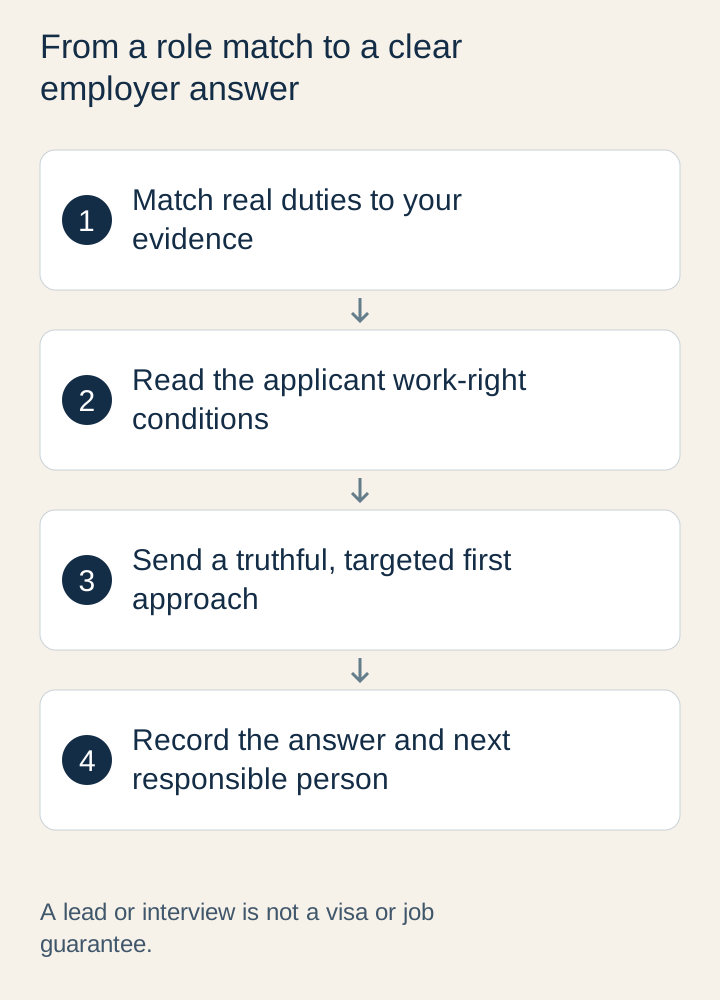
Use six fields: employer and vacancy reference, original source and date, relevant task and your evidence, applicant-rights wording, exact employer response, and next question with its owner. This original tool is more useful than a spreadsheet of famous brands. It records what has been confirmed for one role and what still needs attention, without turning unanswered leads into claimed partnerships.
An original hypothetical row might say: a role's technical coordination duties match documented experience; applicant-rights wording unclear; employer asked for a CV and will refer the permission question to HR. The correct status is employer review pending. Do not upgrade it to offer, sponsorship agreed or visa approved. The row describes a research step, not a real customer outcome or government stage.
Keep separate statuses for not contacted, response pending, unsuitable applicant conditions, further discussion and closed. They are your workflow labels, not official classifications. When a company declines, record the reason it actually gave. “No response” does not prove it never recruits overseas, and “previously hired overseas” does not establish support for you today.
Review the log before following up. Send a concise, relevant reminder through the stated channel if appropriate, referring to the vacancy and outstanding question. There is no universal number of follow-ups that guarantees a reply. Avoid mass messages containing personal records, and stop when the company closes the role or asks not to be contacted again. Quality of evidence matters more than an inflated contact count.
6. Prepare the handoff from recruitment to employer-supported assessment
When discussions become concrete, confirm the legal employer, duties, location, remuneration components and proposed employment period. The GEP and ASMTP official document lists distinguish applicant evidence from company documents. A candidate can organize qualifications and experience; the employer must verify its own appointment information, business facts and applicable supporting material. Do not ask the candidate to invent company finances or create a letter without company confirmation.
Share confidential records only with an identified recipient for a stated purpose and through an agreed secure route. Early job-search notes can say that a document is available without circulating the original. If a title, date or company name differs between the CV and later records, explain the true reason. Editing every document to hide the discrepancy undermines the facts the assessment needs.
Keep the professional route separate from the Technical Professionals Stream, which has designated trades and quota conditions. The word technical in a job title does not settle which arrangement applies. Equally, an imported-labour advertisement is not automatically a GEP or ASMTP professional vacancy. Ask for the actual scheme name before relying on a recruitment promise.
For broader application details, use the PremierVisa Group Hong Kong professional-employment guide. Individual visa issues can be assessed separately under confirmed arrangements. Continue using the existing Hong Kong work-preparation guide for the initial status summary; this article adds the channel, wording, outreach and contact-log steps rather than replacing it.
Before agreeing a start, ask which approval and entry or change-of-employment steps must actually be completed. Recruitment, an application receipt and permission to work are different milestones. Keep relocation and notice planning conditional where necessary. Nobody can convert a shortlist or a positive interview into a guaranteed work visa, permanent residence or continuing vacancy.
7. Frequently asked questions
Is there an official universal list of employers who will sponsor me?
This guide does not establish one. A vacancy or previous hiring record does not confirm a present commitment to you. Ask the actual employer about the specific role, applicant circumstances and support it is prepared to discuss.
Does “overseas applicants welcome” guarantee visa support?
No. It indicates an applicant audience, not an individual decision or a complete support arrangement. Ask who will review the permission question and which employer steps would be considered if the job and route fit.
Can I say I already have work rights because I have a Hong Kong identity card?
Describe the actual permission and its conditions. A card alone does not answer whether a new job is covered or whether prior approval is needed. Obtain appropriate confirmation instead of using a convenient but inaccurate screening answer.
Should an overseas applicant use the Labour Department service as a sponsor database?
No. Its FAQ limits the service to legally employable job seekers, and job information does not equal employer agreement to support a visa. Check service eligibility and research real vacancies through suitable channels.
Can I begin unpaid work while waiting?
Do not treat unpaid work as a visitor-status workaround. The visitor rules prohibit employment whether paid or unpaid. Confirm the actual status and any proposed activity before starting; a pending application is not permission.
Choose one role you can genuinely perform, record its applicant conditions and send a truthful first approach. Submit your background if you need help organizing your CV, interview explanations and next employer questions under confirmed arrangements.
Prepared with AI assistance. General career information; no named professional review has been confirmed. AI cover illustration does not depict our staff, clients or partner employers.