
For an EB-3-related trades opportunity, connect the actual job duties to evidence of your own training and experience, then check the permission required for that work in the intended location. “Two years” is not a universal trade licence or a guarantee of sponsorship. This guide provides a six-field task-and-permission record, an original employer-letter request and a state-specific electrical example. It helps overseas candidates prepare an accurate discussion without turning a trade title, tool photograph or foreign certificate into an approval claim.
- 1. Obtain a precise trade role and worksite description
- 2. Apply the two-year distinction to the actual job, not just your resume total
- 3. Build evidence around work you actually performed
- 4. Check local permission before promising the work you can perform
- 5. Use a six-field task-and-permission record
- 6. Review the offer and plan the next discussion conditionally
- 7. Questions about trades experience and EB-3 preparation
1. Obtain a precise trade role and worksite description
Ask which entity would employ you, where the work takes place, what equipment or systems the role concerns and who supervises it. “Technician” can describe very different work. Installation, maintenance, inspection, workshop production and assisting a licensed worker should not be combined into a single claim if your experience covers only some of them.
The Bureau of Labor Statistics electrician profile describes tasks such as reading diagrams, installing or maintaining systems, testing and following applicable codes. It is a useful example of how a trade can be broken into tasks. It does not establish that every technical worker is an electrician, that you performed those duties or that an employer currently sponsors overseas candidates.
Ask for the current written duties and mandatory requirements, including any supervision or permission condition. A recruiter saying that “trades are needed” does not identify the actual position. If several sites are mentioned, record them accurately and ask the appropriate contact how the role and any case documents describe the expected work location.
Also confirm the employment arrangement. In the PERM context, 20 CFR 656.3 defines employment as permanent, full-time work for an employer other than oneself. A short project, informal self-employed arrangement or vague future opportunity should not be relabelled as the required job without review of the actual facts.
2. Apply the two-year distinction to the actual job, not just your resume total
8 CFR 204.5(l) defines skilled work as requiring at least two years of training or experience and distinguishes other work requiring less than two years. The classification depends on the relevant requirements placed on the job, as certified by the Department of Labor, rather than an applicant selecting a preferred label from their resume.
An applicant's total time in an industry does not establish that all of it is relevant to the proposed duty. Separate employment, apprenticeship, classroom training, supervised work and responsibility for a particular task. Explain overlapping periods and genuine gaps. Do not add concurrent jobs as though they were consecutive years or rename assistance as independent authorised practice.
The rule allows relevant post-secondary education to be considered as training in the skilled-worker provision, but it does not promise that every course replaces the required experience. Keep the actual qualification name, issuer, content and completion date. An intention to attend a course is not evidence that it has already been completed or accepted for the case.
For the broader requirement-to-document comparison, use our qualification-evidence guide. This trades guide adds task scope, supervision and local practice permission. It does not conclude that a person qualifies merely because a certificate and a calendar total appear to reach two years.
3. Build evidence around work you actually performed
Make an index of employers or training providers, roles, periods, tasks and people able to confirm them. Distinguish your own work from a team's output. A project name or photograph may provide context, but it does not prove every duty, responsibility or period claimed. Only use material that you own or are authorised to share, and protect client and former-employer information.
The experience-evidence provision in 8 CFR 204.5(l) describes letters from employers or trainers identifying the issuer and the training or experience. An original request could read: “Please confirm the role, actual period, tasks and supervision your records support. Please identify your name, address and position, and explain which details you cannot verify.” This is an information request, not a government template or a guaranteed acceptable letter.
Where records are incomplete, identify the precise gap and ask the appropriate reviewer what evidence may properly address it. Do not create an employer, ask a friend to sign as a supervisor or produce a backdated certificate. A payroll record, photograph or course brochure is not automatically an interchangeable substitute for the required experience evidence.
For an invented teaching example, a worker assisted with component assembly and recorded checks under supervision, while the proposed role requires independent inspection responsibility. The useful question is what responsibility the earlier issuer can actually confirm and what the new job requires. The answer should not silently upgrade the worker's history. This is not a real customer or a statement that the two jobs are equivalent.
4. Check local permission before promising the work you can perform
Immigration classification and trade permission answer different questions. As a concrete example, Washington State's electrician guidance explains its electrical-construction certification framework and different general journey-level and specialty qualifications. This is a Washington electrical example, not a national licence checklist for every trade.
The BLS profile also notes that electrician licensing requirements vary by state. Use the relevant regulator for the actual location and work. Do not assume a foreign trade certificate, an employer's enthusiasm or an EB-3 assessment automatically authorises the regulated duties. If an apprenticeship or trainee route is proposed, check its actual scope and supervision rather than describing it as unrestricted practice.
Record which authority can confirm the requirement, the category being assessed, any application or examination position and the permission actually issued. Do not convert “eligible to apply” into “licensed.” If someone refers to reciprocity or overseas-experience recognition, ask which rule and credential they mean; do not infer automatic recognition from the fact that another worker once used a route.
An original question is: “For these specific duties at this site, which individual permission or trainee status applies, who confirms it, and what work may be done under the proposed supervision?” Keep the answer separate from whether an employer can support an immigration petition. A company arrangement and an individual's permission should not be assumed to answer the same question.
5. Use a six-field task-and-permission record
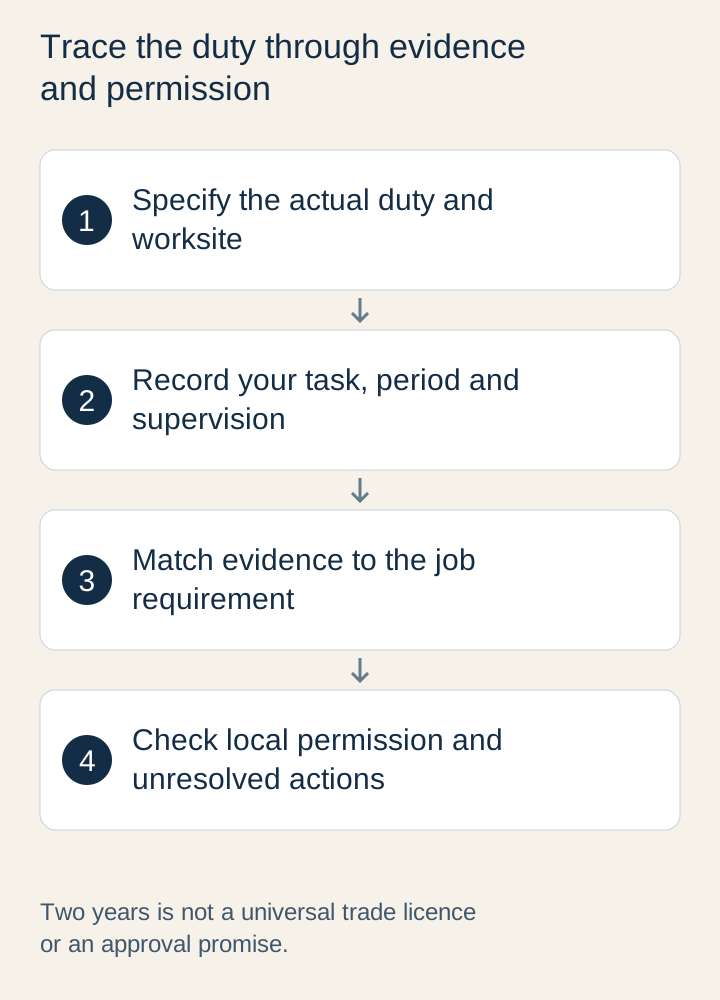
Create six fields: proposed duty and work context; your actual task, period and supervision; supporting record and issuer; the job's training or experience requirement; local permission question and regulator; and the next action with its owner. This original record traces a duty through both evidence and permission instead of treating a collection of tools or certificates as a complete qualification assessment.
| Item to compare | Evidence or clarification | Decision still needing confirmation |
|---|---|---|
| Installation versus assistance | Actual tasks and supervision in previous work | Does the history support this proposed duty? |
| Maintenance or inspection responsibility | Issuer-supported scope and genuine period | Was this your responsibility or the supervisor's? |
| Training or apprenticeship | Actual record, content and completion date | How is it relevant to the job requirement? |
| State-regulated duty | Current regulator and applicable permission | What may you do at this site and under what conditions? |
| Employer's proposed start | Written role and actual work-permission basis | Which conditions remain before starting? |
Keep one row for each material duty rather than a single “experienced tradesperson” conclusion. A gap in one task may need clarification even when other tasks are well supported. If the employer changes the duty or site, revisit the corresponding row. Do not retain a general ready status while replacing the facts underneath it.
Prepare an original spoken explanation alongside the record: “I performed this task in this setting under this level of supervision. These records support it. I have not yet confirmed this local permission or this additional responsibility.” That wording makes the unresolved point visible. It is more useful than claiming you can do every task associated with a broad trade title.
If you need help presenting genuine work experience in a resume or interview, submit your career background. HKJobHunt can discuss preparation and realistic employer-contact directions within an agreed service scope. Trade authorisation and immigration questions need the relevant regulator or appropriately qualified professional; career support cannot issue either permission.
6. Review the offer and plan the next discussion conditionally
Ask for the employing entity, duties, worksite, supervision, pay currency and basis, expected schedule and any transport or accommodation arrangement being discussed. Separate the offered wage from a national occupational statistic and distinguish gross pay from living-cost assumptions. This article does not quote a market wage, decide overtime entitlement or guarantee a particular net income.
If a practical assessment is proposed, ask about the activity, location, supervision and purpose before agreeing. This guide is not a technical repair manual or permission to undertake a U.S. trial shift. Do not treat the word unpaid, training or observation as a substitute for checking the actual activity and applicable conditions.
The Department of State employment-based overview separates the employer's petition from later visa stages. A convincing skills record or a successful hiring discussion does not itself provide immediate work permission. Keep any proposed working start conditional on the actual job, professional or trade requirements and immigration position being confirmed.
Use the employer-verification guide to check the contact and role, and the employer-process guide for the later case handover. Broader background is available through PremierVisa Group's U.S. information, with individual services confirmed separately. Do not use a different worker's approval or a generic occupation list to predict your own outcome.
For a focused conversation, submit your background and the trade duties you are considering. Describe what you actually performed, which evidence exists, where the proposed job is and which permission question remains. That allows practical preparation to move forward without pretending a missing record or licence has already been obtained.
7. Questions about trades experience and EB-3 preparation
Does two years in a trade guarantee a skilled-worker case?
No. The actual job requirements, relevant evidence and individual conditions need assessment. A total calendar period alone does not establish the required work, classification, local permission or immigration approval.
Is my foreign trade certificate automatically a U.S. licence?
Do not assume that. Check the actual regulator, work and location. Any recognition, application, examination or trainee conditions must be confirmed under the applicable rules, rather than inferred from the certificate's name.
Can I list a supervisor's responsibility as my own experience?
No. Explain your actual task and supervision accurately. The fact that you worked on a project does not establish responsibility for every inspection, decision or result. Ask the issuer to confirm what its records support.
Does the Washington electrical example apply to all U.S. trades?
No. It illustrates why a specific regulator and work scope matter. Other trades and locations can have different arrangements. Use the intended job's actual requirements rather than copying that example as a universal checklist.
Can a tool portfolio replace the required letters and permissions?
Not automatically. Genuine authorised photographs can support a discussion, but they do not establish every duty, period or permission. Match the evidence to the actual requirement and have unresolved gaps reviewed before making a working-start commitment.