
Engineering and IT candidates discussing EB-3 with a U.S. employer should start with the work the business needs, then connect their genuine qualifications to that role. A technical title, overseas degree or positive interview does not establish the professional category or permission to start work. Prepare a short role discussion brief covering continuing duties, location, evidence, professional permission and the employer’s decision process. Use it to identify the next decision, rather than asking for an unconditional sponsorship promise.
- 1. Start with an ongoing business need
- 2. Separate the role from the immigration label
- 3. Build evidence around actual responsibilities
- 4. Use the six-field employer discussion brief
- 5. Run a useful conversation and record the outcome
- 6. Manage changes before treating a start date as agreed
- 7. Questions candidates often ask
1. Start with an ongoing business need
“Would you sponsor me?” is difficult to answer when a manager has not decided what job exists. Begin with the recurring problem: maintaining a production system, supporting a product after launch, testing releases, or handling engineering work within a defined team. Ask what continues after the immediate project ends, who supervises it and where the employee would work. These questions help distinguish an ongoing position from a short delivery assignment.
For ordinary permanent labor certification, 20 CFR 656.3 defines employment as permanent, full-time work for an employer other than oneself. An independent contractor arrangement cannot simply be renamed to satisfy that framework. Explain your interest in the actual employee role and ask the employer to clarify its proposed employment arrangement; do not draft an invented business need for a reluctant company.
A permanent position should not be presented as a promise of lifetime employment. Ask what the employer currently intends, what remains subject to approval and how material changes would be communicated. Separate the proposed employment terms from the immigration procedure. Neither party can resolve every future commercial event in an introductory call, but both can avoid describing a tentative project conversation as an approved long-term hire.
2. Separate the role from the immigration label
EB-3 includes different classifications. Under 8 CFR 204.5(l), the professional route concerns a qualifying U.S. bachelor’s degree or foreign equivalent degree and membership of the professions; the evidence must also establish the relevant degree requirement for entry to the occupation. Calling a role “software engineer” does not answer those questions. Nor does a candidate’s advanced degree automatically settle how a different job should be classified.
Ask for the actual job description and minimum requirements before purchasing an evaluation or promising eligibility. Distinguish requirements that apply to every person doing the job from preferences such as familiarity with one product. DOL’s ordinary PERM rule, particularly paragraphs (h) and (i), addresses job requirements and actual minimums. Do not suggest adding your unusual combination of tools to exclude other applicants or changing the role just to fit your resume.
Professional practice permission is another question. Washington’s Professional Engineer licensing page describes its own education, experience, examination and application framework. It also makes clear that sending a credential record does not automatically produce approval. This is a state example, not a claim that every engineering or IT position requires a PE licence. For the proposed duties and location, ask the relevant regulator about the applicable scope and any conditions or exemptions before claiming authority to practise.
| Question | Evidence to discuss | What it does not establish |
|---|---|---|
| What ongoing work exists? | Employer’s real duties, location and employee arrangement | A guaranteed future vacancy |
| How does the candidate qualify? | Actual degree record and relevant experience evidence | Automatic EB-3 professional classification |
| Is local practice permission needed? | Applicable state regulator’s requirements and individual status | Work authorization through immigration |
| Is the employer ready to proceed? | Named decision owner and documented next action | Petition approval or a fixed arrival date |
3. Build evidence around actual responsibilities
Use two or three achievements that demonstrate the work under discussion. Write the situation, your contribution, the evidence you can share and the limits of your responsibility. A team result should identify your part. If a metric cannot be substantiated, explain the improvement without inventing a percentage. Remove confidential customer details and production credentials from any portfolio; a recruiting conversation rarely needs access to a former employer’s live system.
Teaching example, not a real applicant: “I helped maintain a business application after launch. My responsibility was investigating recurring failures, proposing changes and documenting tests under the team lead’s review.” That is more informative than “expert in every platform.” The candidate can then provide an authorised, anonymised process description and an employment reference. It remains for the employer to decide whether that experience matches the proposed role.
Prepare a degree record showing the award and field, a factual employment chronology, relevant training records and a list of people who can confirm your work. Keep original and translated documents linked by an internal reference. Where the institution or former employer uses a different title, explain the discrepancy instead of silently rewriting it. Immigration evidence requirements and an employer’s initial recruiting request are related but different; do not send an entire sensitive application file to an unverified recruiter.
The BLS software occupation profile provides useful context on development, testing, maintenance and teamwork. Use it to understand terminology, then return to the employer’s actual duties. National occupation information does not prove a specific company has an opening, that it sponsors, or that your personal qualifications have been accepted. A copied occupational paragraph is not an employer job description.
4. Use the six-field employer discussion brief
Create one record per role, with a date and version. The purpose is to preserve what was actually discussed, including unanswered questions. It is a working document, not a government form or an employer undertaking. Leave unknown information marked “not confirmed”; a blank should never become an assumed approval during the next conversation.
| Field | What to record |
|---|---|
| Continuing business need | Work that remains after the immediate project; employer’s explanation |
| Role, duties and location | Proposed employee role, team, worksite and genuine minimum requirements |
| Candidate evidence | Degree and specific responsibilities supported by records; outstanding evidence |
| Practice scope question | Tasks possibly requiring local permission and the regulator to consult |
| Decision owner and outcome | Who may approve employment and who coordinates professional assessment |
| Next action and update trigger | Owner, document requested, agreed follow-up and changes requiring review |
In a hypothetical systems role, the manager might describe an ongoing maintenance need but have no authority to approve an immigration budget. Record both facts. The next action could be an introduction to the authorised HR contact, not “sponsorship agreed.” If the position is only a fixed project and the employer cannot identify continuing work, record the mismatch and reconsider the opportunity rather than changing the wording to conceal it.
Use the downloadable discussion worksheet to keep the six fields together. If you need help selecting evidence or preparing the conversation, submit your background to HKJobHunt. The discussion can cover your resume, interview preparation and employer directions that may be practical for your background; the actual service scope needs to be agreed separately.
5. Run a useful conversation and record the outcome
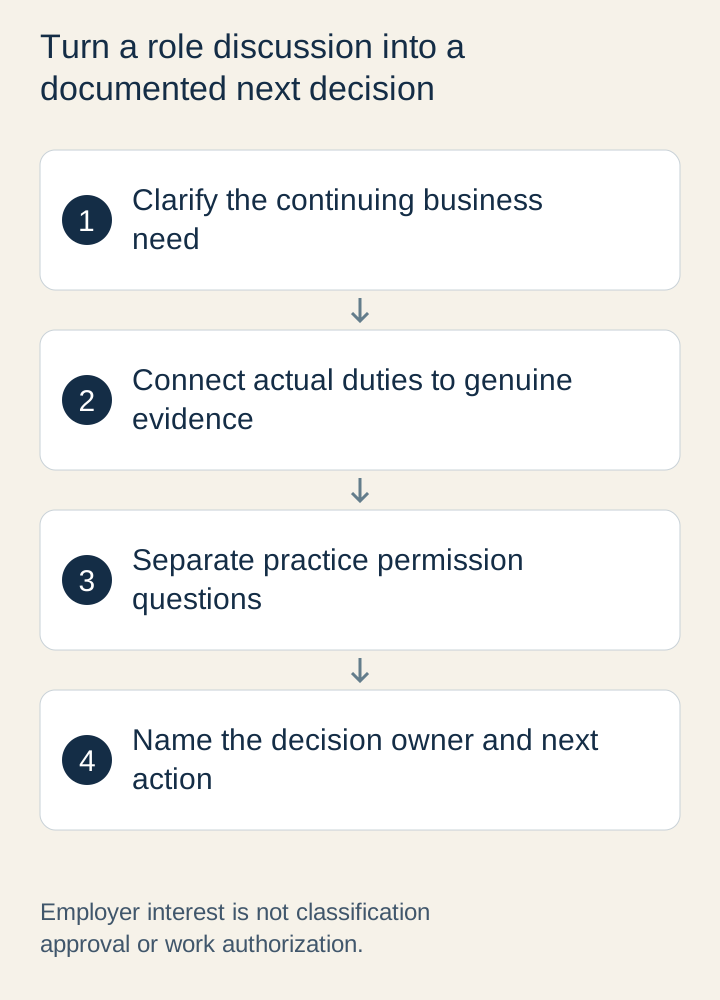
Open with the role: “From our discussion, this position supports the application after delivery and sits in the operations team. Is that an accurate description of the continuing need?” Give the manager room to correct you. Then explain the part of your background that matches it. A brief conversation about the real work is more productive than a long recital of immigration terminology before mutual interest is established.
Next ask about the decision process: “If the team believes I fit the role, who would assess whether the company can consider an employer-sponsored immigrant process? What information would they need from me?” This is a request for a process, not a demand that a recruiter give legal advice. Ask whether the company has authorised that assessment for this role; past sponsorship for another employee is not confirmation of your case.
Clarify timing without inventing a start date: “I do not currently have permission to take this U.S. role. Any start would depend on the appropriate work authorization and other conditions. Is the team exploring a longer-term appointment, or does it need someone already authorised to start?” State your own position accurately. Do not offer to travel as a visitor and begin work while the employer decides what to file.
Afterwards send a concise record through the agreed channel: the role discussed, evidence requested, decisions still open and the next owner. Do not turn “HR will look into it” into “company approved EB-3.” Where a technical lead and recruiter provide conflicting duties, ask for a corrected common description. For spoken practice and resume detail, use the separate interview guide and resume guide.
6. Manage changes before treating a start date as agreed
Keep an update trigger alongside every unresolved issue. A changed worksite, different employing entity, revised duties, new minimum qualifications or withdrawal of internal approval should prompt a fresh discussion with the responsible employer and appropriate professional adviser. Do not decide on your own that all changes are harmless, or that every change automatically ends a possible case. Record the actual change and ask for an assessment of its consequences.
The Department of State employment-based visa overview separates the employer petition from later immigrant visa processing and availability. Use that distinction in planning. A job offer, a completed technical interview and an immigration filing are different events. None should be described as immediate work permission. Do not resign, promise a fixed arrival or make irreversible family arrangements solely because a manager expressed interest.
Maintain a small handover bundle: the latest employer-confirmed role description, your evidence index, unresolved permission questions and the discussion brief. Share only what the verified recipient needs. If the employer requests further legal assessment, establish who is representing whom and what has actually been authorised. This article does not assess a particular foreign degree, professional licence, employer’s ability to proceed or an individual’s immigration eligibility.
For broader immigration context, see PremierVisa Group’s U.S. immigration overview. Bring employment questions back to the actual role, rather than treating a marketing programme name as a hiring decision. Submit your job-search background to discuss how to present relevant achievements and prepare for employer contact. No employer match, job, visa outcome or completion time is guaranteed.
7. Questions candidates often ask
Does an engineering degree automatically put me in EB-3 professional?
No. The actual degree, occupation and role requirements must be assessed under the applicable rules. Keep the official award record and field of study available. A technical job title or the fact that an employer likes your portfolio does not settle the classification.
Can I replace the degree with years of experience?
Do not assume experience substitutes for the qualifying degree in the professional classification. Present your real education and experience separately and seek an appropriate assessment of the actual role and category. The general qualification guide explains why job requirements matter.
Should I promise to stay with the employer forever?
No. Discuss a genuine continuing employee role and realistic intentions. Do not sign an unlimited promise or repayment condition without understanding its meaning and obtaining suitable review. A permanent role description should not be marketed as a lifetime employment guarantee.
Does every software engineer need a U.S. PE licence?
Do not infer that from the title. Identify actual duties, state and professional scope, then consult the relevant regulator where needed. The Washington example shows a separate licensing process; it does not determine every IT role or every state’s exemptions.
What if the employer needs someone immediately?
Explain your current work authorization accurately and ask whether a longer-term appointment remains realistic. If the role requires an authorised immediate starter and you cannot meet that condition, record the mismatch. An EB-3 discussion does not permit visitor-status employment or remove immigration waiting requirements.