
An EB-3 job-search resume should help a U.S. employer understand your actual work, qualifications and present work-right position. Translate unfamiliar duties into clear English, choose examples relevant to the vacancy and keep dates and claims consistent with genuine records. A stronger sentence cannot create a degree, employment period or immigration entitlement. This guide focuses on ordinary employer recruitment, with an original resume-to-record consistency sheet and teaching rewrites; it is not a government application template or a promise of sponsorship.
- 1. Read the job and separate the resume from immigration evidence
- 2. Use readable U.S. recruitment conventions without claiming a universal format
- 3. Rewrite the action and scope, not the person's history
- 4. Make work authorization and availability accurate
- 5. Use a resume-to-record consistency sheet
- 6. Request genuine support and check the exported application
- 7. Frequently asked questions
1. Read the job and separate the resume from immigration evidence
Start with a real vacancy and its actual duties and requirements. Use the employer research guide if the employer, worksite or applicant conditions are still unclear. Do not spend time building a persuasive profile for a supposed slot whose work has never been explained.
Create a private master history containing your employment names, dates, role changes, training and qualifications. From that history, select relevant material for a shorter resume. Keep the underlying records unchanged. A recruitment document can summarize experience without reproducing every certificate, but it must not contradict what actually happened.
The employment-based petition regulation sets out separate requirements for supporting qualifications and employer or trainer evidence. A resume is not a substitute for those materials. Do not treat a resume editor's approval as a legal review of classification or evidence sufficiency.
Check whether the role fits the actual background you can support. The EB-3 category comparison explains why a degree, training or experience requirement cannot be fixed simply by choosing a different English title. If you do not meet something, record a gap and ask about the genuine requirement; do not arrange a false letter to close it.
2. Use readable U.S. recruitment conventions without claiming a universal format
CareerOneStop's formatting guide, sponsored by the U.S. Department of Labor, discusses chronological, functional and combination formats. A readable layout and clear work history help a reviewer understand your background. Follow the employer's instructions instead of treating a template as a law applying to every industry.
For a straightforward application, use clear sections for contact details, relevant skills, work experience and education or training. A short summary can identify your main relevant contribution. Keep enough employment history to explain the background rather than hiding dates under an impressive skills list. Prioritize information useful to this vacancy.
Use a professional email, a telephone number with its country code and your real location. Do not invent a U.S. address or change your country to pass a filter. For an initial resume, think carefully about what contact detail is necessary and provide further information through verified channels when genuinely required. This privacy advice is not a statement that every employer form uses identical fields.
Portland Community College's resume checklist advises its student applicants to avoid unnecessary identifiers, photographs and personal details. Its checklist is recruitment guidance in context, not immigration law. For this general employer-search resume, leave out passport numbers, Social Security numbers, banking details and unrelated age, marital or family information. Regulated or specialized applications may have their own legitimate instructions.
3. Rewrite the action and scope, not the person's history
CareerOneStop's work-experience guidance recommends relevant duties, context and outcomes. Use that principle to explain what you actually did. An original teaching rewrite turns “Responsible for equipment” into “Checked scheduled service items, recorded observed faults and escalated repairs outside my authorization.” It shows action and limits without claiming that you independently performed all repairs.
Another original rewrite changes “Handled orders” into “Compared order details with dispatch records and referred missing information to the responsible colleague before release.” Use only tasks you performed. The sentence does not establish a particular occupation, savings figure or performance improvement. If your role was support work, say supported rather than led.
For numbers, check the period, unit and personal contribution. Do not turn a team result into an individual achievement or invent a percentage because resumes often contain metrics. Where reliable measurements are unavailable, explain the procedure, responsibility and observable outcome. An interview answer should withstand questions about how the result was measured.
Explain unfamiliar overseas employers and internal grades briefly. Keep the actual legal or trading name recognizable and distinguish a translation from a formal title. For a qualification, state the actual credential and institution. “Bachelor's-equivalent” is a conclusion requiring appropriate support, not a decorative phrase to make a diploma look more attractive. Relevant experience also should not be represented as a degree.
4. Make work authorization and availability accurate
A candidate outside the United States who lacks U.S. work authorization can use truthful wording such as: “Currently based outside the United States; appropriate work authorization would be required before starting.” This original sentence is an example, not a finding about every person's situation. Someone who already has authorization must check its actual scope instead of copying an offshore-applicant statement.
An online application may ask whether you are currently authorized, whether future sponsorship would be needed or when you can attend an interview. Read each question separately. Willingness to apply, a recruiter discussion or a pending employment process does not turn a future possibility into present authorization. Ask for clarification when the question does not fit your circumstances.
Keep interview availability, notice period, relocation willingness and lawful start date separate. You may be able to interview online now while further steps are needed before working in the United States. The Department of State visitor guidance lists employment as not permitted on a visitor visa; do not suggest that a tourist arrival can solve a start-date gap.
If you need support explaining your experience, submit your candidate background to discuss resume and interview preparation. Service scope, fee responsibility and the role of appropriately qualified professionals must be confirmed. A resume discussion does not establish an employer partnership, a job offer or immigration approval.
5. Use a resume-to-record consistency sheet
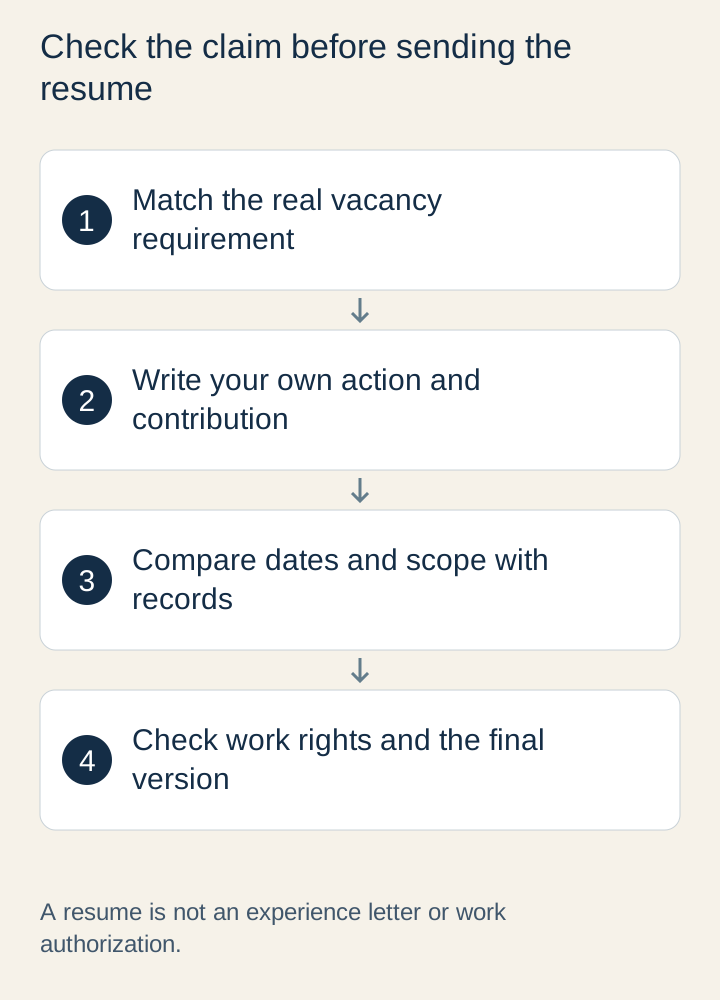
This original sheet checks whether a useful sentence remains anchored in real information. Keep sensitive supporting documents privately rather than attaching them indiscriminately to applications.
| Resume item | Record to compare | Risk to resolve | Acceptable editing direction |
|---|---|---|---|
| Employer and job title | Actual employment record and role history | A translation implies a higher position | Explain the original title and actual duties |
| Employment dates | Genuine start, end and role-change information | Rounded dates create false continuity | Use an accurate, consistent convention and keep exact history privately |
| Achievement statement | Your own contribution and available evidence | A team result becomes personal | Narrow scope and remove unsupported numbers |
| Degree or training | Official credential and course record | A certificate is labelled as a degree | State the credential accurately and flag assessment questions |
| Work-right statement | Your actual current circumstances | A hoped-for approval is stated as existing | Correct the resume and corresponding application answers |
Add the vacancy reference, final file name, evidence location, unresolved question and person to ask. For an original hypothetical row, a resume might say “maintenance supervisor” while the original record says “maintenance assistant”. The next action is to check the real responsibilities and explain the title accurately, not to request a newly invented supervisor letter.
Use an interview test: What did I personally do? Who assigned or checked it? During which period? What could the record-holder confirm? What cannot I disclose because of confidentiality? If a line fails that test, revise the claim before submission. Keeping a weaker but true statement is better than producing an impressive claim you cannot explain.
Do not assume that every difference proves dishonesty. Employer renaming, internal transfers, date conventions and translations can create understandable discrepancies. Preserve the original facts and explanation. Where the issue may affect legal evidence, ask the responsible professional how to handle it; do not silently rewrite the old document or delete an inconvenient period.
6. Request genuine support and check the exported application
The regulation describes letters from employers or trainers identifying the writer and the work or training. Ask someone with actual knowledge to check what they can confirm. A letter written in English is useful only if it remains accurate and the signer understands it. Do not ask a friend or former colleague to attest to employment that never existed.
If the usual evidence is unavailable, record what is missing and which genuine alternatives may be available. The regulation allows consideration of other documentation in relevant circumstances; that does not guarantee acceptance of any substitute or mean a resume alone will suffice. Do not overpromise what an editor can repair. Keep recruitment writing separate from an individual immigration-evidence assessment.
Save the exact resume and message submitted for each vacancy. Follow requested file types and inspect the export for cut-off lines, broken characters, empty pages and comments left in the file. Check that dates in online fields match the resume. Use simple headings and reading order, without hidden keyword blocks or claims that a certain design guarantees an applicant-tracking-system score.
Ask a reviewer to compare the final file with the vacancy and your consistency sheet. If the resume is tailored for a new employer, change relevant examples and order, not the employment facts. Broader immigration questions belong in a separate assessment; the PremierVisa Group U.S. overview provides route-comparison reading, with legal advice and representation handled by appropriately qualified professionals.
Before sending a second version to the same employer, check what changed. Keep a short revision note showing whether you corrected a date, clarified a translated title or made a contribution easier to understand. If an earlier submission contains a material error, seek an appropriate way to correct it rather than leaving two contradictory histories in circulation. A private revision log should identify the recipient and file version without collecting unnecessary personal information about interviewers or former colleagues.
7. Frequently asked questions
Is there one official EB-3 resume template?
This guide establishes none. A recruitment resume should follow genuine employer instructions and present accurate, relevant information. It is separate from government forms and the evidence required for an employment-based petition.
Can I change an overseas title so a U.S. employer understands it?
Explain unfamiliar terminology, but do not upgrade responsibility or qualifications. Keep the original identifiable and add a plain-language duty description. Check that the translation remains consistent with the supporting history.
Must every achievement contain a number?
No. Use reliable numbers only when you can explain the period, unit and contribution. Otherwise, describe the action and observable result without invented metrics. Clarity does not require false precision.
Should I attach all employment and identity records immediately?
No. Share necessary information with a verified recipient for a clear purpose. A first application generally needs a relevant resume, while supporting evidence is handled through the appropriate process. Do not expose unrelated personal or employer information.
Can a resume rewrite fix missing EB-3 qualifications?
It can make real experience understandable, but cannot create a degree, work period or permission to work. Identify the gap and obtain the relevant assessment instead of treating stronger wording as new evidence.
Choose one suitable vacancy, complete the consistency sheet and check a final resume version. If you need preparation support, submit your background to discuss honest experience writing, interview explanations and realistic employer-search directions under confirmed arrangements.
Prepared with AI assistance. General career information; no named professional review has been confirmed. AI cover illustration does not depict our staff, clients or partner employers.
Sources: CareerOneStop formatting and work experience; PCC Career Services checklist; current 8 CFR 204.5; Department of State visitor guidance. Source scope and URLs are in sources.json.