
When a U.S. employer asks about sponsorship, answer two separate questions accurately: whether you are currently authorised to do the proposed work, and whether you need employer support for a future immigration route. Then return to the skills and job conditions being assessed. This guide gives candidates original English answer frameworks, a six-field rehearsal sheet and a follow-up method. It concerns a hiring interview, not a consular visa interview, and no script can create work permission or guarantee employer sponsorship.
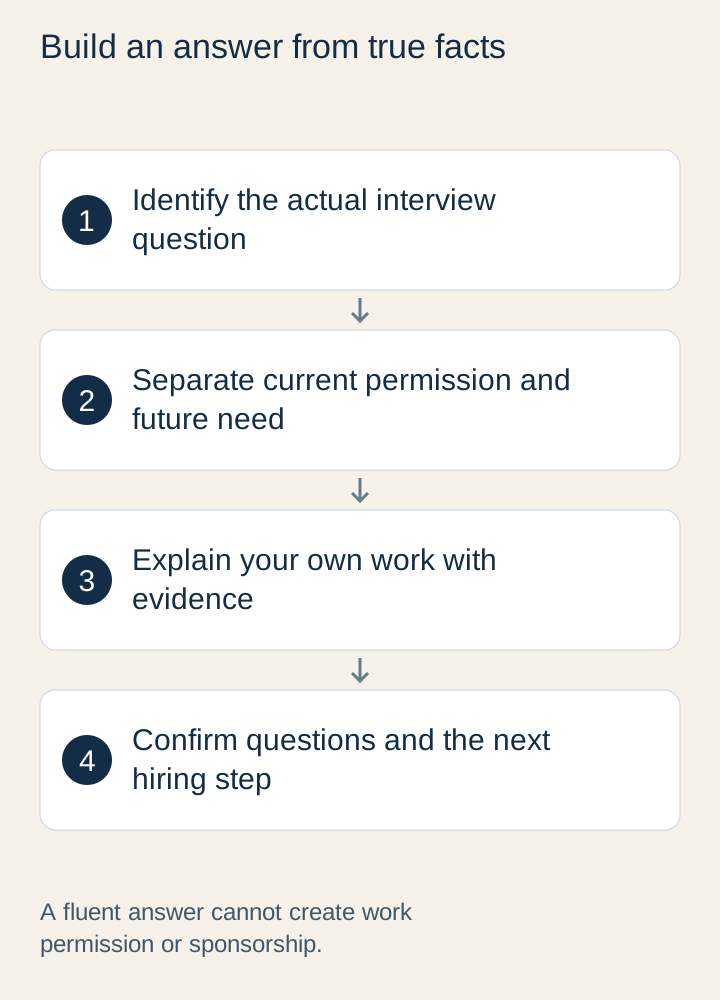
- 1. Find out what this interview is meant to decide
- 2. State current work permission and future sponsorship needs separately
- 3. Show job ability with a specific, truthful example
- 4. Use a six-field rehearsal sheet for difficult questions
- 5. Keep document verification and interview disclosure proportionate
- 6. Confirm the next hiring step without treating interest as sponsorship approval
- 7. Questions about sponsorship discussions in hiring interviews
1. Find out what this interview is meant to decide
Confirm the employer, role, interviewer and purpose of the meeting. A hiring manager may be assessing practical ability, while an HR contact may be clarifying availability and sponsorship needs. An introductory conversation with an agency is not necessarily the employer's selection interview. Ask who is attending and which job description the discussion will use.
Read the duties before writing an answer about immigration. Identify the tasks you can already perform, the evidence you can discuss and the items that need clarification. If you have overseas experience under a different job title, describe the actual work. A recognisable title alone does not prove that the tasks match the U.S. role.
CareerOneStop's interview preparation guidance, sponsored by the U.S. Department of Labor, recommends researching the employer, preparing real examples, practising responses and asking relevant questions. Apply that advice to the particular vacancy. Do not memorise a generic statement about wanting a green card and expect it to answer a question about safe work or customer service.
Keep hiring and visa interviews separate. An employer may ask how you handled a task or whether the proposed shift pattern suits you. A later consular interview has a different purpose and its own instructions. Online lists headed “EB-3 interview questions” sometimes mix the two; identify which discussion you are actually preparing for before using them.
2. State current work permission and future sponsorship needs separately
The Department of Justice IER FAQ says employers generally may ask whether applicants have the legal right to work in the United States and whether they will need sponsorship for an employment visa. These are not automatically forbidden questions. Answer the relevant question truthfully without turning it into a complete account of your family's immigration history.
For an overseas candidate without U.S. work permission, an original framework is: “I am currently based outside the United States and am not authorised to start this U.S. job now. I would need an appropriate employer-supported immigration route to be assessed. I can explain my experience and discuss the role while the relevant requirements are reviewed.” Use it only if those statements match your circumstances.
Someone with existing permission needs a different answer. State the actual position as verified for your case, including any relevant restriction, and distinguish it from future sponsorship. Do not copy another person's description of an unrestricted permission. If you are uncertain about whether the proposed employer or work is covered, say that the scope needs confirmation rather than selecting “yes” to avoid an awkward conversation.
If an application combines several questions in one checkbox, read the wording carefully. It may ask about current eligibility, future sponsorship or both. Ask the recruitment contact to clarify an ambiguous question before submitting an answer you know could be misunderstood. Keep a copy of your actual answer so the interview does not contradict the application.
3. Show job ability with a specific, truthful example
Prepare one example for each important duty. A useful original framework is: the situation, your own responsibility, the action you took and the result you can support. Separate your contribution from a team's total result. If you cannot verify a percentage or financial figure, explain the observable outcome without inventing a number.
For an invented stockroom example: “A delivery arrived with items in the wrong locations. I checked the receiving list against the labels, separated the items that needed review and asked my supervisor to confirm the corrections. I recorded the changes so the next shift could find the stock.” This illustrates a clear explanation of a task; it is not a real customer's story or evidence that every applicant has stockroom experience.
Adapt the framework to your own work. A service worker might explain how they clarified a customer's request; an administrator might describe reconciling a document discrepancy. Avoid using a technical example you cannot explain when the interviewer asks a follow-up. A shorter genuine answer is more useful than a polished story about work you never performed.
You can also identify the limit of your experience: “I have used this procedure in my previous role, but I have not operated that particular system. I would like to understand the training and supervision you provide.” This does not promise that a missing qualification will be waived. It gives the employer accurate information for assessing the actual requirement.
For resume wording that supports the same examples, see our EB-3 resume guide. Keep dates, duties and descriptions consistent across the resume and interview. If you spot an error, correct it clearly rather than preparing a second version of your history to defend it.
4. Use a six-field rehearsal sheet for difficult questions
Create six fields: exact question; job-related point being assessed; your true facts; concise answer in your own words; evidence or unresolved condition; and the follow-up question or action. Keep the sheet private and use record references instead of identity-document numbers. Its purpose is to organise a truthful conversation, not to coach an invented identity.
| Interview question | What to clarify | A useful response direction |
|---|---|---|
| Are you authorised to work here? | Current permission for this actual work | State the verified position and any uncertainty |
| Will you need sponsorship? | Future employer action being discussed | Explain the actual need without claiming approval |
| When could you start? | Work permission and practical notice commitments | Give conditions, not an unsupported arrival promise |
| Can you do this task or shift? | Real duties, skills and schedule | Give a genuine example and ask about the requirement |
| Can you send your documents? | Purpose, recipient and secure process | Confirm what is needed before sharing records |
An original answer to the start-date question is: “I can discuss notice and relocation arrangements, but I cannot confirm a U.S. working start until the relevant permission and job arrangements are verified. Could you explain how you plan conditional hiring timelines?” This lets the employer explain its process without presenting a requested date as a legal entitlement.
For a skills question, write the evidence before the sentence. If the evidence column is empty, either choose a different true example or state the limitation. Rehearse aloud and ask a friend to interrupt with a follow-up question. The test is whether you can explain the work naturally, not whether you can recite an impressive paragraph without pausing.
If you need individual help preparing these answers, submit your career background. HKJobHunt can discuss resume presentation, interview preparation and realistic employer-contact directions within an agreed service scope. Immigration and work-permission questions can be referred for separate case assessment.
5. Keep document verification and interview disclosure proportionate
The EEOC guidance on citizenship inquiries distinguishes pre-employment discussion from the employment-eligibility verification process. It says employees choose acceptable documents for Form I-9, and employers should not demand particular or extra documents based on citizenship status or national origin. The guidance also says the I-9 and E-Verify processes must not be conducted before an offer has been accepted.
This does not mean you should refuse every legitimate qualification request. An employer may need to understand whether your experience fits a job, and later immigration preparation may require specific personal records through the appropriate process. Ask what question the request is intended to answer, who will receive the information and how it should be submitted. Do not confuse a qualification check with a demand for a particular I-9 document.
A calm response could be: “Could you clarify whether this is for assessing the job qualification, immigration case preparation or employment verification? I can arrange the relevant information through the appropriate secure channel.” This is an original clarification script. It does not determine that a request is lawful or unlawful in an individual case.
Keep interview notes factual if something appears inappropriate. Record the actual words, context and date; do not infer discrimination solely from a question about future sponsorship. If you need advice about possible citizenship-status, national-origin or documentary discrimination, the DOJ IER and EEOC resources explain their roles. Their scope and individual protections require appropriate review rather than a blanket conclusion from a general article.
Do not post passports, immigration notices or complete employment records in a public interview group to ask whether they “look right.” A private rehearsal sheet can say which record supports an answer without containing its sensitive contents. Use the employer's verified contact and an appropriate channel for any necessary submission.
6. Confirm the next hiring step without treating interest as sponsorship approval
Ask job questions before closing the meeting: what the everyday duties are, how performance is assessed, what training is available and who will handle the next hiring communication. Add a separate sponsorship question when relevant: “Is the company considering an employer-supported route for this position, and who can explain the assessment and next steps?” A manager's interest is useful, but the answer needs confirmation from the proper contact.
The Department of State employment-based overview describes an employer's immigrant petition and later visa stages. A successful hiring interview does not replace those decisions. Do not promise immediate work, describe a job discussion as an approved visa or agree to an inaccurate statement to make the hiring process move faster.
An original follow-up note could say: “Thank you for discussing the role. My relevant experience is the work we discussed. I understand that the next hiring step is this action with this contact. My current work-permission position and future sponsorship need remain as explained. Please let me know if I have misunderstood the job or next step.” Send only facts that match the actual conversation; the template is not a message already sent by HKJobHunt.
After the meeting, update the rehearsal sheet with the actual question, your answer and any clarification still needed. If you gave an incorrect date or qualification description, correct it promptly through the appropriate contact. If the employer is not considering sponsorship, record that outcome and reassess the opportunity; do not assume an agency can override the employer's decision.
For the stages after an employer agrees to assess the route, use our employer-process guide. For practical help now, submit your background and interview questions. Describe your own experience, the role and the question you find difficult. Support can then focus on an accurate answer and realistic next steps.
Broader immigration background is available through PremierVisa Group’s U.S. information; individual advice and services require a separately confirmed scope.
7. Questions about sponsorship discussions in hiring interviews
Is it illegal for an employer to ask if I need sponsorship?
Not automatically. DOJ guidance says employers generally may ask about the legal right to work and sponsorship needs. Other citizenship, discrimination and document-verification issues have their own rules. Consider the actual question and context rather than assuming every sponsorship question is prohibited.
Should I say I do not need sponsorship to get an interview?
No. An answer that contradicts your actual needs can create a misleading application and an unusable hiring plan. Explain current permission and future needs separately. If the wording is unclear, ask the recruitment contact what it means before answering.
Can I promise to arrive and work while EB-3 processing continues?
Do not promise a working start without a valid basis covering the work. The interview and immigration process do not themselves provide that basis. Any existing permission and the proposed job need their actual conditions checked separately.
Should I memorise fluent answers even if I cannot explain them?
Practise clear answers in language you understand. Use genuine examples, ask for clarification when needed and be ready for follow-up questions. A script should help you explain your ability, not conceal that you did not perform the work.
Is the employer interview the same as the visa interview?
No. The hiring discussion assesses a job and potential employment relationship. A later consular interview concerns visa eligibility and follows official case instructions. Prepare for the actual meeting instead of combining two different question lists.