
Budget overseas hiring in separate lines for recruitment services, the actual immigration process, government charges and lawful onboarding. For an EB-3 proposal, a package price does not establish who may pay each expense, which work is included or when payment becomes due. This guide gives US employers a six-field cost-responsibility ledger and a clearly hypothetical subtotal example. Unquoted items remain pending, and neither a payment nor a completed budget creates a job guarantee, work authorization or immigration approval.
- 1. Define what the company is buying before comparing prices
- 2. Divide recruitment, case work and onboarding into distinct lines
- 3. Check payment responsibility before allocating a cost
- 4. Use a six-field cost-responsibility ledger
- 5. Label the subtotal and leave unknown amounts outside it
- 6. Tie approval and changes to actual events
- 7. Employer questions before approving a hiring budget
1. Define what the company is buying before comparing prices
Start with the genuine role, the employing entity and the support actually needed. Talent search, resume screening, interview coordination, immigration representation and relocation administration are different tasks. One provider may coordinate several, but the quote should identify who delivers each task, the responsible contracting entity and the limits of the engagement. A single description such as “international recruitment package” is insufficient for an informed comparison.
Ask for the deliverable, not just the service label. Does screening mean checking applications against agreed job criteria, conducting interviews, or verifying credentials? Does interview coordination include scheduling only, or a written summary? Avoid assuming a service includes employer financial review or government filing because it mentions sponsorship. Any professional representation needs its own confirmed scope and responsible person.
The DOL's permanent-labor-certification overview places responsibility for that application on the employer and distinguishes certification from later immigration authorization. A recruitment purchase does not transfer the employer's underlying responsibility to an unnamed intermediary. DOL permanent labor certification
For an internal approval note, write what the company needs, what the supplier will deliver, what is excluded and what remains to be assessed. Do not convert an invitation to discuss candidates into a claim that a provider has a confirmed employer network or a guaranteed supply of workers. This article uses no actual supplier price or HKJobHunt fee schedule.
2. Divide recruitment, case work and onboarding into distinct lines
Recruitment costs can include the agreed search service and the company's own interview or administrative time. Case-related costs may concern the applicable labor-certification process, professional representation and later immigration steps. Onboarding can involve orientation materials, equipment and supervisor time. Record only items relevant to the actual arrangement; a checklist is not evidence that every expense must occur.
Keep wages and recurring employment costs separate from one-time preparation. Also distinguish an operational vacancy-cover budget from spending on the overseas case. Otherwise, a company may underestimate the cost of maintaining its current service while a future start remains uncertain. Do not treat a speculative arrival date as the point at which interim costs automatically stop.
| Budget group | Ask what is included | Common scope problem |
|---|---|---|
| Search and interviews | Criteria, deliverables and coordination responsibility | Screening described without an agreed job brief |
| Applicable case work | Stage, professional role and employer obligations | Recruitment mistaken for legal representation |
| Government charges | Agency, category, unit and current basis | One visa charge presented as the full process price |
| Arrival and induction | Actual agreed support and conditions | Travel or equipment promised before start conditions are clear |
| Recurring employment | Relevant payroll and ongoing support | Salary confused with one-time recruitment expenditure |
| Interim cover and changes | Lawful cover and events requiring review | A delayed case assumed to have no operational cost |
Use the same scope when comparing quotes. A lower headline figure that excludes an important stage may not describe the same purchase. Equally, a higher quote is not evidence of better legal work or a more likely approval. Request a line-by-line explanation rather than ranking providers by the size of a bundle.
3. Check payment responsibility before allocating a cost
For a PERM-related arrangement, 20 CFR 656.12 says labor certifications are not commodities for sale. It restricts an employer seeking or receiving payment connected with obtaining certification, including prohibited reimbursement and wage concessions. A candidate's consent or a different invoice label does not remove those restrictions. 20 CFR 656.12
The rule distinguishes an applicant's own representation costs and addresses situations where the same attorney represents employer and applicant, as well as a specific business-relationship exception. Do not simplify this into either “the worker can pay everything” or “every immigration expense has the same payer.” Have the actual activity, representation and payment relationship reviewed before agreeing the allocation.
An original review question is: “This line is described as administration. What work does it cover, who benefits, who is represented, and what supports charging this party?” If it actually reimburses a prohibited employer expense, renaming it does not solve the issue. Ask the qualified reviewing team to record the conclusion and any limitation against the specific line.
Do not reduce the offered wage or arrange free work as an informal way to recover a prohibited cost. Nor should the budgeting team copy a supplier's proposed repayment clause without review. Keep lawful responsibility, the supplier's commercial quote and the company's internal cost centre as separate facts; accounting allocation does not determine who may legally bear the expense.
If you need to clarify the recruitment support required, submit your employer brief to HKJobHunt to discuss talent search, screening and interview arrangements. Confirm the engagement and any referral for immigration assessment; this is not a quotation or a claim of a particular professional licence.
4. Use a six-field cost-responsibility ledger
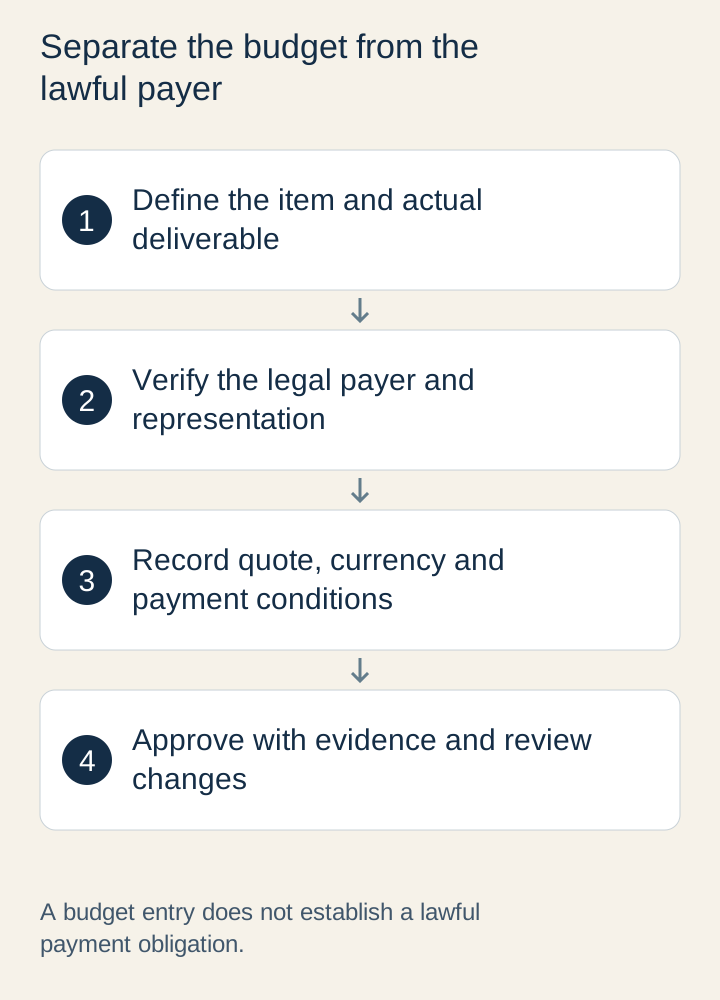
The following original ledger is a preparation tool, not an official fee calculator or an instruction to make a payment. Create one row per cost and keep the underlying quote or official evidence in an appropriately controlled location. A blank amount means not obtained, not zero.
| Ledger field | What to record |
|---|---|
| Item and deliverable | Actual activity, process stage and included output |
| Provider and recipient | Contracting entity, service recipient and representation scope |
| Responsibility basis | Proposed payer, applicable review and unresolved questions |
| Amount and evidence | Currency, quantity, quote or official source, date and exclusions |
| Due event and conditions | What triggers payment, prerequisites and relevant refund terms |
| Owner and change review | Approver, evidence location and event requiring a fresh check |
A quote may be obtained while payer responsibility remains unresolved. Keep both states visible. Conversely, knowing the employer must bear a particular cost does not tell you the supplier's price. Do not mark a row approved until the appropriate financial and responsibility decisions have actually been made.
A useful comparison exercise is to place two anonymized quotes against the same ledger fields. Identify whether they cover the same work, whether government charges are included or estimated separately, and what happens if the role or candidate changes. Do not circulate another client's confidential invoice as a supposed market benchmark.
If an amount is in US dollars, keep that original unit. For a Hong Kong reporting budget, a converted amount should show the chosen exchange-rate date and method as an internal assumption. Do not imply that a rounded converted figure is a supplier's binding quote. Different taxes, bank charges or contingencies also need their own stated basis where applicable.
5. Label the subtotal and leave unknown amounts outside it
Purely hypothetical internal example, not a market price, salary, government fee or HKJobHunt quote: assume an administrative preparation block of USD320 and orientation materials of USD180. Their subtotal is USD500. That arithmetic says nothing about recruitment fees, legal work, government charges, wages or travel; those are expressly outside this teaching subtotal.
If the case-work quote has not been obtained, show “pending quote” next to that line. Do not enter zero and present USD500 as the complete hiring cost. A decision-maker should be able to see both the confirmed or assumed subtotal and the open items that could materially change the project. Keep hypothetical values out of the actual purchasing approval column.
Government fees are also stage-specific. At the 26 October 2026 check, DOS lists employment-based immigrant-visa application processing at USD345 per person and identifies that processing fee as non-refundable. This is a consular-processing item, not the I-140 filing fee or a complete EB-3 price. Recheck the applicable official fee before payment. DOS visa-services fees
For other filing charges, ask the case team for the applicable form, current official basis, date and any employer- or case-specific conditions. This draft gives no unverified USCIS fee amount. Do not use an old university's internal service table, a different visa category or a provider's promotional total as the current government schedule for your company.
6. Tie approval and changes to actual events
Before approving a payment, verify the agreed recipient, task, stage and contractual conditions through the appropriate company process. An invoice is not proof that the corresponding work was completed or that an immigration application was approved. Record whether the company is authorizing an assessment, accepting a deliverable or paying a government charge; those are different decisions.
Ask what happens if the role is revised, the employer changes its plan, an application needs further work or the candidate no longer proceeds. The answer should identify actual terms and responsibility for any additional work. Do not promise a refund that is not in the agreement, and do not assume every fee is refundable merely because the desired outcome did not occur.
An original request to a provider could say: “Please separate search and interview work from any case-related professional service and government charges. For each item, identify the deliverable, payer basis, currency, exclusions, due event and change terms. Please mark estimates and items still requiring assessment.” Adapt it to the real procurement need rather than treating it as a completed contract.
USCIS's EB-3 overview describes a job- and qualification-based immigrant process. A payment or package does not replace that process or authorize a start. USCIS EB-3 overview
For role and financial readiness, see the EB-3 employer hiring guide. For recruitment evidence, use the PERM records comparison. For uncertain starts and interim cover, see workforce planning. Immigration details can be assessed through PremierVisa Group's US immigration overview, with the responsible professional and engagement confirmed.
7. Employer questions before approving a hiring budget
Is there one standard total for an EB-3 overseas hire?
This guide provides no universal total. The genuine role, applicable process, agreed services, individual circumstances and onboarding arrangements differ. Compare a defined scope and dated evidence, and keep unquoted items visible. A confident package price is not proof that it covers everything or that the payment arrangement is lawful.
Can the employee reimburse our PERM expenditure?
Do not assume so. The cited rule restricts payments related to obtaining certification, including prohibited reimbursement and wage concessions. Have the actual expense, representation and any claimed exception reviewed. A worker's signature or a renamed invoice does not establish that the proposed allocation is permitted.
Does the hypothetical USD500 subtotal show a realistic market budget?
No. It demonstrates arithmetic and the treatment of exclusions using invented internal assumptions. It is not a salary, service quote or government schedule. Your real ledger needs actual evidence and a clear distinction between assumptions, confirmed amounts and unresolved lines.
Can we put missing fees at zero until the quote arrives?
Use “pending” instead. Zero means an actual amount of nothing and can make an incomplete budget appear approved. Show any subtotal with its scope and exclusions, then ask the responsible person to obtain the missing evidence. Revisit the decision when a material amount or condition changes.
What should we bring to an initial recruitment discussion?
Bring the actual job brief, employing entity, support sought, existing quotations with sensitive details redacted and the specific scope or responsibility questions. Do not submit confidential financial returns or personal candidate records in a public enquiry. Agree a suitable channel for any later professional evidence review.
Submit your recruitment requirements to discuss search, screening and interview arrangements with HKJobHunt. Use the ledger to define the next decision without promising a fixed total, a ready-made sponsorship place, an arrival date or immigration approval.