
PERM recruitment is not ordinary hiring with an extra advertisement. For an applicable standard PERM case, the employer must follow the required process, genuinely consider US workers and preserve evidence supporting the application. A recruiter finding an overseas candidate does not complete those responsibilities. This guide helps US employers coordinate HR, their usual hiring representative and qualified advisers through a six-field evidence handover, while keeping recruitment records separate from promises about immigration approval or a start date.
- 1. Confirm which recruitment process the role actually needs
- 2. Compare the purpose, decision and evidence
- 3. Give the right person responsibility for applicant decisions
- 4. Build a six-field evidence handover while work happens
- 5. Preserve the report and underlying evidence with the correct clock
- 6. Collaborate with advisers without outsourcing the facts
- 7. Employer questions about PERM recruitment records
1. Confirm which recruitment process the role actually needs
Begin with the employing entity, duties, location and genuine minimum requirements. Ask the qualified case team which process applies before instructing anyone to publish an advertisement. Standard PERM recruitment is not a universal checklist for every employment-based immigrant case. USCIS distinguishes the usual labor-certification route from applicable Schedule A arrangements; a familiar job title alone does not settle the branch. USCIS EB-3 overview
The DOL explains that the employer is responsible for the labor-certification application and describes the assessment concerning available qualified US workers and effects on wages and conditions. Certification and subsequent immigration authorization are separate. Use this distinction when explaining the project to a hiring manager who mainly wants a vacant shift covered. DOL permanent labor certification
Record the agreed role version before outreach. A candidate profile, an approved internal vacancy and the job described in the case may otherwise drift apart without anyone noticing. If a manager changes the location or adds a qualification, send that change for review. Do not keep an obsolete description in the case file merely because the new advertisement looks similar.
A useful first question is: “Which parts of our existing recruitment workflow can support the applicable process, which need different evidence, and who will confirm the plan before publication?” That gets a more actionable answer than asking whether the company's usual recruitment website is generally acceptable. This article does not provide a do-it-yourself filing calendar or determine a role's legal classification.
2. Compare the purpose, decision and evidence
Ordinary hiring also involves legal duties and fair decision-making. The distinction is not that everyday recruitment can be undocumented or discriminatory. The practical difference is that an applicable PERM case has specific labor-certification attestations, recruitment requirements and evidence that cannot be replaced by a company's preferred way to source candidates.
| Question | Ordinary hiring workflow | Applicable standard PERM workflow |
|---|---|---|
| Main operational task | Find and assess people for a genuine vacancy | Conduct the required labor-market process and support the application |
| Channels and timing | Selected for the business, subject to applicable rules | Planned against the applicable regulatory steps and case facts |
| Candidate assessment | Job-related, lawful selection decisions | Genuine US-worker consideration and documented lawful job-related reasons |
| Records | Follow applicable employment and company requirements | Preserve the application and supporting evidence under the PERM rule |
| External help | May support search, screening and interviews | Must fit the rules on representation, assessment and employer responsibility |
| Outcome | May produce a hiring decision | Does not itself establish immigration approval or permission to work |
Use the table to identify questions for the case team, not to declare one process completed because the other produced a suitable candidate. A search report listing overseas applicants does not answer whether the required US recruitment was performed. Likewise, an advertising invoice is not evidence of how US applicants were considered.
The applicable recruitment provisions address methods, content and timing, including distinctions between professional and nonprofessional occupations. Avoid compressing them into a claim that any online posting for a chosen number of days is enough. Have the team approve a role-specific plan and retain the reason for its chosen steps. 20 CFR 656.17
3. Give the right person responsibility for applicant decisions
Identify the employer representative who normally interviews or considers applicants for comparable jobs. The PERM rules address that representative and restrict involvement by the beneficiary and certain agents or attorneys in considering US workers. Do not assume a person can make these decisions simply because they coordinate the foreign candidate's documents. Confirm the arrangement with qualified advisers before allocating access or tasks. 20 CFR 656.10(b)
The employer should understand the requirements it is asking reviewers to apply. A preference for a more polished interview style is not automatically a lawful reason to reject a minimally qualified US worker in a PERM assessment. The rules also address skills that can be acquired during a reasonable period of on-the-job training. Escalate an uncertain case rather than inventing a rejection category to protect a preferred outcome. 20 CFR 656.17(g)–(i)
An original operational example: HR receives an application showing closely related work but with an unfamiliar overseas job title. The reviewer should record what evidence was considered and the actual unresolved qualification question, then use the agreed review process. “Not our preferred candidate” does not explain a lawful job-related conclusion. Do not rewrite notes later to make an already chosen decision appear inevitable.
HKJobHunt can discuss an actual employer brief for talent search, screening and interview arrangements. Confirm the agreed scope and responsible people. Do not assume a search engagement automatically includes PERM legal representation, assessment of US workers or government filing; those responsibilities must be established separately.
4. Build a six-field evidence handover while work happens
The following original tool connects a recruitment activity with its evidence, decision and owner. It is not a replacement for the required recruitment report or an official form. Keep one entry per relevant activity or unresolved issue, with a reference to the controlled role version.
| Handover field | What belongs there |
|---|---|
| Activity and role version | Required step, agreed description and relevant workplace |
| Publication or activity evidence | Actual content, dates and appropriate proof of the activity |
| Applicant consideration record | Where the authorized reviewer keeps the relevant assessment |
| Gap or change | Missing evidence, inconsistent detail or a changed instruction |
| Owner and secure location | Responsible function, authorized access and file reference |
| Review and retrieval status | What needs qualified review, who can retrieve it, and the next action |
Do not use the blank tool to invent completed activities. A planned advertisement remains planned until evidence of the actual placement is available. If the version published differs from the approved text, preserve both and flag the difference. Quietly replacing the old file with a clean final copy can hide the issue that the reviewer most needs to understand.
For a hypothetical example, an invoice confirms payment for an advertisement but does not identify the text that ran. The handover should say that publication-content evidence is missing, name the person obtaining it and link the available invoice. It should not mark the step complete because money was paid. Another entry might record a location change requiring review before further activity.
Keep personal applicant information in appropriate restricted records. The shared coordination sheet can point to a secure location without reproducing every resume or private communication. The benefit is continuity: if the HR contact is absent, the company can still locate evidence and questions without asking the foreign beneficiary to reconstruct the hiring process.
5. Preserve the report and underlying evidence with the correct clock
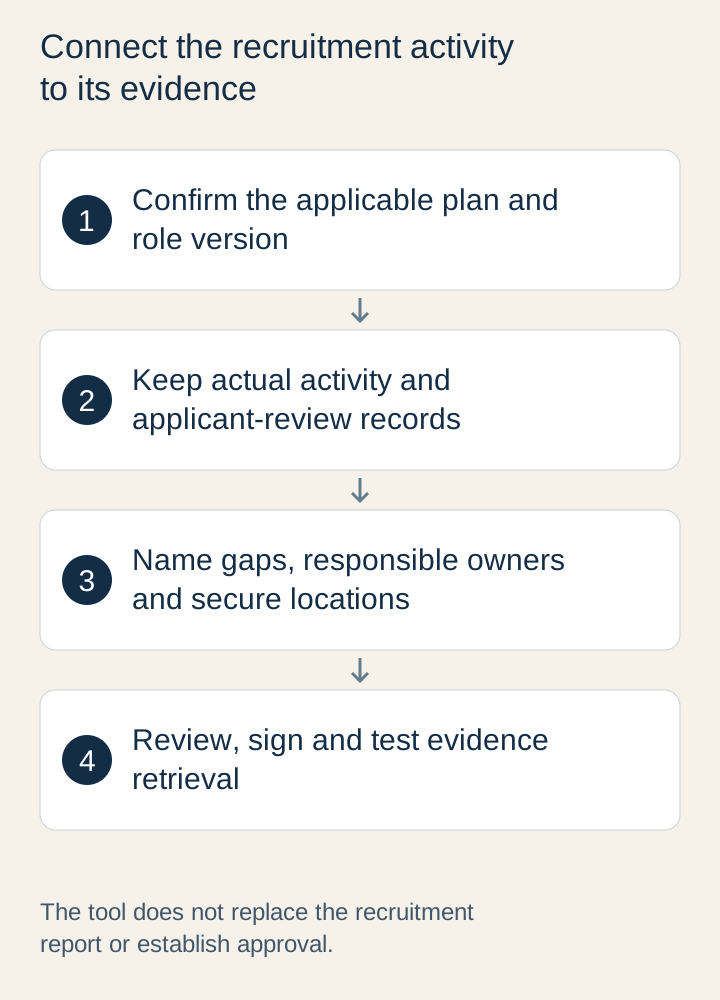
The recruitment-report rule addresses a signed report describing steps and results, including relevant hiring outcomes and lawful job-related rejection reasons. A neat summary must remain consistent with the underlying records. Do not treat the report as a marketing statement saying the company prefers international talent. 20 CFR 656.17(g)
Under 20 CFR 656.10(f), the employer must retain copies of the DOL-filed application and all supporting documentation for five years from the filing date. That clock is not the date the first advertisement ran, the date the candidate signed a service agreement or the date a manager closed the vacancy in an internal system. Other applicable preservation requirements or case circumstances may also need review. 20 CFR 656.10(f)
Assign a record custodian, record the filing date from the actual case evidence and document access arrangements. A colleague's personal inbox is a weak sole repository if they leave the company. Ask the case team which materials must be retained and how revisions, responses and supporting records should be organized. Do not set an automatic deletion date from this article alone.
Perform a practical retrieval check before relying on the archive. Can an authorized replacement find the role version, actual activity evidence, applicant-review location and signed report? Can they identify what is missing? The check is useful even when no audit has been requested. This guide makes no claim about the probability of an audit, a universal response deadline or the likelihood of approval.
6. Collaborate with advisers without outsourcing the facts
Give the advisers the employer's actual facts and uncertainties. Ask for a written division of responsibilities: who confirms the applicable branch and recruitment plan, who conducts the appropriate employer assessment, who keeps records and who decides how a change affects the case. “The agency is handling it” is insufficient if nobody can identify the task, authority and evidence.
The employer remains responsible for accurate representations made on its behalf under the applicable rule. Do not ask an adviser to create missing historical interviews or backdate a document. If a record is absent, preserve the remaining evidence and ask how the gap should be addressed lawfully. An honest unresolved issue is more useful than a polished archive describing events that did not occur.
Separate a status meeting from an approval meeting. HR may report that requested documents were supplied; that does not mean the reviewer accepted their sufficiency or that an application was filed. Use explicit stages such as “provided for review,” “clarification requested” and “filing evidence received.” Those are coordination labels, not government classifications or a promise of an outcome.
For the earlier decision about role and financial readiness, see the EB-3 employer hiring guide. For staffing uncertainty, use the EB-3 workforce-planning guide. Detailed immigration assessment can be discussed through PremierVisa Group's US immigration overview; verify the professional and engagement scope rather than assuming credentials from this article.
7. Employer questions about PERM recruitment records
Can our usual online job advertisement satisfy PERM by itself?
Do not assume so. The applicable methods, content, dates, notice and other requirements depend on the case. Provide the existing advertisement to the qualified team and ask what it can support. A successful everyday recruitment channel does not automatically replace a required step in the applicable PERM plan.
Does receiving a US application mean the case has failed?
No such conclusion follows from receipt alone. The application must be appropriately considered under the applicable requirements. Record the assessment and seek guidance on uncertain qualifications; do not dismiss an applicant to preserve a chosen immigration outcome, or label every incoming resume a qualified available worker without review.
Can the overseas beneficiary organize the rejection reasons?
Do not put the beneficiary in charge of considering US workers or creating the employer's assessment. The governing restrictions and the employer's appropriate representative matter. The beneficiary may be asked for their own credentials through the proper process, but that is different from deciding how competing applications should be evaluated.
When does the five-year document-retention period start?
The cited PERM rule counts from filing the application with DOL. Use the actual filing evidence and retain the application copy and supporting documents. Coordinate any additional preservation requirements with the case team; do not calculate destruction dates from an advertisement date or a service contract.
What should we take to the first coordination meeting?
Bring the genuine role description, existing recruitment workflow, proposed owners and an honest list of available or missing records. Ask for a role-specific plan and secure handover method. Avoid sending applicant files or sensitive business records through a public enquiry message before an appropriate review arrangement is established.
Submit your recruitment requirements to discuss talent search, screening and interview arrangements with HKJobHunt. Use the handover fields to identify the actual support needed, while keeping PERM responsibilities, professional review and immigration approval separate.