
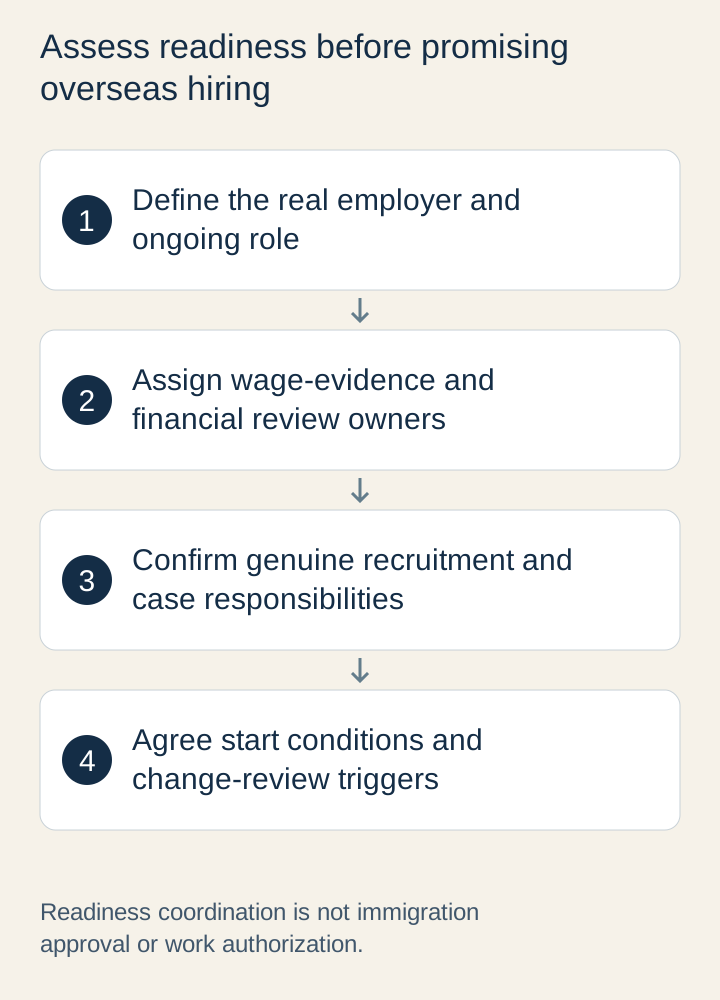
A US employer considering EB-3 hiring should first confirm a genuine permanent, full-time role, realistic wage support and people who can own recruitment and case preparation. An overseas candidate's interest does not establish those conditions, and EB-3 should not be sold internally as an immediate staffing fix. This guide provides a six-field employer readiness brief for operations, HR, finance and qualified advisers to review before making recruitment promises or commitments about arrival.
- 1. Define the business role before choosing a candidate
- 2. Separate a wage budget from evidence of ability to pay
- 3. Put ordinary hiring and PERM responsibilities in the right hands
- 4. Use the six-field employer readiness brief
- 5. Agree wage, cost and timing responsibilities before outreach
- 6. Screen candidates against the role and keep changes visible
- 7. Questions before an employer commits
1. Define the business role before choosing a candidate
Start with the work the company needs to be done. Name the employing legal entity, intended workplace, reporting line, regular duties and reason for the ongoing headcount. An attractive applicant may prompt a useful discussion, but the description should reflect the employer's actual need rather than being designed backwards from that person's resume. Separate the department's urgent staffing problem from its longer-term hiring plan.
USCIS's EB-3 overview describes the category's worker groups and the requirement for a permanent, full-time offer from a US employer. It also distinguishes the usual labor-certification process from applicable Schedule A arrangements. Do not assume every role or candidate follows the same branch. USCIS EB-3 overview
“Permanent” is not a promise that employment can never end. The practical question for planning is whether the company has a genuine ongoing position, not a seasonal gap dressed up as a permanent vacancy. If the underlying need depends on a possible future contract, disclose that uncertainty to the reviewing team. A proposal, a funded role and a confirmed immigration outcome are different states.
Prepare a factual role note before promoting opportunities. Explain duties in ordinary language, show where the work sits in the operation and identify which minimum requirements are genuine. Avoid a combined title that obscures unrelated duties simply to match a preferred candidate. If the team cannot explain who will supervise the role or where it will be performed, resolve that gap before expanding outreach.
2. Separate a wage budget from evidence of ability to pay
Ask finance to identify both the proposed wage and the evidence supporting the petitioning employer's ability to pay it. A hiring manager's approved budget is an important internal decision, but it is not itself the immigration evidence analysis. Nor is a parent group's headline turnover automatically the financial position of the particular employer filing the case.
USCIS's current Policy Manual explains the continuing ability-to-pay requirement from the priority date until the beneficiary becomes a permanent resident, with specific issues requiring their own analysis. Initial evidence generally includes annual reports, federal tax returns or audited financial statements; the regulation includes a financial-officer-statement provision for qualifying larger employers. Submitting a document is not the same as proving the requirement. USCIS ability-to-pay policy, 8 CFR 204.5(g)(2)
For the internal brief, record who holds the relevant company records, which periods are available and who will coordinate qualified review. Do not ask an overseas applicant to obtain the employer's confidential financial files from individual employees. Arrange access through authorized company channels with an agreed purpose and appropriate protection. The hiring team can receive a status and remaining questions without receiving every underlying return.
If several petitions are involved, ask whether the reviewer has considered the relevant combined obligations. Do not multiply one attractive account balance across an unlimited number of candidates. A bank balance on one date does not show all liabilities or the whole relevant period. This guide supplies no pass/fail calculator or substitute accounting opinion; the useful output is a clear evidence owner and a documented unresolved issue.
3. Put ordinary hiring and PERM responsibilities in the right hands
The DOL permanent-labor-certification overview makes the employer responsible for the application and describes the assessment concerning available qualified US workers and effects on wages and conditions. DOL certification and later immigration authorization are separate stages. DOL permanent labor certification
For a standard PERM case, qualified guidance should establish the applicable recruitment, notice and documentation plan. The current rules address actual minimum requirements and a signed recruitment report recording results and lawful job-related rejection reasons. They also address who may interview or consider US workers. An ordinary international talent search is not a substitute for that process. 20 CFR 656.17, 20 CFR 656.10
Do not tell staff to collect resumes merely to prove a preferred overseas applicant must be hired. Recruitment must be genuine, with appropriate consideration of US applicants and lawful reasons for decisions. Do not let a beneficiary or an outside candidate coach become the decision-maker for that assessment. Identify the employer's usual hiring representative and confirm the arrangement with qualified advisers.
Operationally, keep a single role version, a controlled record of decisions and a responsible contact for questions. If duties, location, minimum requirements or the employing entity change, tell the advisers before continuing to use old materials. Do not quietly correct a posted description while leaving the case record unchanged. The appropriate next step may be a reassessment, not another promotional campaign.
If your team needs help turning a vague staffing request into a usable search brief, submit the recruitment requirement to HKJobHunt. Talent search, screening and interview arrangements can be discussed against the actual engagement; immigration representation and approval are separate matters.
4. Use the six-field employer readiness brief
Bring operations, HR and finance together around one short document. The table below is an original coordination tool, not an official form or a finding that the company is eligible. A named owner should be a real person designated by your company, not a fabricated adviser identity in a marketing draft.
| Readiness field | Evidence or question to bring | Responsible function |
|---|---|---|
| Employer and ongoing role | Legal entity, workplace, duties and business need | Operations with HR |
| Genuine minimum requirements | Existing role evidence and any uncertainty | Hiring manager with qualified review |
| Wage and financial evidence | Proposed terms, records available, review gaps | Finance with qualified advisers |
| Recruitment and case plan | Applicable branch, responsibilities and records | HR and qualified advisers |
| Candidate and interview scope | Job evidence, screening criteria, permission questions | Authorized recruitment team |
| Start conditions and review trigger | Dependencies, interim staffing, changes requiring review | Business owner and HR |
Write “not yet reviewed” where appropriate. Do not mark a field green merely because someone promised to obtain records later. The brief should help the company decide whether to commission further assessment, revise a role or stop an unsuitable proposal. It should not generate a “sponsor approved” badge or appear in public advertising as evidence of government clearance.
An original hypothetical example: a distribution company wants an ongoing coordinator, but its initial brief mixes warehouse duties with an unrelated technical function. Operations must first clarify the real role. Finance has current management figures but has not assembled the relevant regulatory evidence. HR has an interested overseas candidate but no agreed process. The next step is coordinated assessment, not announcing an approved start date.
The example uses no market wage or predicted processing duration. For your own planning, label assumptions separately from official determinations and confirmed company facts. Keep the exact documents and sensitive figures in restricted company records. Share only the necessary recruitment information with the search team, and use separate, authorized channels for professional case review.
5. Agree wage, cost and timing responsibilities before outreach
A recruitment budget, a prevailing-wage determination and an ability-to-pay analysis answer different questions. The DOL rules address the offered wage and prevailing-wage determination for the relevant job. Do not choose an advertised salary simply because a candidate says they will accept it or because a generic online average looks affordable. 20 CFR 656.10, 20 CFR 656.40
Review who must bear each process cost with appropriate advice. Under 20 CFR 656.12, permanent labor certifications are not items for sale, and employers must not seek or receive prohibited payments connected with obtaining certification, including prohibited reimbursements and wage concessions. An applicant's willingness to pay does not remove the rule. Costs relating to an applicant's own representation and the rule's specific exceptions must be distinguished; this is not a claim that every immigration expense has the same payer. 20 CFR 656.12
For operations, create a separate interim staffing plan based on lawful options actually available to the company. Keep critical shifts, service commitments and supervision covered without assuming the overseas candidate can arrive on demand. An offer, a filed petition or an interested recruiter does not alone authorize work. Avoid asking the candidate to travel as a visitor and begin work while the company finishes paperwork.
Use conditional language when communicating with candidates: the company is assessing a role and process; any employment start depends on the relevant approvals, lawful work authorization and agreed hiring conditions. Do not frame uncertainty as a guaranteed wait followed by guaranteed entry. This article quotes no processing-time estimate, government fee amount or arrival commitment.
6. Screen candidates against the role and keep changes visible
Once the role is usable and the assessment scope is clear, create interview questions tied to actual duties. Ask for a work example, what the candidate personally did, how they handled an exception and what evidence can support the account. Do not promise that a polished resume can compensate for unmet job or regulatory requirements. Check regulated-occupation issues separately where relevant.
Keep the recruitment team informed about the level of commitment. “Exploratory conversation,” “professional assessment commissioned” and “company decision to proceed subject to conditions” should not be used interchangeably. If a manager changes a verbal statement, update the written candidate communication. A candidate should not have to infer the employer's current position from an older agency message.
Use an original interview prompt such as: “Describe how you recorded an operational exception, who had authority to resolve it, and what you did when information was missing.” The answer helps explore job evidence. It is not a government assessment or a request for confidential documents from the candidate's former employer. Ask for an appropriately redacted explanation where necessary.
For the candidate-facing preparation side, see the EB-3 interview guide. For route discussions, see EB-3 versus H-1B employer questions. Immigration details can be assessed through PremierVisa Group's US immigration overview, with the responsible professional and engagement scope confirmed. This article does not establish any HKJobHunt licence or representation credential.
7. Questions before an employer commits
Can a small business consider EB-3 hiring?
Company size alone is not a readiness finding. The real job, applicable requirements, evidence and employer obligations need assessment. A small company should identify which records it can provide and who will review them. Do not assume either that small employers are automatically excluded or that a registration certificate alone makes sponsorship viable.
Does a large bank balance establish ability to pay?
Not on its own. The issue concerns the actual petitioning employer, relevant period and evidence as a whole. A balance can include money already committed elsewhere. Ask the qualified reviewing team what the records support and what is missing; do not advertise a financial conclusion based on one screenshot.
Can the overseas worker manage the US recruitment for us?
Do not assign that task without checking the governing restrictions. PERM rules address who can interview and consider US workers, as well as actual minimum requirements and recruitment records. The beneficiary's involvement cannot replace the employer's appropriate hiring responsibilities. Confirm the responsible representative before commencing the applicable steps.
Can we charge a worker for a guaranteed sponsorship place?
Do not sell a labor certification or use reimbursement arrangements to evade prohibited-payment rules. Obtain a cost allocation review covering the actual services and representation involved. No contract can guarantee a government result, and a worker's payment does not create a genuine role, eligibility or work authorization.
What should the first employer enquiry contain?
Provide the type of business, employing entity, workplace, genuine duties, headcount need, proposed terms and your internal contact functions. Indicate which decisions and records are still pending. Do not place confidential financial statements or personal candidate files in a public enquiry message; agree a suitable process for any later evidence review.
Submit your recruitment requirements to discuss talent search, screening and interview arrangements with HKJobHunt. Start with the readiness brief so the next conversation can identify a practical scope and outstanding decisions, without promising an employer-sponsored job, arrival date or immigration approval.