
Before asking an employer for EB-3 or H-1B support, clarify the actual job, its qualification requirements and the company’s hiring needs. H-1B specialty-occupation employment and EB-3 employment-based immigration address different questions; neither name proves a vacancy or immediate work permission. Prepare a role-to-route enquiry brief so the employer and appropriate adviser can assess the facts. Compare what needs to be verified, rather than choosing a route from a promised start date or a generic sponsorship advertisement.
- 1. Ask what job the employer intends to fill
- 2. Understand the different immigration purposes
- 3. Connect qualifications to the job without mixing rules
- 4. Separate LCA, labor certification and start conditions
- 5. Prepare the six-field role-to-route enquiry brief
- 6. Use the brief in an employer conversation
- 7. Questions before choosing a hiring discussion
1. Ask what job the employer intends to fill
Begin with duties, reporting relationships, location, expected availability and genuine minimum qualifications. Ask who is authorised to discuss employment and who assesses immigration participation. A recruiter may know the technical requirements but lack authority to approve a sponsorship assessment. “We have sponsored before” is useful background, not confirmation that this job or candidate has been accepted for a particular process.
Explain your current location and work-permission position accurately. An employer needing an already authorised immediate starter is making a different recruiting decision from one willing to investigate a longer-term appointment. Do not promise to begin work while the company works out the legal basis. If timing cannot be reconciled, record the mismatch rather than selecting whichever immigration label sounds faster.
Keep the role separate from the candidate’s preferred programme. A person with a postgraduate degree may be interested in a job whose actual duties do not require specialised degree-level knowledge. Conversely, a technical title alone does not establish that a role meets a particular classification. Ask for the real requirement and the evidence supporting your experience before paying for assessments or rewriting a resume around an advertisement.
2. Understand the different immigration purposes
USCIS describes H-1B as a nonimmigrant classification, with specific criteria for specialty-occupation work. The H-1B column here concerns that employment context. A temporary immigration classification does not mean every underlying job must be a short fixed project. The actual employment terms and the permitted immigration stay are related but separate matters to clarify.
EB-3 is an employment-based immigrant category covering skilled workers, professionals and other workers under different requirements. A genuine permanent, full-time offer and the applicable process matter. The category name is not a promise that every low-qualification role is suitable, that every applicant qualifies, or that permanent residence is granted when the employer first agrees to consider a case.
H-1B support is not a prerequisite built into every EB-3 case, and it does not automatically turn into an EB-3 approval. An employer’s willingness to assess one process does not commit it to a later immigrant process. If both are being discussed, ask for separate employment, procedural and responsibility decisions. Do not call an unassessed sequence a complete career-to-residence plan.
| Employer discussion | H-1B specialty-occupation context | EB-3 context |
|---|---|---|
| Core purpose | Nonimmigrant employment classification | Employment-based immigrant classification |
| Role question | Does the actual position meet specialty-occupation criteria? | Does the genuine role fit the relevant EB-3 subgroup and requirements? |
| Candidate question | Do the actual qualifications meet the applicable requirements? | Does the evidence meet the selected subgroup and job requirements? |
| Employer process | Applicable LCA, petition and other requirements | Applicable labor certification or special procedure, petition and later steps |
| Timing question | Applicable cap or exemption, current procedure and permission conditions | Employer readiness, government stages and visa availability |
| What an offer alone proves | Employment interest or stated terms, not immigration approval | Employment interest or stated terms, not permanent residence |
3. Connect qualifications to the job without mixing rules
For H-1B specialty occupations, the current 8 CFR 214.2(h)(4) and USCIS guidance connect the role to a directly related specific specialty degree or its equivalent, alongside other criteria. The role’s requirements and the individual’s qualifying evidence are separate parts of the assessment. Do not simplify this into “any bachelor’s degree plus any office job.”
EB-3 professional degree requirements should not be replaced with an H-1B equivalency shortcut. Skilled-worker and other-worker requirements also need their own assessment against the actual role. Present your real degree award, field, employment chronology and task evidence without assuming that an evaluation prepared for one classification settles another. A course certificate or a senior-sounding title is not a universal substitute for the required evidence.
Consider an invented teaching example: an employer needs someone to analyse and develop a specific technical system, and a candidate has related study and practical evidence. The next step is assessment of the real duties and qualifications, not declaring either route approved. In another hypothetical situation, the candidate has an advanced degree but the proposed work is routine general support. Their education alone does not establish that the support role is a specialty occupation.
Ask the employer to confirm the job as it genuinely exists. Do not request a new degree requirement just to fit your records or remove a requirement you cannot meet. Where professional practice permission is relevant, identify the regulator and actual work scope separately. For evidence preparation, use the qualification guide and engineering and IT discussion brief.
4. Separate LCA, labor certification and start conditions
The Department of Labor’s H-1B programme page describes the Labor Condition Application, including the employer’s attestations. In the specialty-occupation process, an LCA is distinct from the H-1B petition and from an EB-3 permanent labor certification process. Similar-looking labour terminology does not make the documents interchangeable. Ask which document exists, what it concerns and who is responsible for the next action.
H-1B cap-related procedures and exemptions require a case-specific check under current rules. EB-3 has its own petition, visa-availability and later processing questions. Do not describe all H-1B employers as subject to the same registration situation, or compare that situation with EB-3 as if both were a single queue. Keep the actual employer, classification and current procedural position attached to any timing discussion.
The Department of State employment-based overview separates petition approval from later visa stages and availability. Its temporary-worker guidance likewise describes petition and visa steps where relevant. An interview, employer assessment or petition notice should not become a guaranteed visa, admission or work-authorised start. Current location and status can change which steps need assessment.
Fees, registration arrangements and entry-related measures can change, including through official updates and litigation. Before an employer commits to an actual filing or quotation, its responsible adviser should check the current applicable instructions and their dates. This comparison does not quote a universal package cost, selection method or completion time. An old PDF or an undated screenshot cannot establish the terms that apply to a new case.
5. Prepare the six-field role-to-route enquiry brief
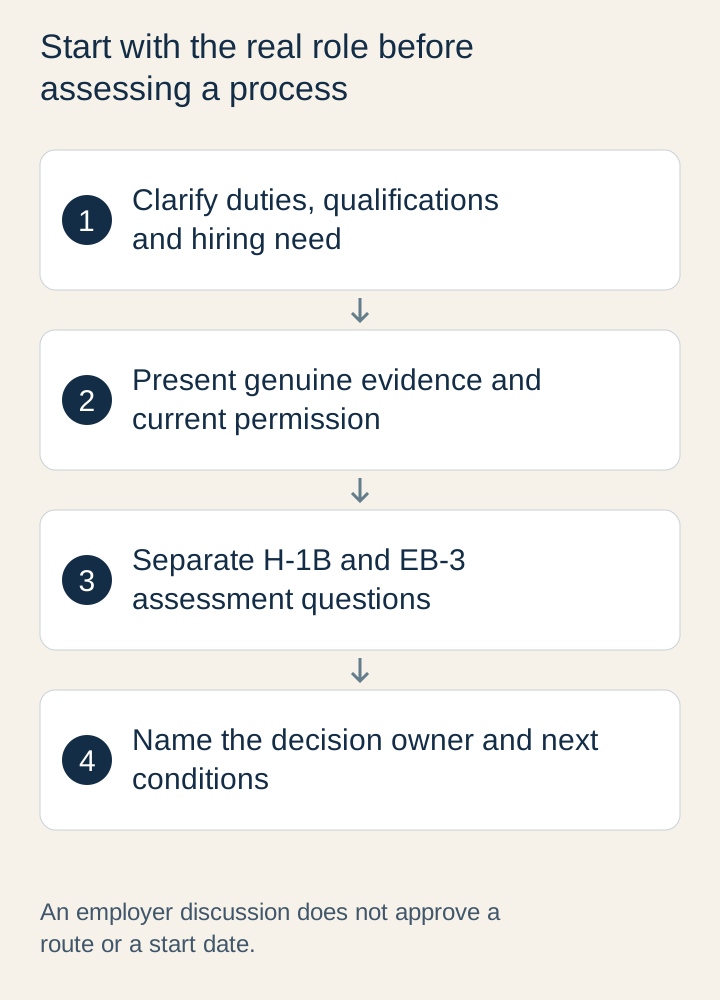
Create one brief for the real opportunity and date each version. Keep a fact separate from a proposal and from an unresolved legal question. The purpose is to obtain a concrete next decision from the employer, not to self-certify a visa category. Mark missing information “not confirmed”; do not select a route to hide the absence of a genuine role or authorised contact.
| Field | Information to preserve |
|---|---|
| Real role and need | Duties, team, worksite, minimum qualifications and employer’s intended employment |
| Candidate evidence | Actual degree, field, task evidence and missing records |
| Current work position | Location and verified basis, scope and limits of any permission |
| Processes being assessed | H-1B and/or EB-3 discussion, each with its own eligibility questions |
| Employer decision owner | Who can approve further assessment and provide accurate role information |
| Next action and conditions | Requested records, responsible person, update trigger and conditions before work |
The role-to-route worksheet keeps the comparison focused on the hiring facts. If you need help presenting achievements or preparing the first conversation, submit your background to HKJobHunt. Resume and interview support, employer-contact directions and immigration representation have different scopes; agree what is actually being provided and any appropriate referral.
For example, an employer may be willing to review a candidate for specialty-occupation employment while having made no decision about an immigrant case. Record that limited outcome. The next question is who, if anyone, may consider a longer-term immigrant process, rather than telling the candidate that permanent residence is already included. A candid partial answer is more useful than an unsupported complete plan.
6. Use the brief in an employer conversation
Start with capability: “These are the duties I understand the team needs, and this is the evidence of my relevant work. Are those the actual requirements?” Allow the employer to correct your understanding. Then give your truthful availability and work-permission position. Keeping those facts clear helps the company decide whether it can continue the discussion without making a promise it has not assessed.
Ask a process question: “If there is a role match, who assesses whether the company can support an appropriate employment or immigrant process? Which route is actually under consideration, and what information is needed?” This asks for an authorised assessment rather than requiring a technical manager to choose immigration law. Avoid insisting that a programme you read about must fit the company’s need.
Afterwards, record whether the company declined, agreed to assess a particular possibility, requested documents or made another specific decision. Keep H-1B and EB-3 outcomes separate. “We accept overseas resumes,” “HR will investigate” and “an application was approved” describe different events. If the role, location or employer’s intention changes, update the brief and ask whether the earlier assessment still applies.
For immigration background see PremierVisa Group’s U.S. overview. Submit your job-search background to discuss resume, interview and realistic employer-contact preparation. No vacancy, employer participation, immigration route, work permission or start date is guaranteed by the comparison. Keep the record so your next decision follows verified information about the actual opportunity.
7. Questions before choosing a hiring discussion
Must I obtain H-1B before an employer can consider EB-3?
Do not treat H-1B as a universal required preliminary step. EB-3 has its own eligibility and process. Ask how the genuine role and your current circumstances would be assessed; one possible temporary-work arrangement is not automatically a condition of every immigrant case.
Does H-1B sponsorship include a future green card?
Not automatically. Record any immigrant-process discussion separately, including who is authorised to assess it and what the employer has actually agreed. A temporary employment petition does not itself approve EB-3 or commit the company to every later service.
Is a degree enough to make any role H-1B eligible?
No. The actual specialty-occupation requirements and the candidate’s qualifications both matter. A person’s degree cannot change the genuine nature of unrelated duties. Provide the real records and obtain the appropriate assessment rather than rewriting the role to match a preferred category.
Are LCA and PERM the same document?
No. They belong to different labour and immigration processes. Confirm which actual document is being discussed and what stage it supports. An LCA should not be described as an approved EB-3 labor certification, immigrant petition or permission to begin work.
Which route guarantees the earliest start?
Neither can be selected on a universal promise. Employer readiness, eligibility, applicable procedures and permission conditions differ. Identify the actual next decision and missing evidence instead of treating another person’s timeline or a quoted filing date as your authorised start.