
Plan EB-3 hiring as a conditional, long-term staffing project, not a guaranteed arrival date. US employers need separate plans for today's lawful staffing, the candidate's verified case stage and eventual onboarding. Visa availability, case decisions and admission can affect the sequence. This guide uses a six-field contingency board to assign owners, communication triggers and practical alternatives, without treating a filing, interview or visa-bulletin movement as permission to start work or a promise that an employee will stay.
- 1. Separate operational demand from a candidate's case
- 2. Read visa availability as a condition, not a countdown
- 3. Maintain a contingency board with six clear fields
- 4. Build interim cover without quietly starting the overseas job
- 5. Communicate changes before expectations become promises
- 6. Prepare fair onboarding and retention around the real job
- 7. Employer questions about delayed EB-3 starts
1. Separate operational demand from a candidate's case
Describe the work the business must cover independently of any particular immigration forecast. List the tasks, supervision, service commitments and consequences of leaving them uncovered. Then distinguish the ongoing position being considered for the candidate from the immediate gap on the rota. If next week's operations depend entirely on an uncertain overseas arrival, the staffing plan is incomplete even if the underlying role is genuine.
USCIS describes EB-3 as an immigrant category with job, qualification and petition requirements, including a permanent, full-time job offer. An interested candidate or a manager's preferred timetable does not complete that process. Confirm the applicable branch with qualified advisers rather than treating every overseas hire as an identical case. USCIS EB-3 overview
Maintain a concise internal need statement: what work continues, who owns it now, which proposed position is being assessed and what facts could change the need. Do not advertise an approved start date merely because a recruitment agency supplied a candidate profile. Keep the business case and the immigration status evidence in separate records that can be compared when a decision is needed.
For a hypothetical distribution business, the ongoing coordination role may be genuine while today's delivery exceptions still need an authorized local team to handle them. The company should allocate that work lawfully and realistically. This is a planning example, not a real vacancy or a statement that any particular interim hiring route is available to your business.
2. Read visa availability as a condition, not a countdown
The State Department's Visa Bulletin separates Final Action Dates from Dates for Filing and uses category and chargeability information. Date movement is not a personal arrival forecast. The applicable row and column must be checked for the individual case, and future movement should not be extrapolated as a fixed number of months remaining. DOS Visa Bulletin index
At this article's check on 25 October 2026, the official index lists October 2026 as current and November 2026 as upcoming. November's publication does not make it the applicable October bulletin. Keep the month in the planning record so a downloaded chart is not reused silently after its period. This article deliberately does not reproduce cutoff dates as a staffing promise. October bulletin, November bulletin
The October bulletin explains that dates can retrogress and a category may become unavailable when applicable limits are reached. The relevant USCIS chart choice also matters for an adjustment-of-status filing; it is not interchangeable with an overseas consular case. Ask the responsible professional what a new publication means for the actual next step, rather than telling operations that a chart change approves work. USCIS filing-chart guidance
Keep the candidate's nationality, residence and chargeability questions distinct. Do not choose a column solely from the country where the resume was submitted. Where those facts are uncertain, leave the planning condition unresolved and seek appropriate assessment. The business needs a reliable dependency statement, not a guessed immigration classification in its staffing spreadsheet.
3. Maintain a contingency board with six clear fields
Use one board per proposed role or staffing need. Store sensitive case documents separately; the operations board should carry the minimum verified status needed for decisions. The following original tool is not a government application, a processing-time estimator or a retention contract.
| Board field | Useful entry |
|---|---|
| Need and current coverage | Continuing duties, current authorized cover and business owner |
| Verified stage | Source, date and precise scope of the case update |
| Unresolved dependency | Decision, availability, document or condition still outstanding |
| Lawful alternative | Feasible cover action, responsible manager and review condition |
| Communication trigger | Who updates whom, on what event and through which channel |
| Onboarding decision | Conditions for preparation, confirmed start and later review |
Do not use the same word “approved” for an internal budget, petition decision, visa issuance and admission. State exactly what the evidence establishes. If the case team says documents are ready to review, the board must not say they were filed. If an interview is scheduled, do not record the candidate as cleared for travel or work.
An example entry might say: “Ongoing coordinator role; current team covers exception logging; professional update received but next-stage timing unconfirmed; operations manager reviews cover when the next documented milestone occurs.” It contains no invented government deadline. The employer can choose a sensible internal review cadence, but that cadence is a management decision, not an official processing estimate.
Use the board at operational meetings to ask one concrete question: “What action can we take based on what is verified today?” That may be maintaining interim cover, preparing public orientation information or obtaining clarification. It should not become pressure on a candidate to produce an approval date that they cannot control.
4. Build interim cover without quietly starting the overseas job
Identify lawful staffing options actually available to the company, and have the relevant employment conditions checked. Do not assume another visa category is available simply because EB-3 timing is uncertain. A workable alternative must fit the actual worker, role and permission conditions. Keep supervision and workload realistic for existing staff rather than treating indefinite overtime as a complete plan.
USCIS explains that work authorization depends on the person's classification and conditions. A recruitment offer, a pending process or a signed service agreement does not by itself create permission for the proposed employment. Do not instruct someone to enter as a visitor and begin shifts while paperwork is completed. USCIS working overview
Distinguish recruitment communication from productive work. Sharing public information about the company or asking about availability is different from assigning live customer accounts, dispatch tasks or unpaid trial shifts. If a proposed activity could amount to work, obtain appropriate advice about authorization and employment obligations before proceeding. Calling it “preboarding” does not settle its legal nature.
HKJobHunt can discuss the actual scope of talent search, screening and interview arrangements. Explain which need is immediate and which is longer term. Immigration and work-permission questions can be referred for individual assessment; a recruitment discussion does not establish an alternative visa or a guaranteed supply of candidates.
5. Communicate changes before expectations become promises
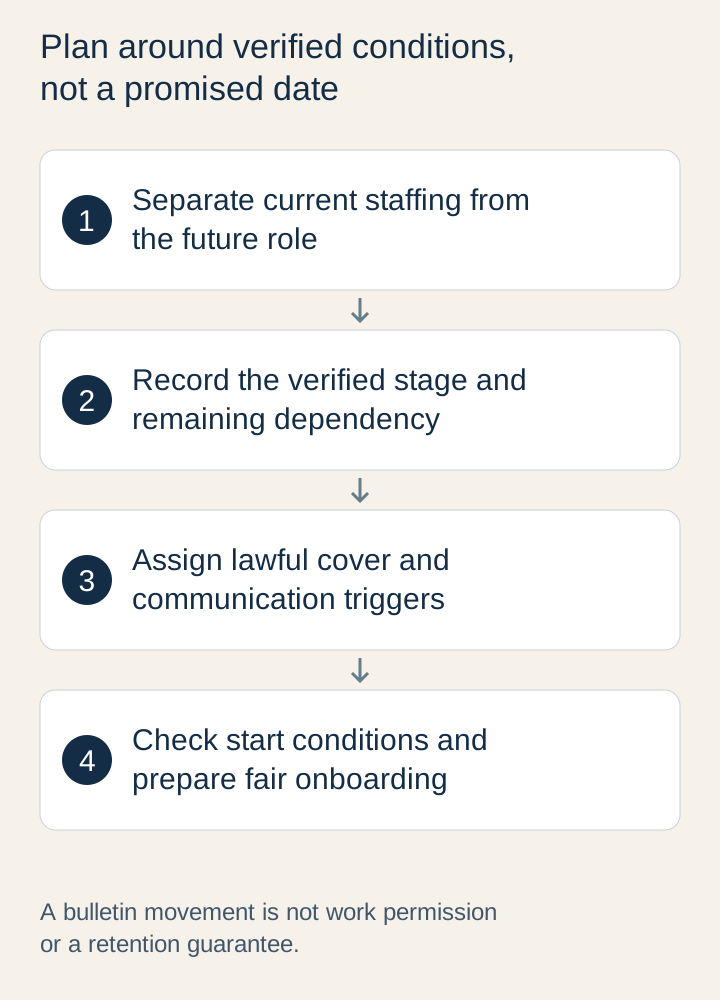
Assign one company contact for candidate updates and one person to obtain verified case information. Agree which events trigger a review: a formal decision, a request for further evidence, a change in the role or workplace, a new applicable bulletin, or the candidate reporting a material change. These are management triggers; they do not replace professional instructions or official deadlines.
An original update could read: “We remain in discussion about the coordinator position. The latest confirmed update is the stage stated in the case team's communication. The next condition remains outstanding, so we cannot confirm a start date. Our HR contact will update you when that condition changes, or at the next agreed check-in. Please tell us if your availability changes.” Replace the generic stage with an accurate, limited description.
Do not repeat a target date in every message until it begins to sound approved. Record whether a date is an internal scenario, a candidate preference or a confirmed arrangement supported by the necessary conditions. When a manager changes the plan, update any recruiters communicating on the company's behalf. A candidate should not hear one promise from operations and another from HR.
Avoid unnecessary circulation of personal immigration files. The operations manager may need to know that a start condition remains unresolved, not every family document or government identifier. Confirm the lawful, appropriate disclosure channel with the responsible people. A clear status summary can support decisions without turning the workforce board into an unrestricted case archive.
6. Prepare fair onboarding and retention around the real job
Use uncertain waiting time to improve the employer-controlled parts of the role: accurate duties, supervision, accessible orientation information, an induction plan and a realistic way for the employee to raise questions. These are practical preparation steps, not a claim that preparation authorizes work. Reconfirm the current role and terms with the case team when material facts change.
For an overseas consular case, DOS advises against irreversible arrangements such as resigning or booking non-refundable travel before receiving the immigrant visa. Its guidance also distinguishes visa issuance from admission. Align the company's communication with those conditions instead of pressuring the candidate to move early to satisfy an internal rota. DOS after-interview guidance
Retention begins with a job the employee understands. Before lawful commencement, clarify the reporting manager, actual location, agreed terms and induction contact through the appropriate process. After commencement, review whether duties and support match what was explained. Invite specific feedback about instructions, supervision and practical barriers. Do not invent a promised retention rate or assume immigration sponsorship guarantees loyalty.
Do not create an arbitrary minimum-service period, passport-retention arrangement or punitive repayment demand as a shortcut to retention. Any proposed contractual term or cost arrangement needs appropriate review against applicable law and facts. Focus the workforce plan on fair management and a genuine role, with a separate continuity plan if circumstances change, rather than advertising workers as permanently tied to the business.
For initial readiness, see the EB-3 employer hiring guide. For the required recruitment evidence, see the PERM recruitment comparison. The candidate timeline guide explains the individual perspective. Immigration details can be assessed through PremierVisa Group's US immigration overview, with the engagement and responsible professional confirmed.
7. Employer questions about delayed EB-3 starts
Can we calculate an arrival date from the latest bulletin?
No reliable personal start date follows from a chart alone. The correct category, chargeability, applicable month and remaining case steps matter. Keep the bulletin as one dated dependency and ask what it changes for the specific case. Do not convert recent movement into a guaranteed month-by-month forecast.
Does petition approval let the person start shifts?
Do not treat a petition decision alone as permission for the proposed employment. Check the actual work-authorization basis and relevant conditions. An overseas case may still require later steps, and a person already in the US has their own situation. The staffing board should record the limited decision rather than expanding its meaning.
Should we ask the candidate to resign to show commitment?
Do not use resignation or irreversible travel as a loyalty test while conditions remain uncertain. The DOS guidance addresses such commitments before immigrant-visa receipt. The company can discuss availability honestly and keep contact without presenting a preferred start date as an approved outcome.
Can pre-arrival tasks solve the current staffing gap?
Do not assume that calling tasks remote, voluntary or preparatory makes them permissible. Productive work, payment and location can raise authorization and employment questions requiring assessment. Keep the interim plan based on lawful available staff, and obtain appropriate advice before assigning work to the overseas candidate.
How can an employer improve retention without guarantees?
Set accurate expectations, provide clear supervision and induction, and ask about concrete workplace difficulties after lawful commencement. Keep a continuity plan in case circumstances change. No source in this guide establishes a guaranteed service period or retention rate, and no such result is promised by a consultation.
Submit your recruitment requirements to discuss talent search and interview arrangements with HKJobHunt. Bring the contingency board, the immediate staffing need and the longer-term role, so the next discussion can address practical support without guaranteeing arrival, continued employment or immigration approval.