
If US employers are not replying, audit the evidence before rewriting every resume. A missing reply does not identify the cause: the role may not match, the application may be incomplete, sponsorship may not be available, or the hiring decision may still be pending. This guide helps overseas applicants separate those questions using a six-field application audit. Answer work-authorization questions accurately; an EB-3 discussion or employer interest does not itself give permission to work.
- 1. Start with the application, not a theory about rejection
- 2. Separate job fit from current and future work permission
- 3. Test whether the resume proves the required work
- 4. Use the six-field unanswered-application audit
- 5. Make one controlled improvement and follow up clearly
- 6. Keep an EB-3 discussion separate from an ordinary application
- 7. Questions applicants ask after repeated silence
1. Start with the application, not a theory about rejection
Open the exact posting you applied to and locate your submission receipt. Record the role reference, employer, location, submission date and resume version. Save the wording that applied at submission if you lawfully retained a copy. A vacancy that has since changed is not reliable evidence of what the original application asked. If the posting is unavailable, write “original wording not retained” rather than reconstructing it from memory.
Then distinguish three outcomes. “Submitted” means you completed the process; “received” means the system or employer acknowledged it; “under consideration” requires a corresponding employer statement. None means an interview is promised. A blank inbox is an observation, not a rejection reason. Check the portal and your own spam folder without creating duplicate accounts or repeatedly resubmitting the same role.
Do not infer that a particular applicant tracking system automatically rejected you because a response arrived quickly. Nor does a long wait prove a human has read the resume. Unless the employer provides a reason, record the reason as unknown. That discipline saves time: you can repair a missing attachment immediately, while an unexplained hiring decision remains outside your control.
Keep the audit narrowly relevant. It needs the job and application evidence, not passport scans, full immigration files or private messages from unrelated applications. Use a private record for detailed facts and a redacted summary when requesting feedback. You are trying to locate the next useful question, not build a dossier to circulate widely.
2. Separate job fit from current and future work permission
Read the posting for duties, minimum qualifications, location, schedule and any express sponsorship statement. “Remote” does not by itself mean work can be performed from any country. A US role with a required on-site location may be unsuitable for an applicant who cannot relocate lawfully on the employer's timetable. Ask about the actual arrangement instead of assuming that an online interview solves the location issue.
USCIS explains that permission to work depends on the applicable immigration classification and its conditions. Distinguish current authorization for the proposed employment from whether an employer process may be needed now or later. Do not answer “no sponsorship needed” merely to pass a screening question when that would be untrue. Conversely, do not assume every noncitizen necessarily requires a new employer-sponsored process. Check the facts of your own situation. USCIS working overview
The Department of Justice's IER FAQ says employers generally may ask about the legal right to work and a need for employment visa sponsorship. It also addresses limits on discriminatory practices and employment-verification document demands. A screening question is not a reason to upload every identity document unsolicited. Read the precise question, answer accurately, and seek qualified advice when your position is uncertain. DOJ IER FAQ
If an employer explicitly says it cannot support the process you need, record that statement as a practical mismatch for this vacancy. Do not convert it into a finding that your resume is poor, or a general legal judgment about all applicants. If you believe a stated restriction is unlawful, retain the wording and consider the IER information; this article cannot determine an individual discrimination claim.
3. Test whether the resume proves the required work
Choose a small set of genuinely relevant applications and compare each posting with the submitted resume. The set is for your own review, not a statistically representative hiring study. Highlight a required task, find the passage demonstrating it, and identify the underlying evidence. “Experienced administrator” says little if the role involves reconciling records and coordinating exceptions. A reviewer should be able to see what you actually handled.
CareerOneStop, sponsored by the US Department of Labor, recommends relating work experience and accomplishments to the target job, using relevant posting terminology and concrete context. Apply that principle to truthful evidence; do not copy its sample resumes or invent numerical improvements. CareerOneStop work experience guide
Original teaching example: “Helped with deliveries” could become “Maintained the delivery exception log, checked missing reference numbers with dispatch, and passed unresolved cases to the shift lead.” Use that wording only if it describes your actual work. If you did not measure a reduction in delays, do not append an impressive percentage. A verified process contribution is more useful than a fabricated result that cannot survive an interview.
For overseas experience, add enough context for an unfamiliar reader: the kind of operation, your responsibility and the tools you genuinely used. Retain the accurate original job title and explain its function rather than upgrading it to a US title implying qualifications you do not hold. Check the resume's ordinary text, dates and contact details after export. A readable file is worth checking; a paid “ATS score” is not proof that an employer will shortlist it.
If you want another person to challenge your evidence mapping, you can submit your job-search background and discuss resume preparation, interviews and employer-contact directions with HKJobHunt. This does not establish a vacancy or confirm sponsorship.
4. Use the six-field unanswered-application audit
Create one row per vacancy. Avoid combining an agency's promotional message with the employer's actual application outcome. The following is an original working tool; its categories are review prompts, not an employer scoring model.
| Field | What to record | What the entry can tell you |
|---|---|---|
| Vacancy and receipt | Employer, reference, location, date, receipt | Whether you can identify the application |
| Required work and evidence | Key duty, resume passage, genuine supporting example | Whether the fit is visible |
| Work-rights question | Exact wording and your accurate answer | Whether clarification is needed |
| Sponsorship statement | Employer's wording, source and date; otherwise unknown | What has actually been confirmed |
| Response and stage | Portal status, reply or no reply, observation date | Where the process is observable |
| Next action and owner | Repair, clarify, follow up or archive; review condition | What to do without guessing a cause |
Keep “unknown” available in every field. An unanswered sponsorship enquiry belongs in that category, not in “sponsorship refused.” Where you discover an incorrect answer or attachment, use the employer's permitted correction channel. Keep the corrected version and date so you do not later analyse the wrong document.
Example: one application has no receipt and an expired portal session; another has a receipt and an express statement that the employer cannot consider the requested immigration process. The first calls for a submission check, the second for reconsidering this particular target. Sending the same newly styled resume to both does not address either underlying issue.
Download or reproduce the blank fields for your own use. Record facts about your applications only, avoid sharing another candidate's status, and remove sensitive details before discussing the pattern. A consultant can work from a summary of the problem without receiving your entire personal archive at the first enquiry.
5. Make one controlled improvement and follow up clearly
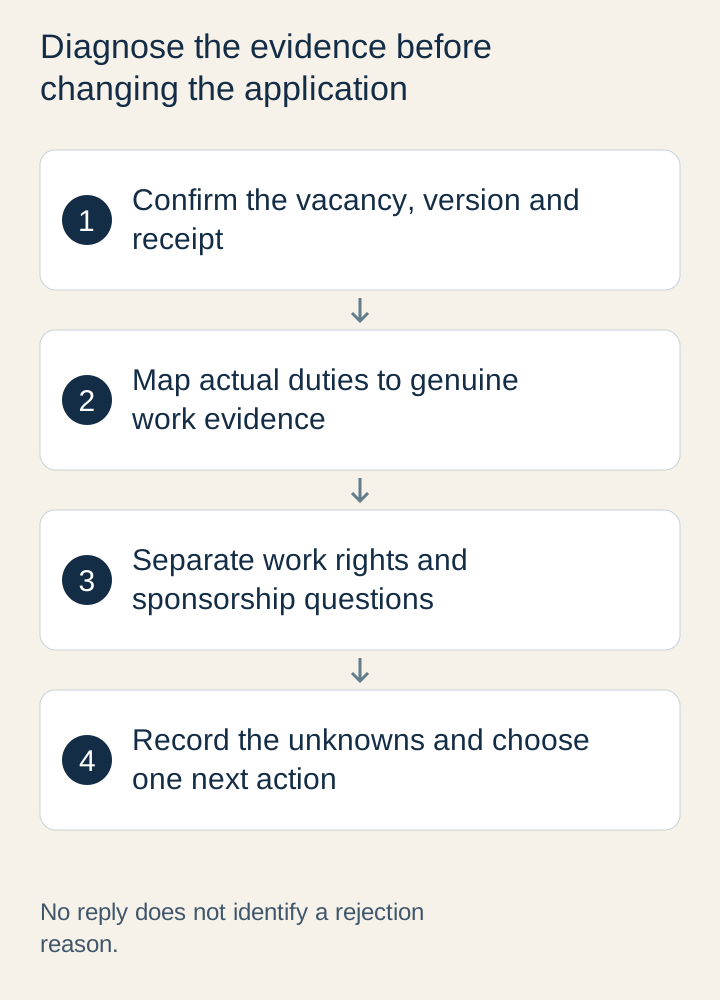
Choose the change that your record actually supports. If relevant work is buried, rewrite that evidence and retain the old version. If the posting's location conflicts with your plan, ask a location question before investing in another lengthy application. If sponsorship information is missing, ask whether the company will consider the process required for that role, without suggesting that it has already agreed.
Do not send conflicting versions for the same vacancy as a supposed experiment. Compare your own future applications to suitable roles, noting that employer, timing and competition also differ. An improvement in replies cannot prove that one wording change caused it. The useful result is a clearer, more consistent application, not an unsupported conversion-rate claim.
An original follow-up could read: “I applied for the operations coordinator role, reference listed in my submission, and received the portal acknowledgement. My relevant experience includes maintaining exception records and coordinating handovers. Could you confirm whether the application remains under consideration and whether a further document is required? I understand any employment start depends on the applicable hiring and work-authorization conditions.” Adapt the facts and keep the note short.
Use the published contact method and any timing instruction supplied by the employer. There is no universal legal response deadline asserted here. If the posting asks applicants not to contact the hiring team, respect that instruction. Do not repeatedly message different employees or send identity documents to someone whose recruiting role you have not verified. Archive an inactive lead when your chosen review condition is reached, while preserving its factual status.
6. Keep an EB-3 discussion separate from an ordinary application
An employer that interviews overseas candidates has not necessarily agreed to an EB-3 case. Ask what is actually being considered: a current vacancy for someone already authorized to work, a discussion of future sponsorship, or an approved internal decision to assess a particular immigrant process. Use the employer's words in your log rather than upgrading “we will ask HR” to “sponsor confirmed.”
USCIS identifies EB-3 as an immigrant category with job and qualification requirements and an employer petition process. A resume submission or offer is not the completion of that process. USCIS EB-3 overview
For a structured first approach, see the EB-3 employer search guide. For rewriting evidence in detail, use the EB-3 resume guide. If the unresolved issue is your location and existing permission, consult the overseas versus US applicant comparison. Each answers a different question from this audit.
Detailed immigration assessment can be discussed with PremierVisa Group through its US immigration overview. Ask who will handle the assessment and what the engagement covers. Do not resign, travel for work or promise a start date because an unanswered-application problem seems to have improved. A recruiter reply is progress in recruitment, not evidence that work rights have changed.
7. Questions applicants ask after repeated silence
Does no reply mean my resume failed an automated filter?
Not by itself. You have evidence of silence, possibly a portal status, but usually no evidence of the mechanism behind the decision. Check submission completeness, readable text and visible job fit. Keep the cause unknown unless the employer provides something more specific; avoid paying for a service that claims to know a hidden rejection reason from your inbox alone.
Should I hide that I need sponsorship to get an interview?
No. Answer the actual question truthfully. Current permission and future sponsorship are different questions and may require clarification for your situation. A misleading answer can undermine a later discussion. Obtain individual advice if you cannot confidently explain your position rather than selecting the answer you think will produce more replies.
Can I attach passport or work-permit scans to every application?
Do not treat unsolicited document circulation as a way to prove seriousness. Follow the verified employer's lawful process and distinguish recruitment questions from employment verification. The IER FAQ explains document-choice and discrimination issues. Keep sensitive material private until there is a legitimate, verified reason and an appropriate channel to provide it.
How many applications should I send before changing strategy?
There is no universal number in this guide. Review a manageable set for identifiable defects and unanswered questions, then prioritise better-matched roles. A high total conceals little if every application had the same unaddressed location conflict. Your next action should follow the evidence in the audit, not a promised industry response rate.
What should I bring to an adviser?
Bring redacted postings, the submitted resume versions, accurate summaries of work-rights answers, portal receipts and the specific question you cannot resolve. Separate confirmed employer statements from your assumptions. That makes a resume or interview discussion more useful and helps identify when a qualified immigration assessment is needed.
Submit your background to HKJobHunt to discuss your resume, interviews and practical employer-contact directions. Bring the audit and identify the next decision you need help making; a consultation does not guarantee a job, sponsorship or immigration approval.