
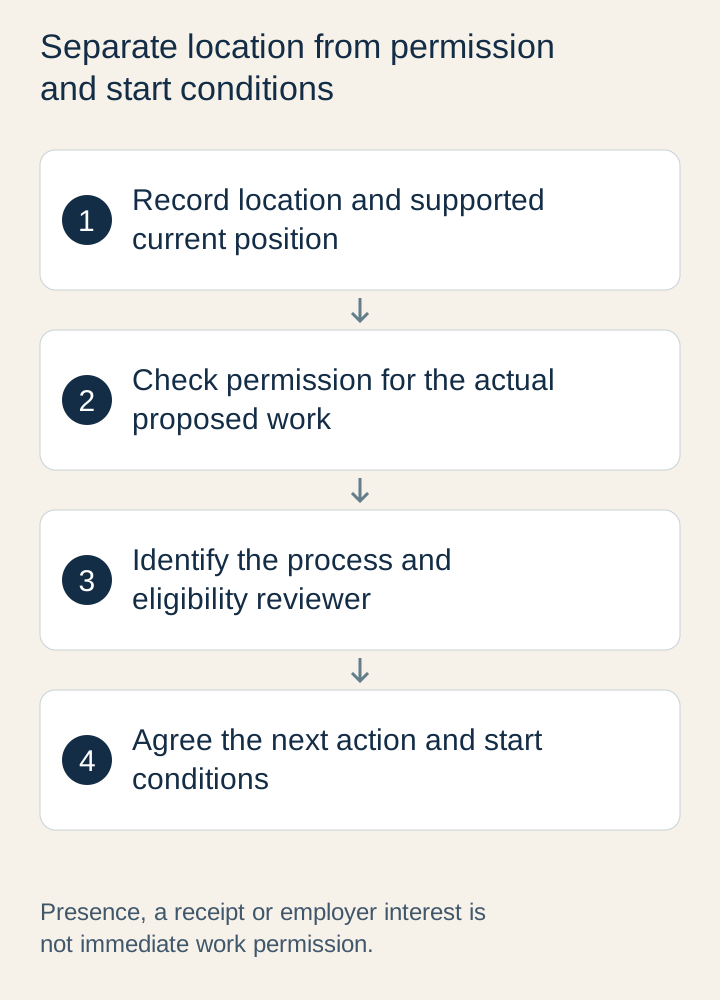
An overseas EB-3 candidate and someone already in the United States may approach the same employer, but they cannot assume the same start conditions. Location, current immigration position, permission for the actual job and eligibility for a later immigration process are separate questions. Consular processing and adjustment of status are different procedures, not interchangeable recruiting promises. Use a candidate readiness record to explain verified facts, identify the right assessment and agree the next step without claiming immediate work authorization.
- 1. Separate location, status, work permission and process
- 2. Understand what the two procedures change
- 3. Check permission for this work, not just a document name
- 4. Prepare the six-field candidate readiness record
- 5. Adapt employer communication to the real starting point
- 6. Reassess travel, changes and start conditions
- 7. Questions about overseas and U.S.-based applications
1. Separate location, status, work permission and process
“I am in the United States” answers a location question. It does not explain the basis for being there, whether a person may take a particular job or whether they qualify to adjust status. Equally, living overseas does not establish that an employer will wait, that a visa will be available or that a particular consular post will process the case. Begin with facts that can be supported, rather than a label such as “local applicant.”
Use four distinct questions. Where are you now? What is your current immigration position, supported by the relevant records? What permits you to do this proposed work, if anything? What immigration process has actually been assessed for your circumstances? Keep uncertainty visible. If a recruiter asks about immediate work permission, a statement that an immigrant petition is planned does not answer the question.
The USCIS adjustment overview describes adjustment as a process for seeking permanent residence while present in the United States, subject to eligibility and visa availability. 8 CFR 245.1 contains substantive conditions and restrictions. Neither is a basis for telling everyone physically present that they can file. Specific history, exceptions and consequences need appropriate individual assessment.
2. Understand what the two procedures change
For an overseas candidate, an employment discussion can lead to employer assessment and, where appropriate, an immigrant process with later consular steps. The Department of State employment-based overview describes petition, NVC, documentation, interview and visa-availability stages. An employer expressing interest or a petition decision is not the same as an issued immigrant visa, admission or present permission to work in the United States.
A person in the United States may need an assessment of adjustment eligibility; physical presence alone is insufficient. Ask the appropriate adviser to review the actual entry, status and employment history, category and available filing route. Do not use this guide to decide an exception, calculate a forgiveness period or repair a status problem. It provides the questions and evidence to bring to a qualified assessment, not instructions to file an individual application.
| Recruiting question | Candidate overseas | Candidate currently in the United States |
|---|---|---|
| What can you tell the employer now? | Current location and truthful present work-authorization position | Location plus the actual basis and scope of any work permission |
| What later procedure may be relevant? | Consular process after appropriate assessment | Adjustment only if eligible; another procedure may need assessment |
| Can the employer assume an immediate start? | No, from EB-3 interest alone | No, from U.S. presence or a pending filing alone |
| What should the next decision cover? | Genuine role, willingness to consider a longer-term candidate and responsible contact | Same role questions plus verified permission for this employer and work |
Do not advertise either route as automatically faster. The government stage, visa availability, case history and actual employer readiness can differ. Compare what must be verified and who will act, rather than converting someone else’s timeline into your expected arrival date. The separate timeline guide addresses how to read stages without promising completion.
3. Check permission for this work, not just a document name
The USCIS employment authorization document page explains that an EAD is one way to demonstrate work authorization and that some categories instead involve permission tied to their status and employer. A card is therefore not the only possible evidence, but a familiar immigration label is not a universal permission either. Identify the actual category, validity and conditions with the appropriate responsible person.
For someone with a pending adjustment application, do not say “I filed I-485, so I can start.” 8 CFR 274a.12(c), including (c)(9) distinguishes applying for employment authorization from having it. Existing permission may also require its own assessment. Do not assume an application receipt, a pending renewal or another employer’s permission covers the proposed job; any extension or portability rule must be checked for the actual circumstances.
Likewise, an overseas candidate should not propose arriving as a visitor to begin the role. The Department of State visitor page identifies employment as a purpose not permitted on a visitor visa. If a proposed interview visit, training, trial shift or productive task raises a permission question, get an assessment before agreeing to it. Calling work “unpaid” does not, by itself, settle the issue.
4. Prepare the six-field candidate readiness record
Use one record for the actual opportunity, dated and updated when relevant facts change. Give a recruiter a short factual summary; keep sensitive identity and immigration documents for a verified, appropriate recipient through an agreed secure channel. This is a preparation tool, not a declaration that a particular status or route has been legally confirmed.
| Field | What belongs in the record |
|---|---|
| Current location and position | Where you are; immigration position supported by actual records; uncertainty noted |
| Permission for the proposed work | Basis, relevant validity and restrictions; what still needs checking |
| Process being assessed | Consular or adjustment discussion and who is assessing eligibility |
| Role and practical availability | Employer, duties, worksite, interview time zone and realistic notice needs |
| Evidence and responsible recipient | Relevant records, missing items and verified adviser or employer contact |
| Start condition and next action | What must be confirmed before work, who decides and what triggers an update |
Suppose an invented applicant lives in the United States and has permission associated with a different employer. The location field can be confirmed while permission for the new role remains unresolved. The correct next step is a review of the proposed change, not a promise of an immediate start because the applicant already lives nearby. An overseas applicant, meanwhile, may be ready for remote interviews without being ready for U.S. employment.
The readiness worksheet keeps these distinctions visible. If you need help explaining your background or preparing employer contact, submit your job-search background to HKJobHunt. Immigration eligibility and permission questions can be referred for appropriate individual assessment; sending the worksheet does not itself appoint a legal representative or confirm permission.
5. Adapt employer communication to the real starting point
For an overseas introduction, use a concise statement: “I am currently based outside the United States and can attend remote interviews. I do not currently have permission to take this U.S. role. If there is mutual interest, would the company consider a longer-term employer-sponsored process, and who would assess that possibility?” State only what is true for you. This allows a company that needs an immediate authorised starter to identify the mismatch early.
For a U.S.-based introduction, do not replace the work-permission answer with your city. A useful structure is: “I am currently based in this area. My current work-permission position is [state your verified facts]. Whether it permits this proposed role is [confirmed or awaiting appropriate review]. What information does the authorised HR contact need?” Replace the bracketed instructions with real information before using the wording; they are teaching prompts, not completed applicant statements.
Ask who can decide whether to explore the case and how the employer describes the role, location and expected availability. Keep the technical interview focused on capability and the role, while directing detailed status questions to the appropriate contact. You do not need to send a full passport, complete immigration file or personal legal history to every person arranging an interview. Confirm their role and the purpose of any requested document first.
After the discussion, record the employer’s actual answer: not considering sponsorship, willing to assess, requesting documents, or making another specific decision. Do not convert “send your resume” into sponsorship approval. For interview delivery and role evidence, see the interview guide and qualification guide; this article’s tool addresses the candidate’s starting position and handover.
6. Reassess travel, changes and start conditions
Before making travel plans, changing employers or leaving an existing job, ask how the intended action interacts with your actual position. For adjustment applicants, 8 CFR 245.2(a)(4) addresses departure and contains specific conditions and exceptions. This is why a pending application should not be treated as an unrestricted travel permission. Do not infer the correct travel document or re-entry outcome from a friend’s experience.
Keep expiry dates and actual official notices distinct from forecast dates. A recruiter’s hoped-for start, an employer’s internal target and a government appointment are not equivalent. When a new document or decision arrives, update the record and ask whether it changes permission for the proposed role. Do not assume that every filing preserves the same position, that every receipt extends permission, or that a planned process cures an earlier issue.
For overseas applicants, maintain a practical interview and document plan while continuing to respect the conditions where you live and work. Avoid resigning or paying for irreversible relocation on an unconfirmed arrival date. For U.S.-based applicants, keep existing obligations and permission limits visible while a prospective employer assesses an opportunity. Neither applicant should be told to work first and solve the legal basis later.
For wider background, read PremierVisa Group’s U.S. immigration overview, then bring the actual employment and immigration facts to individual assessment. Submit your background to discuss resume, interview and realistic employer-contact directions. No location, passport, employer conversation or pending application guarantees a job, immigration approval or a fixed start date.
7. Questions about overseas and U.S.-based applications
Must an overseas applicant move first to find an employer?
No move should be assumed necessary just because you want an employer discussion. Remote interviews and document preparation may be practical. Whether any visit or later work is permitted depends on its actual purpose and your circumstances; a visitor route is not permission to begin employment.
Does being in the United States make adjustment automatic?
No. Eligibility depends on more than location, including the applicable category, circumstances and visa availability. Have the actual records reviewed. Do not infer eligibility from a U.S. address, a recruiter’s promise or another person’s successful application.
Does filing I-485 allow me to take the offered job?
Not by itself. Confirm the actual basis, validity and scope of work authorization. A pending application and permission to work are distinct; existing permission or any applicable extension also requires a fact-specific check rather than an assumption based on a receipt.
Is an EAD always required for every applicant?
No. USCIS describes different ways people may be authorised, including certain employer-specific status arrangements. Identify which basis actually applies and whether it covers this role. Do not insist on one document for everyone or assume every immigration document permits employment.
Which route is faster?
There is no reliable universal answer from location alone. Consider eligibility, government stages, availability and employer readiness for the actual case. Keep a comparison of confirmed conditions and unresolved actions rather than treating a quoted completion date as a guarantee.