
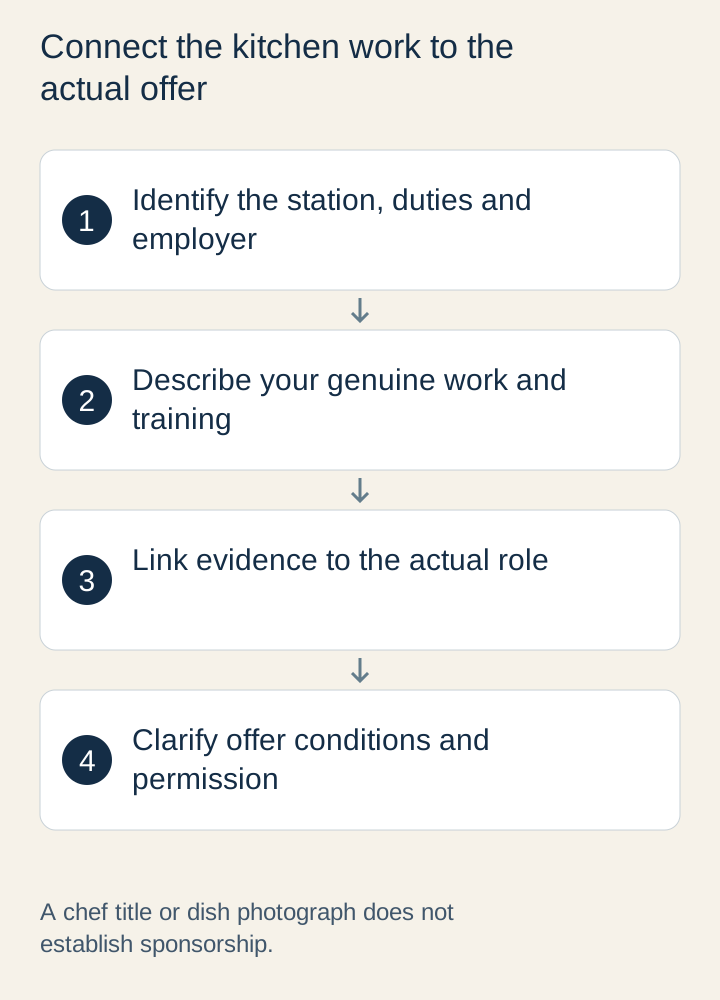
For an EB-3-related chef opportunity, compare the restaurant's actual duties with your own cooking, training and supervisory experience, then verify the employer and written conditions. A chef title, food photograph or years in a kitchen does not establish the immigration classification or a genuine sponsored vacancy. This guide helps cooks and chefs prepare a station-to-offer brief, describe their contribution honestly and ask specific questions before treating a restaurant discussion as an employment or immigration commitment.
- 1. Identify the actual kitchen role before choosing a category
- 2. Describe station skills and responsibility in language an employer can assess
- 3. Organise genuine experience and training evidence
- 4. Build a six-field station-to-offer brief
- 5. Read the offer as a real kitchen job, not only an immigration label
- 6. Verify the employer discussion and plan the next step conditionally
- 7. Questions chefs and cooks ask about EB-3 opportunities
1. Identify the actual kitchen role before choosing a category
Ask which employing entity and restaurant are involved, where the work will take place, who supervises the role and what the daily duties are. A restaurant's trading name may differ from the employing entity. Keep the current description and contact details, and ask who is authorised to confirm the job rather than assuming every person discussing a menu can agree to sponsorship.
Distinguish hands-on cooking from responsibility for a section or the kitchen. The Bureau of Labor Statistics chef and head-cook profile describes food preparation oversight, menu and supply responsibilities, supervision and kitchen standards. It is occupational context, not a requirement that every cook perform all those tasks. A role called “chef” may still need a more precise description.
The qualification provisions in 8 CFR 204.5(l) distinguish skilled workers, professionals and other workers by the relevant requirements. A skilled job involves at least two years of training or experience, but the title alone does not establish that basis. Do not describe all restaurant roles as skilled, or assume every applicant who has worked in a kitchen satisfies the particular job.
Also confirm the job's nature. For the PERM context, 20 CFR 656.3 defines employment as permanent, full-time work for an employer other than oneself. A temporary event assignment should not be relabelled as a permanent restaurant role. Ask the appropriate reviewer to connect the real duties, requirements and proposed route.
2. Describe station skills and responsibility in language an employer can assess
Start with the station or type of work you actually handled: preparation, hot food, pastry, service coordination or another genuine responsibility. Explain what you did yourself, what a supervisor checked and where you supported a team. A broad phrase such as “managed the kitchen” is unhelpful if your actual responsibility was one task under supervision.
O*NET's chef and head-cook task profile includes coordinating food preparation, monitoring sanitation, instructing staff and ordering supplies. Use it to identify the kind of question an employer may ask, not to copy a job description into your resume. Only include tasks you performed and can explain when asked about the process.
An original achievement framework is: station or service context, your action, the check or coordination involved, and the observable result. For an invented example, a cook notices a mismatch between the preparation list and the service plan, checks the change with the supervisor and updates the handover for the next cook. It demonstrates communication and task control; it is not a real client's story or an invented percentage improvement.
Be accurate about cuisine and equipment experience. Having cooked one menu does not establish mastery of every regional cuisine or unfamiliar machine. Say what you know, identify what needs training and ask which skills are mandatory before selection. A truthful limitation helps the employer assess the role; a claim of universal ability creates questions you cannot support.
3. Organise genuine experience and training evidence
Prepare a chronology of employers, actual roles, periods and relevant duties. Separate apprenticeship, employment, short courses and supervisory responsibility. Overlapping periods should be explained accurately rather than added as consecutive years. Do not change a former title to head chef simply because that title appears in the proposed U.S. job description.
Under the experience-evidence provisions in 8 CFR 204.5(l), letters from employers or trainers support required training or experience and identify the issuer and the work or training described. A menu, social-media post or photograph can provide context, but it is not automatically a substitute for the required evidence. Ask the appropriate reviewer which records support the actual requirement.
The BLS profile describes varied education and training routes into the occupation. That does not decide whether a particular foreign award or employment history meets an immigration requirement. Keep the original qualification name, issuer and actual completion date. If a record needs translation or assessment, confirm the applicable instructions before commissioning a generic package.
An original request to a former employer could say: “Please confirm the role, actual period and duties your records support, including the station or supervisory tasks you can verify. Please identify the issuer's position and contact details, and tell me which items cannot be confirmed.” Do not ask them to sign a description of work you did not perform or to issue a backdated record.
Keep portfolios proportionate. Use photographs you own or have permission to use, explain your contribution to the dish or service and remove confidential customer information. Do not copy another restaurant's menu, recipe or marketing image into your application as your own work. A useful portfolio supports a truthful conversation; it does not turn a shared team product into sole authorship.
4. Build a six-field station-to-offer brief
Use six fields: proposed station and actual duty; your corresponding responsibility and period; genuine supporting record and issuer; a service or coordination example; the offered condition or unresolved question; and the next verification action with its owner. This original brief joins practical kitchen work to the actual offer instead of treating qualifications and employment conditions as unrelated folders.
| Kitchen issue | Evidence or explanation to prepare | Question for the actual employer |
|---|---|---|
| A named station or menu responsibility | Work you personally performed and its setting | Which station and duties does this role cover? |
| Supervising other cooks | Actual responsibility, reporting line and issuer | Is supervision required or only occasional support? |
| Preparation and service handover | A genuine example of checking and communicating changes | How are preparation and service coordinated here? |
| Food-safety training named in the job | Actual record, issuer and completion date | Which local requirement and accepted evidence apply? |
| Written employment conditions | Current offer version and unresolved points | Who confirms pay basis, schedule and worksite? |
For an invented teaching comparison, one role mainly involves preparing food under a head chef, while another includes section coordination and ordering. The same applicant should not send an identical “kitchen manager” claim to both. Use the brief to ask what the second employer actually requires and which responsibilities your genuine records establish. Neither example is a current vacancy.
Add a short original service example rather than confidential operating instructions. You can explain how you checked a discrepancy, communicated a change or asked for supervision without publishing a former employer's recipe or internal standards. If the employer requests a practical assessment, confirm its purpose and arrangements; this guide does not grant permission to undertake U.S. work or a trial shift.
If you want help turning your actual experience into a resume and interview brief, submit your career background. HKJobHunt can discuss preparation and realistic employer-contact directions within a confirmed scope. A stronger presentation does not guarantee selection, a sponsor or immigration approval.
5. Read the offer as a real kitchen job, not only an immigration label
Request the job title, duties, worksite, pay currency and basis, proposed hours, schedule, reporting line and any stated meals, accommodation or transport arrangement. Keep benefits and deductions identifiable rather than treating a single package number as take-home pay. This guide does not quote market wages, decide overtime entitlement or assume a salary label resolves employment-law questions.
The BLS profile describes schedules that may include early mornings, evenings, weekends and holidays, alongside fast-paced work and substantial time standing. Ask about the actual restaurant's arrangements instead of assuming your previous schedule will continue. If the description involves several venues, ask who employs you and where duties are expected to be performed, with the relevant case implications reviewed separately.
If the job names a food-safety certificate, food-handler requirement or local permission, ask which jurisdiction and role it concerns and which evidence is accepted. Do not assume a certificate from another country automatically meets it, or that one commercial course is mandatory nationwide. Keep food-safety preparation, employer selection and immigration permission as separate checks.
A useful clarification request is: “Please confirm the current job and offer version, the station and supervision expected, the pay basis and schedule, and any qualification that must be demonstrated before selection or starting. Which contact can answer the unresolved items?” Record the reply against the same version rather than mixing several informal messages into an assumed final contract.
6. Verify the employer discussion and plan the next step conditionally
Ask who owns the restaurant's recruitment decision and who will assess any immigration support. If an agency introduced the contact, clarify its role and connection to the employing entity. A restaurant photograph, popular review page or list of chef titles does not establish a sponsoring relationship. Use our employer-verification guide for the deeper checks.
The Department of State employment-based immigrant visa overview separates the employer petition from later visa processing. A successful chef interview or useful skills brief does not provide immediate work permission. Confirm any existing permission and the actual basis for starting separately; do not agree to begin because someone describes an unpaid trial as automatically acceptable.
For the later recruitment-to-case handover, see our employer-process guide. For spoken explanations of work permission and future sponsorship needs, use the interview preparation guide. These practical guides serve different questions and do not replace individual immigration assessment.
Broader background is available through PremierVisa Group's U.S. information, with individual advice and service arrangements confirmed separately. Keep proposed start dates conditional on the actual job and permission requirements. Do not use another chef's advertised success story to predict your case or assume the same employer, worksite and conditions are available.
To prepare a focused discussion, submit your background and the kitchen role you are considering. Include your real duties, training, experience and the conditions still needing clarification. The next conversation can then address a useful preparation step instead of treating every kitchen title as an approved sponsored job.
7. Questions chefs and cooks ask about EB-3 opportunities
Does the title chef automatically make a job a skilled-worker role?
No. The actual requirements and appropriate classification need assessment. A title does not establish the training or experience required, the applicant's qualifications or the employer's immigration support. Start with the real duties and written requirements.
Can food photographs prove the required experience?
They can support a conversation if genuinely yours and properly explained, but are not automatically substitutes for the required employer or training evidence. Identify your contribution and ask which records meet the actual job and application requirements.
Must every chef have a university degree?
Do not assume one rule for every role. Occupational education routes and immigration branches differ, and the actual position's requirements still apply. Keep training, experience and qualifications accurate rather than claiming a blanket degree exemption.
Will an overseas food-safety certificate be accepted everywhere?
Do not assume that. Ask which local requirement and role the employer means, who can confirm it and what evidence is accepted. A course's existence does not establish nationwide recognition or immigration eligibility.
Can I start an unpaid kitchen trial while the case is being discussed?
Do not treat the word unpaid as permission to work. Clarify the proposed activity and obtain appropriate advice on the actual permission and conditions before agreeing to a U.S. working start. An interview or sponsorship discussion does not supply that permission.