A Hong Kong employment visa is not permanent resident status, and an employer cannot promise that a job will automatically produce that status after seven years. Candidates should separate permission to work, extension of stay and any later right-of-abode assessment. This guide helps professional workers organise employment changes and truthful records, ask employers useful questions and identify when immigration advice is needed, without treating a calendar or a collection of payslips as proof of eligibility.
- 1. Keep three decisions separate when comparing jobs
- 2. Read the permission you hold before making a change
- 3. Treat extension preparation as a current responsibility
- 4. Understand ordinary residence without inventing a day rule
- 5. Build an employment and residence change log
- 6. Ask employers for facts they can actually provide
- 7. Questions workers ask about jobs and later residence
1. Keep three decisions separate when comparing jobs
A job offer answers whether a company proposes to employ you on particular terms. Immigration permission answers whether you may undertake the relevant work under your actual conditions. A later permanent resident assessment concerns its own requirements. Confusing these decisions makes a long-term plan look more certain than the evidence permits.
Begin your comparison with the immediate role: actual responsibilities, employing entity, reporting line and conditions. Then record your current permission and the question that must be checked before starting. Keep any long-term residence objective in a separate section, labelled as an objective rather than an outcome the employer has agreed to deliver.
The official GEP information and ASMTP information distinguish professional-employment arrangements and their conditions. Mainland professional candidates should not select GEP simply because a recruiter uses that acronym. Other arrangements, including graduate or imported-worker schemes, must not be treated as interchangeable with these professional routes.
Use the GEP and ASMTP job-search guide for the initial route discussion and the offer checklist for written terms. Here the additional task is to make changes, evidence and unanswered residence questions traceable across a working career.
2. Read the permission you hold before making a change
Do not describe your status only as “I have a Hong Kong ID.” Identify the actual permission, the permitted period and any employment condition that applies. An identity card, a job offer and an application acknowledgement are different documents with different purposes. Keep a clear index to the relevant originals rather than carrying an assumption from a previous conversation.
For professionals admitted on employment conditions under GEP or ASMTP, the official pages require prior approval for a change of employment. Their provisions for qualifying top-tier professionals on time limitation only differ. Check which conditions you actually hold; do not turn either rule into a statement about every worker or every Hong Kong visa.
Ask a prospective employer who will coordinate the relevant employment-change information, which role and entity the company is confirming and how a proposed start will be reviewed. Do not promise immediate availability merely because you are already in Hong Kong. Equally, do not assume that a change necessarily destroys every earlier residence fact; these are separate questions requiring the actual circumstances.
A useful original question is: “My present permission has these conditions. Who will coordinate the proposed change, and what confirmation do we need before fixing the first working day?” Share the information needed through a verified channel. Avoid sending complete identity files to multiple recruiters simply to demonstrate that you have lived locally.
3. Treat extension preparation as a current responsibility
Keep the permission expiry visible in your own calendar and identify who will provide company-side information. An employer's informal promise to renew does not replace your need to understand the application status. Record whether materials are being prepared, an application has been submitted or a decision has been received. Each description should refer to something that actually happened.
The current GEP and ASMTP professional-employment pages say extension applications should be made as early as possible within the three months before expiry and, in all circumstances, at least six weeks before expiry. Verify the current guidance for your actual route. A pending application does not generally authorise remaining beyond expiry without exceptional approval.
Practical preparation begins earlier than a last-minute request for a signature. Ask HR which contact handles employment confirmations, how you obtain a factual record of your duties and how you will be informed if the employment situation changes. Do not assume the company will preserve every document indefinitely or reconstruct an old reporting arrangement from memory.
Use a record index with document category, date, issuing party, location of the authorised copy and an unanswered question. Keep company confidential material in its appropriate channel. Never ask an employer to backdate a letter or describe a role you did not perform. A polished retrospective statement cannot substitute for an accurate account of the employment.
4. Understand ordinary residence without inventing a day rule
The Immigration Department's definitions explain ordinary residence and the relevance of individual circumstances, including temporary absence. Do not reduce the concept to an invented annual day threshold. Record what actually happened during travel or a period away, then seek a scoped assessment where needed instead of arranging documents to imitate a supposedly safe formula.
The right-of-abode FAQ identifies different eligibility categories. Seven years of continuous ordinary residence is relevant to specified categories, but the complete requirements differ; the non-Chinese category includes additional matters. Do not infer a person's applicable nationality category from language, a Taiwan address or an overseas passport alone.
The definitions also identify periods not regarded as ordinary residence, including specified imported-worker and foreign domestic helper circumstances. This is one reason a generic claim that every work visa counts in the same way is unreliable. This article concerns preparation by professional job seekers and does not calculate anyone's qualifying period.
For a travel or work event, note dates, purpose, where the work was based and the records that genuinely exist. An unresolved gap is a question to explain, not an invitation to create a false tenancy or invent attendance. Tax, employment or housing documents have particular purposes; none should be advertised as a standalone permanent residence guarantee.
If your employment decisions and immigration questions overlap, submit your job-search background to HKJobHunt. A consultant can discuss your CV, interviews and realistic employer-contact direction. Residence and visa matters can be referred within PremierVisa Group for individual assessment under the agreed engagement.
5. Build an employment and residence change log
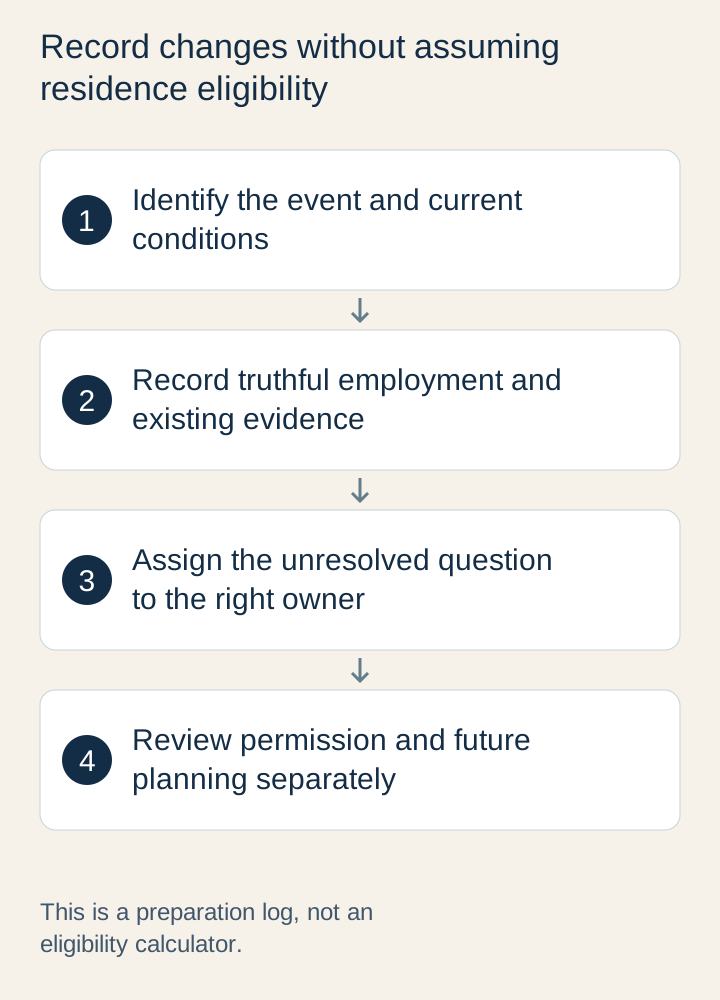
Use this original six-field tool to connect real events with the right follow-up. It is a personal preparation method, not an official evidence list or eligibility calculator. Store references to authorised documents without exposing identification numbers, passwords or confidential company files in a shared spreadsheet.
| Field | Record | Next question |
|---|---|---|
| Event and date | Offer, role change, travel or employment ending | What actually changed? |
| Current permission | Relevant condition and expiry reference | Does the proposed activity need review? |
| Employment facts | Entity, duties, work base and responsible contact | Which facts can the company confirm? |
| Existing evidence | Issuer, document date and secure reference | Is the account accurate and complete? |
| Open issue and owner | Missing fact, conflicting date or advice question | Who is qualified or authorised to answer? |
| Next review | Application preparation or other real trigger | What must happen before reliance? |
A useful entry might say: “Proposed reporting role with a new entity; current permission conditions to be checked; HR will confirm the duties and coordination contact; start date not settled.” An unhelpful entry says: “Another year towards PR.” The first preserves the decisions still needed; the second assumes a legal conclusion from a job event.
For a period away, record its actual purpose and circumstances. Do not label every absence a break, or every trip a harmless holiday, without examining the facts. Keep the entry factual enough that an adviser can see what needs to be considered. The log should reveal uncertainty rather than resolve it with a colour code.
Update the log when a material event occurs. If a document has a wrong date, ask the issuer for an accurate correction and keep the explanation. Do not rewrite earlier records quietly to make the timeline smoother. Consistency means that genuine changes and corrections can be understood, not that every document must tell an artificially identical story.
6. Ask employers for facts they can actually provide
Ask who issues employment confirmations, what the company can confirm about your real role and who coordinates a permission-related change. Ask how notice of a restructure, transfer or contract change will reach you. These are employment coordination questions an employer can address; a promise of future permanent status is a different claim.
For example: “If my employing entity or work base changes, can you identify the person who will confirm the new arrangement and coordinate any required immigration review?” This is more actionable than asking whether the company guarantees seven years. It also avoids asking HR to decide a right-of-abode question outside the scope of an ordinary recruitment discussion.
Consider a fictional professional choosing between a clearly defined role with transparent coordination and a vague role promoted as a guaranteed residence pathway. The useful comparison concerns the actual duties, terms, company responses and remaining conditions. Do not assign an invented probability of permanent residence to either offer. A higher salary or a famous brand cannot answer every question about future circumstances.
When employment ends or a planned move changes, review the present permission promptly and seek appropriate advice. Do not assume there is an automatic job-search grace period or that a pending future residence application settles current conditions. For immigration detail, read PremierVisa Group's professional-employment information; for company-side preparation use the employer-check guide.
7. Questions workers ask about jobs and later residence
Does holding a work visa for seven calendar years automatically make me permanent?
No automatic conversion should be promised. Identify the applicable category, actual residence circumstances and any other requirements in the official guidance. The date you received a document alone cannot decide the complete question, and an employer cannot replace the relevant assessment.
Does every trip outside Hong Kong restart the residence period?
Do not use that blanket rule. Temporary absence and its circumstances need to be considered under the official definitions. Preserve truthful dates and reasons and obtain individual advice where the facts are material, rather than relying on an invented annual travel allowance.
Can my employer guarantee an extension if I keep working?
The employer can describe its intended support and provide accurate employment facts. It cannot guarantee the immigration decision. Keep preparation, submission and approval separately recorded, and check your own expiry and actual conditions while the matter is being handled.
Are payslips and a rental contract enough to prove eligibility?
Do not treat a short bundle as a universal test. Records may help explain particular facts, but their relevance depends on the question and circumstances. Keep accurate originals and an index, and avoid fabricated or backdated material intended merely to fill a checklist.
What should I prepare before discussing a job change?
Prepare a factual CV, the relevant permission conditions, the proposed offer and a dated change log. Separate confirmed facts from plans and unanswered questions. Share only necessary documents through a verified channel, so the discussion can focus on employment preparation and the immigration issues requiring separate assessment.
To discuss your CV, interview preparation and practical employer-contact direction, submit your job-search background. HKJobHunt, 卓越國際職涯, is within the PremierVisa Group service system. Individual support and referrals depend on your circumstances and the agreed service scope, without guaranteed employment or residence outcomes.