When a Hong Kong job offer involves a family move, ask what the employer will actually provide, who qualifies, when support begins and which costs remain yours. An introduction to a school or landlord is different from paying fees or guaranteeing a place. This guide helps professional candidates negotiate a written relocation plan while separating the worker's permission, family members' arrangements and the practical timing of housing, schooling and the first working day.
- 1. Define the household needs before requesting a package
- 2. Separate family permission from employer assistance
- 3. Translate benefit labels into a written commitment
- 4. Ask about school and housing help without expecting guarantees
- 5. Build a relocation-support responsibility board
- 6. Negotiate timing and a fallback before committing
- 7. Questions before accepting a family relocation offer
1. Define the household needs before requesting a package
Begin with your own decision sheet rather than a demand for a standard expatriate package. List who may move, whose work or study arrangements need checking, the earliest practical move and the matters still unresolved. You do not need to disclose every family document during a recruitment conversation. Explain the constraints necessary to discuss the offer, then use verified channels for any later evidence.
Separate essential conditions from preferences. A confirmed ability to begin the proposed job is different from a preference for a particular neighbourhood. A child's current school transition may affect the family's timing without giving the employer control over an admission decision. Make these relationships visible before comparing a headline allowance with another employer's offer.
The immigration route must also match the principal candidate's circumstances. Use the official GEP guidance or ASMTP guidance as applicable. A Mainland professional, a Taiwan resident and another overseas candidate should not copy one another's arrangements solely because all are moving to Hong Kong.
This article adds a practical employer-negotiation tool, rather than a complete family immigration or neighbourhood guide. For the core job document, use the offer checklist. For who is employing you and coordinating company material, use the employer-check guide.
2. Separate family permission from employer assistance
Ask who coordinates immigration questions and what assistance is included in the company's offer. “We help with family visas” could mean providing an introduction, assisting with administration or agreeing to meet specified costs. Those are different commitments. Identify the contact and the relevant written scope instead of recording the whole sentence as an approved family application.
The Immigration Department's dependant guidance sets out qualifying relationships and sponsor circumstances. Do not assume every relative can join under the same arrangement. A company cannot create eligibility by calling someone a family member, and a principal worker's approval is not proof that every other person's application has been approved.
For dependants of professionals admitted under GEP or ASMTP, the official guidance does not prohibit employment; that statement should not be extended to every dependant category. Check the person's actual permission and circumstances. A partner's hoped-for future earnings should not be presented as confirmed household income simply because work may be permitted.
Keep an individual status row for each person: arrangement to be checked, evidence owner, current stage and next question. Avoid collecting sensitive relationship documents in a shared benefits spreadsheet. If a family member will arrive later, ask how that affects the agreed assistance without assuming their timetable must match the worker's start date.
3. Translate benefit labels into a written commitment
For each item, ask whether support is information, a company booking, reimbursement, a fixed payment or a policy benefit. Then identify who qualifies, the conditions, any stated limit and the point at which the support becomes available. Do not invent a normal market amount or suggest that every professional employer provides the same package.
For flights or shipping, ask which travellers or items are covered, who authorises a booking and what evidence is required for a claim. For temporary accommodation, ask the provider, period, check-in conditions and what happens if the move is delayed. A promise to give housing contacts does not itself pay a deposit or create a tenancy.
For family medical insurance, request the applicable policy explanation: who may be enrolled, the start of cover, exclusions or waiting conditions and who can answer a specific coverage question. Do not treat a general benefits heading as proof that a family member's treatment will be covered. Obtain the actual explanation before relying on the benefit.
Read any repayment or early-departure condition rather than considering only the amount offered. Ask which event triggers repayment and how the company explains the calculation. This article cannot decide the enforceability of a clause; seek suitable individual advice where the consequences matter. Do not assume that a reimbursement is unconditional or that it will arrive before you must pay a supplier.
4. Ask about school and housing help without expecting guarantees
For schooling, ask whether the employer supplies information, an introduction, time to attend meetings or a specifically agreed financial benefit. The Education Bureau's placement guidance explains direct school applications and placement assistance. A useful introduction can help you ask questions; it does not give the employer control of a school's available places.
The Education Bureau's placement FAQ also addresses the documents and immigration clearance relevant to non-local children. Do not plan school attendance on the assumption that visitor entry is sufficient. Eligibility to study, an application and admission to a particular school are distinct matters.
Prepare a school-information index: current learning stage, language and curriculum questions, documents the school requests, actual admissions response and any decision deadline. Keep it separate from an employer's reimbursement approval. A parent may still need to clarify class placement or support needs even if a fee contribution has been offered.
For housing, identify whether assistance is a contact list, a viewing appointment, temporary accommodation or a defined payment. Ask how the location relates to the actual workplace and any eventual school journey. Avoid committing to a long-term address purely because an employer has mentioned a preferred area. A provider introduction is neither a verified rental contract nor an immigration approval.
If family constraints affect your job discussion, submit your job-search background to HKJobHunt. A consultant can discuss your experience, CV, interviews and realistic employer-contact direction. Immigration questions can be referred within PremierVisa Group under the agreed service scope; do not assume that a job enquiry includes school admission or a housing guarantee.
5. Build a relocation-support responsibility board
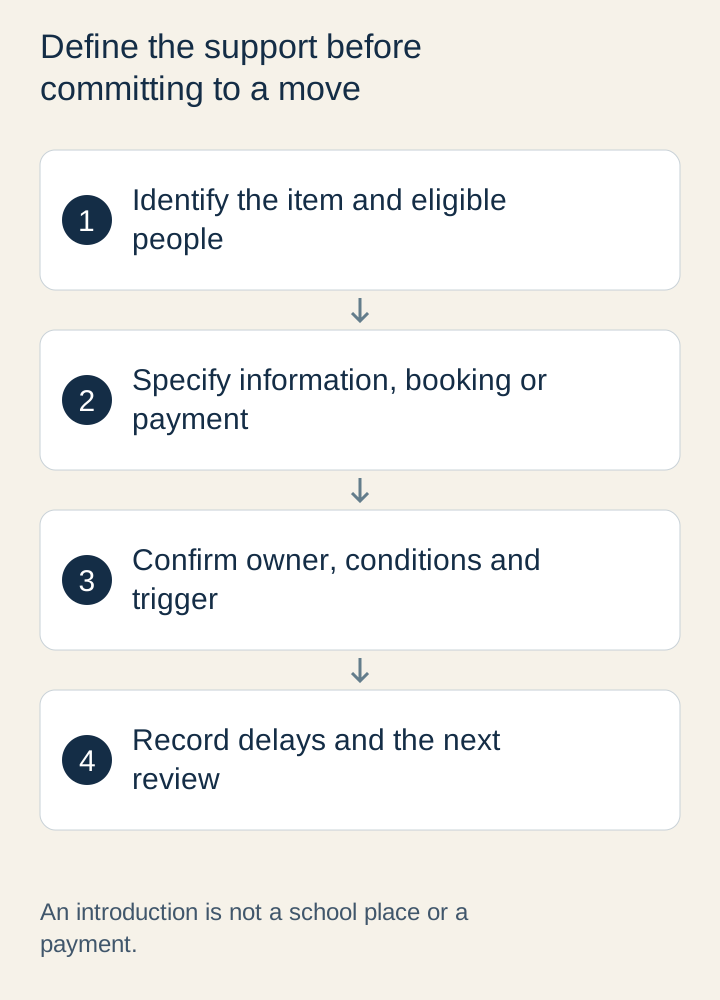
Use one row per benefit or practical arrangement. This original six-field tool makes the difference between a suggestion and a commitment visible. It is a negotiation record, not a supplier recommendation, a market price guide or a guarantee of immigration or school outcomes.
| Field | What to record | Question to close |
|---|---|---|
| Item and person | Travel, temporary stay or other defined need | Who is actually included? |
| Form of support | Information, booking, payment or reimbursement | What action has the employer agreed to take? |
| Owner and version | Company contact and policy/offer reference | Who can confirm the current arrangement? |
| Condition and limit | Stated scope, evidence and restrictions | What is not included or remains unknown? |
| Trigger and timing | Approval, booking, claim or payment event | When does support become usable? |
| Change and next step | Delay scenario, possible repayment and review | What happens if circumstances change? |
A useful entry reads: “Temporary accommodation discussed; HR to confirm provider, included household members and delay arrangements in the offer supplement; no booking made.” An inadequate entry reads: “Housing covered.” The first tells both sides what remains to be done. The second could mean almost anything and may conceal a substantial personal expense.
Keep the board free of passport numbers, school reports, health details and private relationship evidence. Record an authorised reference if a later process needs documentation. A recruitment contact does not need every family record simply to explain whether the company reimburses shipping.
When an answer changes, retain the earlier version and ask whether the offer or policy needs updating. Close one item at a time. Confirmation of a flight contribution does not settle a child's permission or the start of medical cover. The point of the board is to make interdependent decisions understandable, without pretending they are one approval.
6. Negotiate timing and a fallback before committing
Separate the worker's intended start, each family member's move, accommodation availability and school decisions. Ask which events must be confirmed before dates can be fixed. Do not use a predicted visa processing time or a possible school response as a guaranteed milestone. The employment-offer checklist helps keep work permission and a contractual date distinct.
An original message could say: “To assess the move, could you confirm which family members the temporary stay includes, when the booking is authorised, and how we review the arrangement if permission or school timing remains unresolved?” It is a question for discussion, not a pre-approved contract clause. Identify the responsible person and ask for the agreed answer in the appropriate document.
Consider an original fictional negotiation: a recruiter says family relocation is supported, but the attachment describes temporary accommodation for the employee alone. The candidate asks three separate questions about eligible household members, booking authorisation and the policy version governing any later reimbursement. They retain the unresolved difference rather than recording housing as covered. No employer, market price or successful outcome is represented.
If the company cannot provide a requested benefit, record that honestly and reassess the job using the actual terms. Do not hide an unresolved condition in an optimistic total package. For immigration background, see PremierVisa Group's professional-employment information. Long-term residence is a separate question addressed in the work and residence planning guide.
7. Questions before accepting a family relocation offer
Does a company introduction mean school admission is arranged?
No. Clarify what the introduction provides, then check the actual school's response and the child's permitted study arrangements. Keep admission, information support and any fee contribution separately recorded. Do not resign from a current school arrangement solely because a recruiter says the company has contacts.
Should I expect the employer to pay every relocation cost?
Ask what the specific offer includes. There is no package amount established by this article. Compare the form of assistance, eligible people, conditions and timing rather than assuming a broad label covers everything. Where an obligation is disputed, obtain an appropriate individual explanation.
Can my partner's possible job be included as confirmed income?
Keep permission to work separate from finding a job and receiving wages. Record future job searching as a plan, not secured income. The person's actual immigration conditions also need to be checked instead of using a statement about a different dependant category.
What if the family moves after I start?
Ask whether that changes any stated booking, reimbursement or enrolment conditions. Give the employer the timing information necessary to answer and agree when the plan will be reviewed. Do not assume that support either automatically continues or automatically disappears; read the actual arrangement.
What should I bring to a consultant discussion?
Bring a factual CV, the relevant offer and a brief responsibility board. Explain the family timing constraints and unresolved questions without sending unrelated sensitive files. Distinguish employer promises, official requirements and preferences so the discussion can focus on practical job preparation and any separate referrals needed.
To discuss your CV, interviews and realistic employer-contact direction, submit your job-search background. HKJobHunt, 卓越國際職涯, is within the PremierVisa Group service system. Assistance depends on your circumstances and the agreed engagement; no job, family permission, school place or residence outcome is guaranteed.