
Mainland applicants can begin a Hong Kong job search by matching real vacancies to evidence of their experience, then asking the actual employer about the next hiring and permission steps. Do not treat a job-board label, an interview or a promise to consider ASMTP as a confirmed sponsored position. This guide connects local job wording, an honest CV, employer contact and a six-field outreach ledger. It focuses on practical preparation for professional roles, without promising employment, entry permission or a start date.
- 1. Start with the work, not a list of supposed sponsors
- 2. Translate role wording into questions and CV evidence
- 3. Identify the relevant route without turning the search into an application
- 4. Use a vacancy-to-evidence outreach ledger
- 5. Make a focused first approach and prepare a useful interview
- 6. Hand over documents only when the next step is real
- 7. Questions Mainland applicants ask before contacting employers
1. Start with the work, not a list of supposed sponsors
Write down the duties you can actually perform, the evidence behind them and the kind of Hong Kong role you want. Separate occupation, industry, seniority and workplace requirements. A search for “Hong Kong sponsorship” alone can miss relevant vacancies and produce advertisements whose main attraction is an immigration promise rather than a clear job.
Build search phrases from the work. Someone who coordinates supplier issues might search for supplier coordination, operations support and relevant industry terms, then read each description. These are teaching search examples, not equivalent titles, regulated classifications or claims that those jobs are currently available. Keep an unfamiliar term as a question until the employer explains it.
The Labour Department's Mainland talent vacancy information page is a useful illustration of the boundary. It explains that employers supply advertisements voluntarily, the page does not provide referral service, and an advertisement need not satisfy ASMTP criteria. Government publication is not an individual immigration assessment or proof that a particular employer will hire you.
At the 26 October 2026 read, this draft did not obtain a usable list of employer vacancy rows from that page. That is an access observation about the displayed list, not proof that Hong Kong has no vacancies. Use current employer-controlled recruitment channels and record what you can actually verify; do not invent a partner-employer list to fill the gap.
2. Translate role wording into questions and CV evidence
Compare the advertisement's actual duties with your previous work. A familiar title may hide a different reporting level or function. Ask whether “executive” refers to an operational position or decision authority in that particular company; do not translate it automatically into your previous Mainland corporate grade.
Keep language requirements specific. A role may use English for reports, Cantonese with customers and Putonghua with a supply chain, but this guide claims no universal combination. Record what the actual advertisement says and ask how the language is used. A nationality, a degree or residence near the border does not establish professional language ability.
Use an original CV exercise. A vague line such as “Responsible for project management” can become, if true: “Coordinated the supplier-issue log, assigned follow-up items to the responsible team and checked supporting records before closure.” That sentence describes a contribution rather than inventing a management title, budget, percentage improvement or customer result.
Add scale only when you can substantiate it and disclose it appropriately. If a figure belongs to a confidential client file, explain the process without copying the file. If your contribution was part of a team result, state your part. A clearer CV helps an employer understand the work; it does not create qualifications or satisfy immigration criteria by itself.
For detailed CV preparation, use the Hong Kong work-visa CV guide. This article's task is the connection between one real vacancy, the relevant evidence and an employer enquiry, rather than another complete CV template or a new immigration-process overview.
3. Identify the relevant route without turning the search into an application
The ASMTP professional-employment guidance concerns Mainland Chinese residents with relevant skills, knowledge or experience and applicable job and remuneration conditions. A genuine offer and background matter together. Do not describe a degree, a job title or a company willing to talk as sufficient for approval.
GEP, ASMTP and IANG are not interchangeable names for “Hong Kong work visa.” Eligible graduates and certain overseas Chinese circumstances require separate consideration. The GEP page distinguishes its scope from Mainland professional admission. This guide does not assess Technical Professionals Streams or imported-labour arrangements, which have separate conditions.
For a candidate holding Mainland status, explain the actual background and present permission rather than simply saying “I am Chinese.” For a Taiwan reader assisting a Mainland colleague, do not assume the colleague's route applies to you. If an effective permission already exists, the relevant employment conditions must still be read before discussing a new job.
An employer can assess a CV before agreeing to coordinate a professional-employment application. That early recruitment conversation is useful, but record it as recruitment. For route background, see the GEP and ASMTP job guide; for the interview answer, see the work-permission discussion guide.
4. Use a vacancy-to-evidence outreach ledger
Create one row per real opportunity. This original preparation tool prevents a promising conversation from becoming an unsupported claim that sponsorship is arranged. It is not an official application, a live job directory or a verified employer database. Keep a private secure copy and mark unknown information as unconfirmed.
| Ledger field | What to record |
|---|---|
| Original vacancy wording | Source link, observation date, employing name and role version |
| Duties and language questions | Your interpretation and the particular point requiring clarification |
| Relevant applicant evidence | Your actual contribution, period, suitable evidence location and disclosure limit |
| Employer contact and response | Verified recruitment channel, responsible contact and what was actually said |
| Document coordination | Applicant and employer tasks, owner and current decision or missing information |
| Next action and start condition | Agreed follow-up, unresolved permission question and condition before commencement |
For example, a fictional applicant finds an operations role and asks whether its supplier-reporting duty matches their experience. HR requests a CV and says it will consider whether further employment-permission discussion is appropriate. The ledger should show “CV requested; employer process not confirmed,” rather than “sponsor secured.” Nothing in this example identifies a real client, vacancy or cooperating employer.
Use the ledger to compare decisions, not count applications as success. A recorded contact, a reply, an interview, a written offer and a permission decision are separate events. If the employer changes the role or employing entity, create a dated update and recheck the evidence connection instead of silently replacing the old description.
If you need help selecting evidence or preparing that first conversation, submit your job-search background to discuss your CV, interviews and practical employer-contact directions with HKJobHunt. Confirm the service and engagement scope; a consultation is not a guarantee of an employer network or immigration outcome.
5. Make a focused first approach and prepare a useful interview
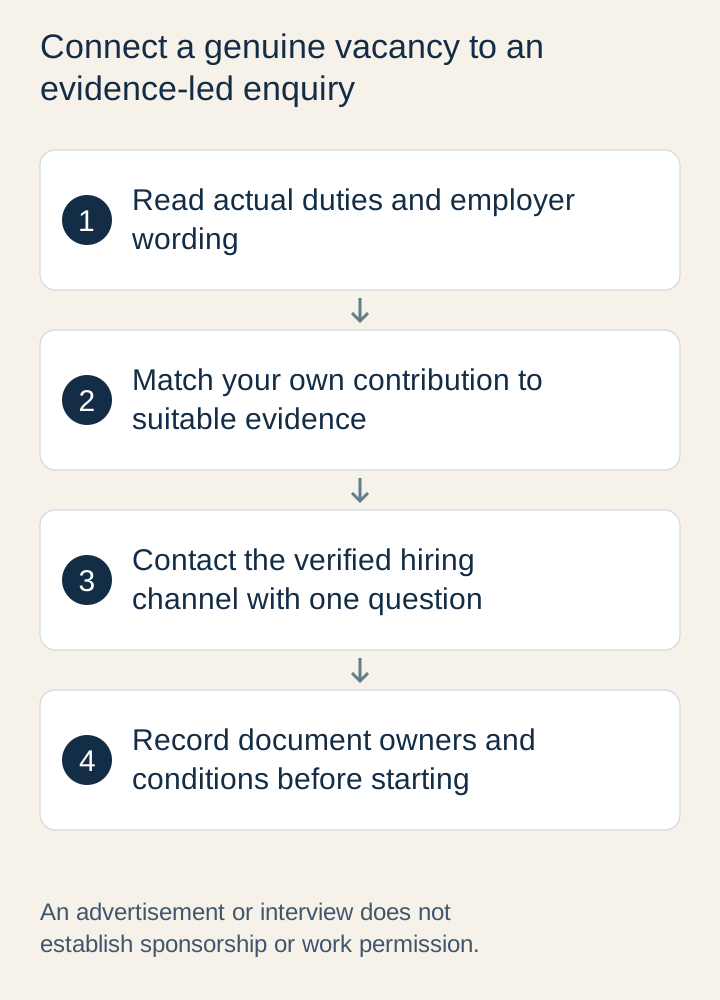
Use the recruitment channel actually published by the employer. Verify the company and role through an appropriate official company website or recruitment process before sending sensitive records. A forwarded message or personal account may be a lead, but it is not enough to establish who is receiving your documents.
An original first message could say: “I am applying for the stated role from the Mainland. My experience includes the supplier-record coordination described in my CV. Could you confirm the main reporting duties and whether the hiring team will consider discussing the applicable employment-permission process if there is a suitable match?” Adapt it to a real vacancy; do not mass-send it with invented experience.
Attach only the requested application material through the verified channel. A CV should state your actual location and relevant availability conditions. Do not imply you are already based in Hong Kong, have unrestricted permission or can start immediately merely to pass a filter. Explain an unresolved point briefly rather than hiding it inside an unrelated personal story.
Prepare one job-specific example and one question. Explain the situation, your action, how the work was checked and its limitation. If you have no Hong Kong experience, discuss transferable duties without claiming that Mainland experience and local regulatory knowledge are identical. Ask which local knowledge the role needs, then decide whether you can demonstrate it or need further preparation.
Language practice should follow the actual interview arrangement. Request clarification of whether the discussion or a practical exercise will be in a particular language. Do not promise fluency you cannot demonstrate, and do not assume the company requires no English because a recruiter first contacted you in Putonghua.
6. Hand over documents only when the next step is real
The ASMTP FAQ identifies an employer role in online submission and directs applicants to the professional-employment guidebook for supporting evidence. The current main page separates applicant and employer document categories. Coordinate those responsibilities rather than assuming the applicant can replace employer evidence with a CV.
| Preparation stage | Candidate's useful action | What it does not prove |
|---|---|---|
| Vacancy screening | Match actual duties and identify the employer | A genuine offer or suitable immigration route |
| CV and interview | Explain relevant contribution and current circumstances | Employer agreement to support an application |
| Offer discussion | Compare duties, remuneration and employing entity | Government acceptance of the case |
| Document coordination | Confirm owners, evidence and applicable requirements | Submission, approval or permission to start |
| Decision and arrival planning | Read actual permission and travel conditions | That every later employment change is allowed |
The applicant's current official checklist includes relevant academic and experience evidence and, where applicable, the Mainland consent-to-work document. Employer evidence concerns the actual company and employment; facilitation measures can affect what must be supplied. Use the current category-specific requirements and ask who will provide each item, rather than treating this article as an exhaustive document list for every case.
Do not ask for confidential employer financial returns in a first interview, fabricate an employment confirmation or rewrite duties to fit a preferred route. If a document is not in Chinese or English, the main guidance specifies an appropriate certified translation. Keep translation and document questions with the responsible reviewer, not an unverified recruiter promising approval.
The official visitor guidance prohibits visitors from paid or unpaid employment. A recruitment trip, submitted application or proposed “trial” is not an automatic work entitlement. Successful Mainland applicants also need the applicable travel document and relevant Mainland exit endorsement described in the ASMTP guidance; do not substitute a general travel permission for the employment arrangement.
For immigration background, use PremierVisa Group's Hong Kong professional-employment information, with individual scope and responsibility confirmed. For comparing an actual offer, see the salary and duties review. Recruitment preparation, professional assessment and a government decision remain separate.
7. Questions Mainland applicants ask before contacting employers
Do I need a list of approved sponsoring employers first?
This guide supplies no such list. Begin with genuine roles and employer-controlled channels, then verify what the company is actually prepared to consider. A government or commercial advertisement is a lead, not an individual eligibility decision or evidence of an available sponsorship place.
Should I change my Mainland job title to sound more senior?
Explain the actual duties and your own contribution. You may add a clear English description, but do not manufacture authority, qualifications or results. A title that sounds familiar to Hong Kong HR should still match the evidence you can honestly discuss.
Can I write that I need GEP because the advertisement is in English?
Interview language does not select an immigration route. Mainland professional admission, overseas Chinese circumstances and qualifying graduate arrangements have distinct scopes. State your actual background and identify the appropriate assessment question rather than selecting a convenient label.
Does an employer asking for documents mean the application is approved?
No. A document request may be part of recruitment or preparation. Record which task, who requested it, the verified recipient and the current stage. A request, submission acknowledgement and actual decision need separate evidence, and none should be renamed to make progress look faster.
What can I do while a route question is unresolved?
Continue preparing accurate CV evidence, studying genuine job duties and arranging appropriate recruitment conversations. Do not assume that an unresolved permission question permits work. Bring the specific gap to the responsible employer or appropriately engaged adviser and keep commencement conditional.
Submit your job-search background to discuss CV preparation, interviews and practical employer-contact directions. Bring the outreach ledger so the next step addresses a real role and a real question, without promising a job, sponsorship, approval or permanent residence.