Hong Kong overseas hiring has no single guaranteed end-to-end duration. For professional applications under GEP and ASMTP, the Immigration Department currently states that processing normally takes four weeks after all required documents and the relevant application fee are received. That is not a promise measured from advertising, interview or offer acceptance. Employers should track recruitment, preparation, official processing and permission to start as separate events, with an owner and a fallback for each unresolved dependency.
- 1. Decide which timeline the business is asking about
- 2. Read the official processing reference with its starting condition
- 3. Map the dependencies before adding calendar dates
- 4. Track document gaps and further requests without inventing rules
- 5. Build an event, owner and replanning register
- 6. Plan the start and fallback using actual permission
- 7. Questions employers ask about timing
1. Decide which timeline the business is asking about
“How long will hiring take?” may refer to finding a suitable person, agreeing terms, preparing evidence, receiving an immigration result or beginning the actual job. These are different questions. Put the desired business outcome beside the event you can actually observe, rather than treating a single date as an answer to all of them.
Start with the role and employing entity. A recruitment process cannot be planned accurately if managers are still changing the primary duties or the company that will sign the offer. Use the employer preparation brief to identify the facts and their owners before describing a package as ready.
Record the candidate's actual circumstances and applicable arrangement. Mainland professional applicants and other candidates may need different route and travel questions addressed. A person already in Hong Kong may have conditions relevant to a change of employment. Do not use a timeline for another scheme or a visitor application simply because its processing figure looks convenient.
Separate a business target from a confirmed milestone. The business can prefer a particular start, but that preference does not establish that candidate selection, evidence, immigration or travel matters will be complete. A useful plan shows where the target still depends on another decision.
2. Read the official processing reference with its starting condition
The current GEP page and ASMTP page, checked on 26 October 2026, both state a normal processing reference of four weeks upon receipt of all required documents and the relevant application fee. They also say processing cannot start until those requirements are received. Keep that condition attached whenever the figure is repeated.
Do not count the reference from the first consultant call, CV submission, signed offer or an internal upload. An acknowledgement and a company's belief that its files are complete do not justify inventing a guaranteed decision date. Use the actual application communications to understand its status, and keep anything not confirmed labelled as such.
Official processing is only one part of the hiring plan. It does not include an employer's search and interviews, time needed to resolve an inconsistent job description or all arrangements after a successful decision. Do not add unsupported standard durations to the official reference and advertise the result as a reliable total.
The official pages make clear that applications are determined individually and approval is discretionary. A normal duration is neither an approval probability nor a deadline binding every case. Avoid describing a file as delayed solely because your internal target has passed; identify the actual state and what can be checked next.
3. Map the dependencies before adding calendar dates
Use an event sequence that reflects your case. Define the role, assess candidates, agree the relevant terms, assign evidence, prepare and submit through the proper process, address any further request, then verify the result and the remaining start conditions. Some preparation may overlap, but a dependency should not disappear just because two tasks are being worked on at once.
The table below is an original employer planning aid. Only the official-processing row contains a sourced numerical reference. Other periods are case-specific and are not estimated by this guide; an unknown duration is not zero.
| Planning stage | Evidence of the event | Timing description |
|---|---|---|
| Recruitment decision | Role and selection decision confirmed | Employer-specific; no standard period asserted |
| Terms and preparation | Current offer and relevant evidence responsibilities reconciled | Depends on actual work remaining |
| Official processing | Required documents and relevant fee received under the applicable process | Normally four weeks for the cited professional applications, subject to the official conditions |
| Further information | Actual request, response owner and submission record | Case-specific; no invented additional period |
| Result and travel/conditions | Actual decision and relevant documentation/conditions checked | Depends on the granted arrangement and person |
| First working day | Required permission and agreed employment conditions confirmed | Confirm separately; not inferred from a target |
Ask who owns each transition. A hiring manager can confirm the selected duties; a company document owner can confirm company facts; the candidate supplies truthful personal evidence. A coordinator can maintain the plan without becoming the decision-maker for every subject.
If you cannot identify what completes a stage, the date is probably carrying an assumption. Replace “visa done” with the actual event you mean and the record supporting it. Keep preparation, submission, decision and permission to undertake the intended work distinct.
4. Track document gaps and further requests without inventing rules
For an outstanding item, record the category, its owner, the specific unanswered question and the next action. Do not mark a file complete because a folder contains an attachment. A document can exist while using an old employing entity, inconsistent duties or a date that needs correction.
The GEP and ASMTP pages allow further supporting information to be requested where necessary. If a request arrives, identify what it actually asks and which source can answer it. Do not assume a universal extra period, an automatic clock reset or a guaranteed priority route unless an applicable official statement establishes that arrangement.
Keep the request and response version traceable through the authorised process. Do not circulate confidential financial or personal files merely to demonstrate activity. An accurate status message can identify the issue and owner without exposing the underlying documents to everyone on the hiring team.
Use a neutral update: “The company-background clarification is being prepared by the authorised contact; the response has not yet been submitted; the proposed start remains subject to confirmation.” This is an original communication example, not a real case. It tells colleagues what remains open without presenting preparation as a result.
If coordination is difficult, submit your hiring requirements to HKJobHunt. A consultant can discuss talent search, screening and interview arrangements. Visa matters can be referred within PremierVisa Group for case assessment under the agreed service scope; no processing date is guaranteed.
5. Build an event, owner and replanning register
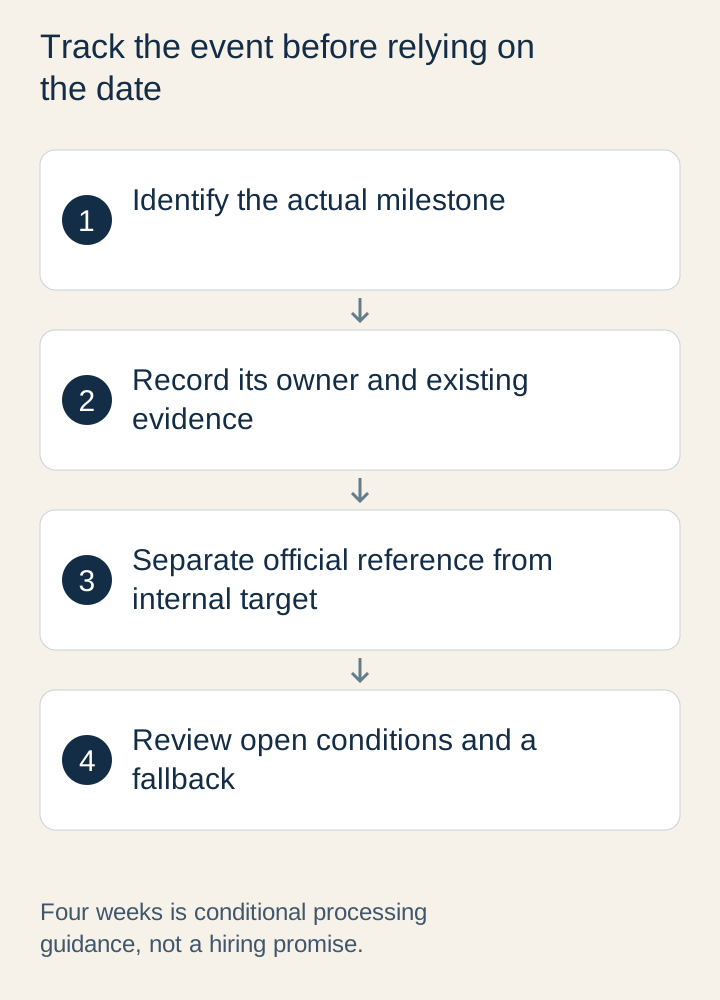
This original six-field tool records the state of each dependency. It is not an official immigration tracker and should not contain login credentials, identification numbers or confidential attachments. Keep authorised references and factual status updates.
| Field | What to record | Replanning question |
|---|---|---|
| Stage and event | The actual milestone being discussed | Is this preparation, submission or a result? |
| Owner | Person responsible for the next action | Who can supply or confirm the fact? |
| Existing evidence | Dated message or authorised reference | What proves the present state? |
| Timing basis | Official reference, employer target or unknown | Are different kinds of date being confused? |
| Open dependency | Missing fact or external decision | What must happen before reliance? |
| Review and fallback | Trigger, respondent and revised action | What changes if it remains unresolved? |
A useful entry says: “Offer duties reconciled; candidate evidence item outstanding; document owner to answer the specific question before readiness is reviewed.” A weak entry says: “Four weeks until arrival.” The first names work that can be progressed. The second assumes an official starting condition and all later arrangements without evidence.
When the business asks for a revised forecast, explain which part is within company control and which depends on an external response. For example, an owner may commit to reviewing a document, while being unable to promise when an authority will decide it. Record both statements accurately instead of converting the internal commitment into a forecast for the external event.
Keep an agreed review event, such as receipt of a specified answer or an actual application update. Do not repeatedly move a target in a spreadsheet and call the change a confirmed schedule. Explain what new fact caused the revision and which other commitments need review.
Where a candidate is also serving notice elsewhere, treat that obligation as its own dependency. The new employer's preferred date does not determine the old contract's requirements. For written terms and a conditional-start discussion, use the offer checklist.
6. Plan the start and fallback using actual permission
A successful application result may still require the relevant issuance, travel or entry arrangements to be followed. The GEP and ASMTP pages describe their respective documentation steps, including additional Mainland travel arrangements where applicable. Do not assume that receiving one message completes every action for every person.
Check the conditions actually held before the intended work begins. For professionals on employment conditions, the official routes distinguish changes needing prior approval from qualifying top-tier time-limitation-only circumstances. A candidate already locally resident should not be treated as automatically ready for any new employer.
The Immigration Department's visitor guidance prohibits paid and unpaid employment by visitors. Do not fill a timing gap with productive unpaid work or assume a training label removes the restriction. The proposed activity and actual conditions need the appropriate assessment.
Agree how the team will respond if a dependency remains open: review the proposed date, reallocate existing authorised work or postpone a commitment where feasible. These are planning choices, not guaranteed legal solutions. For immigration detail, see PremierVisa Group's professional-employment information, and keep candidate assessment separate from urgency to fill the vacancy.
7. Questions employers ask about timing
Can we promise a start four weeks after signing the offer?
No. The official processing reference has a different starting condition and does not cover the whole hiring process. A signed offer does not establish receipt of every required item, a favourable result or completion of later arrangements. Confirm the actual dependencies before relying on a date.
Does an acknowledgement mean the application will be approved?
No. It records a stage in the process, not a favourable decision. Use actual communications to track status and distinguish what is confirmed from what the business hopes will happen. An internal readiness label cannot replace the immigration assessment.
How many extra weeks should we add for further documents?
This guide does not assert a universal number. Read the actual request, assign the correct owner and identify what can be answered. Do not invent an automatic reset or a standard additional duration without an applicable official basis.
Can the candidate work unpaid while waiting?
Do not use that as a general workaround. Visitor employment restrictions include unpaid work, and other statuses have their own conditions. Check the actual activity and permission before it begins rather than renaming productive work as a trial.
What should we bring to a recruitment-timing discussion?
Bring the real role, current offer, actual status and the event register with unanswered dependencies. Identify the recruitment assistance needed and the immigration questions requiring separate assessment. Remove unrelated confidential material and distinguish targets from confirmed milestones.
To discuss talent search, screening and interview arrangements, submit your hiring requirements. HKJobHunt, 卓越國際職涯, is within the PremierVisa Group service system. Support and any referral depend on the case and agreed engagement, without promised jobs, visa approvals or fixed arrival dates.