Before preparing a Hong Kong professional-employment application, an employer should define the genuine vacancy, relevant candidate evidence, applicable arrangement and responsibility for company documents. A willing candidate, an impressive title or a signed offer alone does not establish approval. This guide provides a pre-application brief for hiring managers and HR, helping them resolve differences before material is used, while keeping recruitment decisions, immigration assessment and the employee's actual permission to start separate.
- 1. Start with the business need and the employing entity
- 2. Connect necessary duties to actual candidate evidence
- 3. Establish the applicant's actual arrangement and conditions
- 4. Assign company-document owners and check facilitation scope
- 5. Use a pre-application role and evidence brief
- 6. Set boundaries for communication and the proposed start
- 7. Questions employers ask before preparing an application
1. Start with the business need and the employing entity
Identify the company that will employ the person, the business activity creating the vacancy and the output expected from the role. A group brand or a general wish to recruit internationally is not a job description. Write who needs the work, who supervises it and what responsibility belongs to the new employee.
Ask the hiring manager to explain why the position exists now. The answer might involve a reporting requirement, a service function or a particular project interface, but it must reflect the real business. Do not manufacture customer contracts, headcount, revenue or expansion plans because they sound persuasive in an application narrative.
Keep the internal vacancy brief, recruitment advertisement and proposed offer consistent. If the team changes the primary duties, record the change and have the relevant manager confirm it. Do not recruit for one job and describe another solely to make an immigration argument appear stronger.
This is preparation before application materials are relied on. Detailed candidate comparison, a promised processing calendar and day-one onboarding are separate tasks. Candidates checking a company's information can use the employer-verification guide; this article assigns the employer's own responsibilities for an accurate brief.
2. Connect necessary duties to actual candidate evidence
Translate the role into material tasks and the skills or experience needed to perform them. Distinguish necessary requirements from preferences. Avoid selecting a qualification simply because a preferred candidate has it; the requirement should have a reason connected to the actual work.
For each key task, identify what the candidate can truthfully demonstrate. A CV title is not the same as evidence of personal responsibility. Ask for a relevant explanation of the output, the candidate's action and its limits. Professional recognition or task authority, where relevant, needs its own check and should not be inferred from a translated overseas title.
The official General Employment Policy guidance addresses a genuine vacancy, relevant background, employment and remuneration criteria. The ASMTP guidance sets out the corresponding professional route for its applicant scope. Neither page makes an employer's willingness a substitute for the relevant assessment.
An original working note might say: “Role prepares internal reporting inputs; candidate describes reconciliation and exception logging; manager to confirm whether the role includes client acquisition.” This identifies a difference to resolve. It does not invent exceptional ability, claim no local candidate exists or predict the immigration result.
3. Establish the applicant's actual arrangement and conditions
Ask for the facts needed to determine which arrangement should be considered: the person's relevant background and current status, the proposed activity and any question requiring individual immigration assessment. Do not choose a route only from the language used in the interview or the location from which an email was sent.
GEP, ASMTP, IANG and imported-worker arrangements must not be treated as interchangeable. Mainland professional applicants and Taiwan residents need their own scope checked. A candidate already in Hong Kong may also hold conditions that affect a proposed change or start; “has a Hong Kong visa” is not a complete statement of work permission.
Assign a person to coordinate questions with the candidate and the appropriate adviser or authority. HR should know which facts are confirmed, which are being assessed and which remain unknown. Keep the recruitment assessment separate from the immigration determination rather than having a hiring manager casually certify the candidate as eligible.
For an introduction to the professional routes, use the GEP and ASMTP employment guide. Detailed immigration services can be discussed through PremierVisa Group's professional-employment information. No description here guarantees an application or replaces the conditions actually granted.
4. Assign company-document owners and check facilitation scope
Use the current official supporting-document section to separate applicant and employing-company material. Create an index of categories, responsible owners and the authorised handling channel. A recruitment coordinator needs a clear status, not unrestricted access to every confidential financial or personal document.
The GEP and ASMTP pages include employer-side evidence about the offer and company circumstances, with footnotes affecting what is required. Check the current list against the particular case. Do not create an unofficial minimum turnover, capital balance or staff count, and do not assume a newly established company is automatically excluded.
Read the official facilitation measures with those lists. A specified measure can affect specified supporting evidence in qualifying circumstances; it is not a blanket exemption from truthful information or approval. Relevant documents may still be requested in an individual case. Record the measure and its scope rather than writing “company exempt” without explanation.
Where a category is outstanding, record who will confirm it and what is needed before reliance. Do not ask the candidate to invent company background or sign an empty declaration. If a document conflicts with the current offer, resolve the difference through the authorised owner and retain the accurate version.
If you need help defining the vacancy and recruitment work, submit your hiring requirements to HKJobHunt. A consultant can discuss talent search, screening and interview arrangements. Immigration matters can be referred within PremierVisa Group for case assessment under the agreed service scope; recruitment assistance does not promise a visa decision.
5. Use a pre-application role and evidence brief
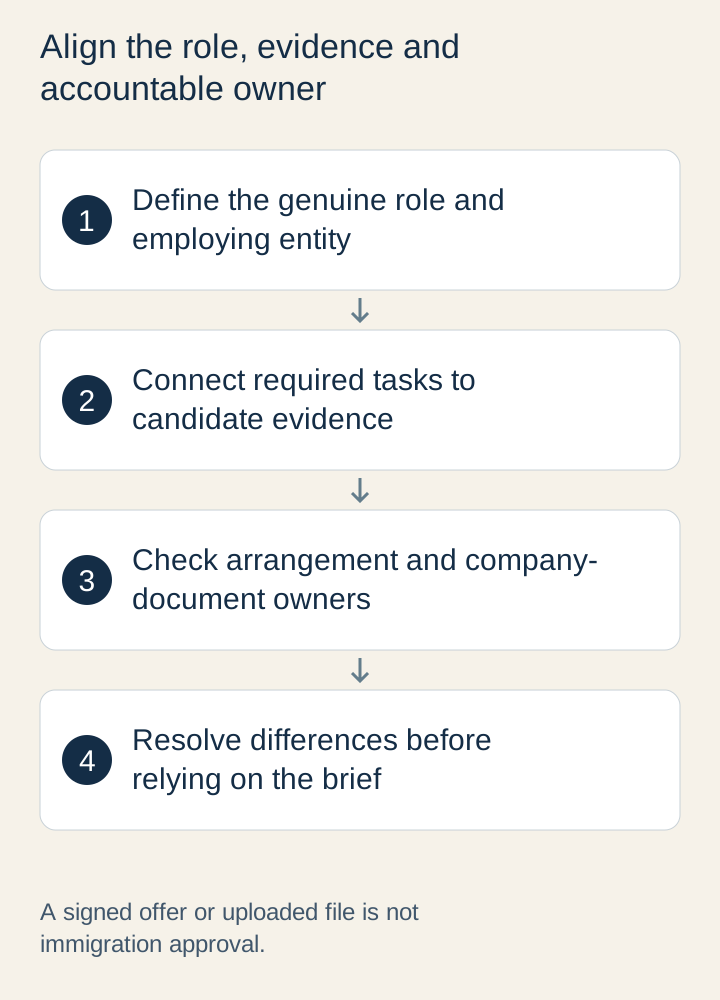
This original six-field tool helps the hiring manager, HR and any appointed adviser work from the same facts. It is a preparation brief, not an official form, a candidate-scoring model or proof of eligibility. Keep sensitive underlying records in the proper channel and use authorised references in the brief.
| Field | What to capture | Question before reliance |
|---|---|---|
| Entity and vacancy | Employing company, work output and business need | Does the role genuinely exist as described? |
| Necessary requirements | Task, reason and required responsibility | What is essential rather than preferred? |
| Candidate evidence | Actual experience, source and limitation | What can the person truthfully support? |
| Arrangement and conditions | Current status, proposed route and open question | Who will assess the applicable position? |
| Company evidence | Category, owner, channel and facilitation scope | What is ready and what remains outstanding? |
| Difference and decision | Conflicting version, respondent and next action | What must be reconciled before use? |
A useful entry reads: “Hiring brief describes internal analysis; offer draft adds sales targets; manager to confirm the primary role before HR finalises the description.” A weak entry reads: “Senior specialist, visa should be easy.” The first assigns a factual problem to an owner. The second gives a confidence claim without the underlying work or evidence.
Mark each item as confirmed, outstanding or requiring assessment, with a reference and a next action. Do not colour the whole brief green because someone has uploaded a file. A file can exist while containing the wrong entity, old terms or an unexplained difference. Document availability and factual suitability are different checks.
Make the handover explicit when more than one person contributes. The hiring manager confirms the actual work, the company document owner confirms company facts, and the candidate confirms personal experience. A coordinator can collect the answers without becoming the authority for every subject. If one answer remains unresolved, name the issue and the next respondent instead of circulating an unqualified statement that the application is ready. This prevents an internal file-sharing milestone from being mistaken for a completed factual review.
Keep a short change history. When the manager revises duties or the company changes the proposed entity, identify which offer and evidence references need reviewing. Do not quietly replace one version while others continue to rely on it. The purpose is shared understanding of accurate facts, not an artificially uniform story.
6. Set boundaries for communication and the proposed start
Tell the candidate what the company has actually decided and what remains conditional. Distinguish a recruitment preference, an issued offer, an application being prepared and an immigration result. Avoid statements that payment guarantees sponsorship or that a role can be promised before its conditions have been resolved.
Ask a focused question when information is unclear: “Please explain your own role in this example and the evidence you can provide,” or “Which current condition needs to be checked before the proposed work begins?” Do not request a complete private history simply because the candidate is overseas. Agree the relevant recipient and purpose for any material that is actually needed.
The Immigration Department's visitor guidance prohibits visitors from paid and unpaid employment. Do not use productive unpaid work as a temporary solution while permission is unresolved. Renaming work as a trial does not establish that it is allowed; the actual activity and conditions matter.
Use the offer checklist to separate the intended start from the conditions requiring confirmation. Assign the person who will communicate a change and record what must be checked before work begins. A preferred business date, an estimate or a submission acknowledgement is not a substitute for permission.
7. Questions employers ask before preparing an application
Can we choose a visa route because the candidate is currently abroad?
Location alone does not settle the arrangement. Consider the candidate's actual circumstances, proposed activity and current status. Mainland professional scope, GEP and other arrangements need their respective requirements checked rather than selecting an acronym for convenience.
Does a previous non-local hire mean no company documents are needed?
Check the specific facilitation measure and its conditions. Do not assume a past hire creates a permanent company exemption. Record which evidence the measure affects, and remember that relevant material may still be requested in the individual case.
Can a candidate write our company explanation for us?
The candidate can explain personal skills and experience. Company representations should be checked and confirmed by the responsible company owner. Do not ask someone to invent customers, turnover, staffing or plans to fill a blank in the preparation brief.
Can we fix the start because the offer is signed?
Keep the agreement and work permission separate. Confirm the person's actual conditions and any required decision before the intended work begins. If something remains unresolved, identify its owner and agree how the proposed date will be reviewed.
What should we provide for a recruitment discussion?
Prepare the genuine role brief, employing entity, necessary requirements and open questions. Explain the recruitment assistance you want, such as search, screening or interview coordination. Share sensitive evidence only through the appropriate confirmed process, and distinguish recruitment needs from immigration assessment.
To discuss talent search, screening and interview arrangements, submit your hiring requirements. HKJobHunt, 卓越國際職涯, is within the PremierVisa Group service system. The actual assistance and any immigration referral depend on the case and agreed engagement; no employer partnership, ready candidate supply or approval outcome is invented or guaranteed.