When a Hong Kong vacancy is difficult to fill, clarify the real duties and evidence needed before widening an overseas search. Compare candidates against job-related criteria, distinguish observations from impressions and check work permission separately. This guide gives employers an original interview evidence matrix, helping managers explain selection decisions without treating an overseas title, a familiar accent or a strong interview performance as proof of professional authority or immigration eligibility.
- 1. Diagnose the vacancy before blaming the talent pool
- 2. Turn broad requirements into observable work
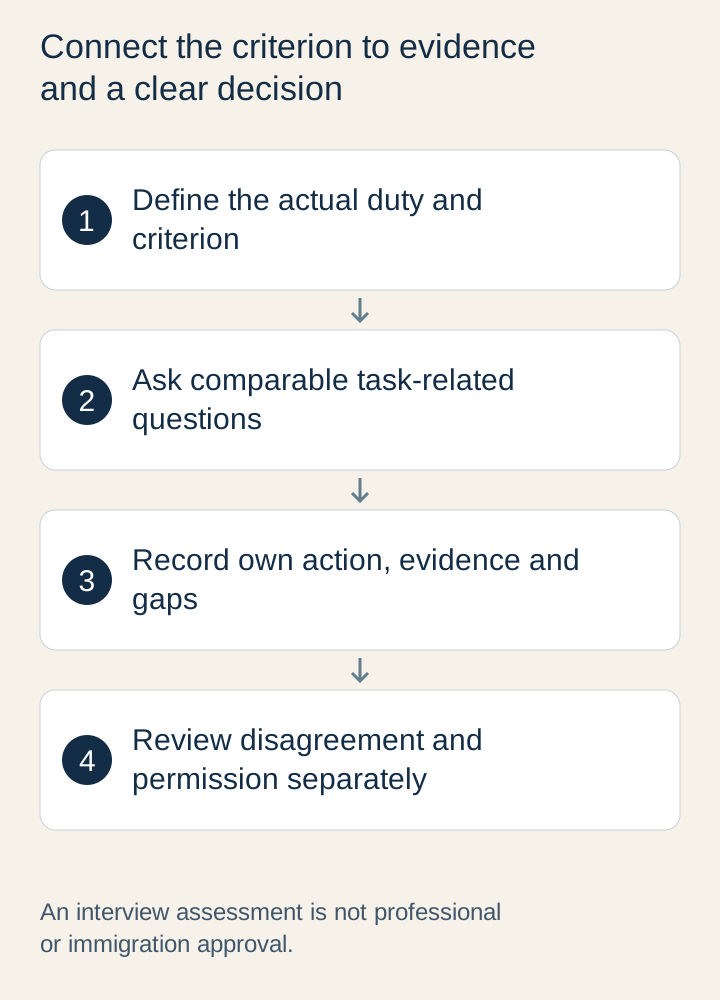
- 3. Ask comparable questions and record actual evidence
- 4. Assess language and qualifications for the actual task
- 5. Use a criterion, question and evidence matrix
- 6. Preserve recruitment facts and keep permission separate
- 7. Questions employers ask about evaluating overseas talent
1. Diagnose the vacancy before blaming the talent pool
Start with the work that remains undone. Identify the output, its user, the decisions involved and the level of responsibility. “We need an international professional” does not explain whether the person must analyse information, resolve a customer issue, supervise a process or exercise a regulated function.
Review whether the advert, internal brief and hiring manager describe the same role. If one document emphasises service delivery while another adds sales management, resolve that difference before comparing candidates. Otherwise, interviewers may assess different jobs while believing they disagree about the same person.
Difficulty recruiting is an observation, not proof that no suitable local candidate exists. Record where and how the vacancy was advertised, which requirements were assessed and what information is missing. Do not invent a recruitment history, rejection reason or number of unsuccessful applicants to support a later application narrative.
The pre-application employer brief helps establish the entity and company evidence responsibilities. This article goes further into how the team assesses work-related ability. Processing estimates and onboarding are separate tasks and should not be allowed to determine a candidate's competence score.
2. Turn broad requirements into observable work
Take each important duty and ask what satisfactory performance would involve. Replace “excellent communicator” with a relevant activity, such as explaining an unresolved service issue and agreeing the next action. Define the audience, language and responsibility without assuming one personality or background is the only way to perform it.
Separate essential requirements from preferences before interviews begin. A particular system, market or sector may matter, but ask whether direct experience is necessary or whether transferable evidence can address the task. Do not quietly change the standard when a preferred candidate appears.
The EOC's employment code under the Sex Discrimination Ordinance recommends consistent selection criteria related to duties and responsibilities. Its guidance supports an objective framework; it does not mean an employer's own scoring sheet has been approved or that a numerical total settles every legal question.
Use a plain criterion statement: “Identifies missing information, explains the consequence and assigns a next action within the role's authority.” That can be discussed using different genuine experiences. A vague statement such as “has the right cultural fit” needs clarification before it is used to reject anyone.
3. Ask comparable questions and record actual evidence
Agree a core question for each material criterion. Interviewers can clarify a person's experience while preserving the same underlying standard. Ask what the candidate personally did, what information was available and which decision belonged to someone else. A team result alone does not establish individual contribution.
An original prompt might be: “Describe a service handover where information was incomplete. How did you identify the gap, explain it and confirm who would act next?” Follow up on the person's own action and evidence. Do not ask for confidential customer details to make the account feel more convincing.
Record the relevant answer and its limitation separately from your assessment. “Candidate described an escalation note but did not explain how ownership was confirmed” is more useful than “not confident.” The former identifies a specific gap that another interviewer can understand and a follow-up question can address.
Where a short exercise is appropriate, explain its purpose and boundaries. Do not use a recruitment exercise to obtain productive work while permission is unresolved. The Immigration Department's visitor guidance prohibits paid and unpaid employment by visitors; a trial label does not establish that the activity is permitted. Obtain an appropriate assessment if the actual arrangement is unclear.
4. Assess language and qualifications for the actual task
Specify the language activity rather than relying on a broad fluency label. Reading a procedure, writing a customer message and discussing an exception may involve different demands. Assess the capability relevant to the role, and distinguish clarity of communication from an interviewer's preference for a familiar accent.
The EOC's race-discrimination FAQ explains that a language requirement used in rejecting a candidate needs justification connected to the job. Do not turn nationality or a stereotyped assumption into evidence of language ability. Any particular legal issue still requires its own circumstances to be considered.
For qualifications, retain the issuer, jurisdiction and actual status. A translated title, overseas membership or company licence does not establish every individual's Hong Kong authority. Identify who can check a regulated responsibility before relying on it. Do not describe a pending recognition process as completed.
The official GEP guidance and ASMTP guidance concern their respective professional-employment assessments. Relevant experience and genuine employment matter, but an interviewer's positive view is not immigration approval. Keep route and current conditions as a separate workstream.
If the team needs help defining criteria and recruitment arrangements, submit your hiring requirements to HKJobHunt. A consultant can discuss talent search, screening and interviews. Immigration questions can be referred within PremierVisa Group for individual assessment under the agreed service scope.
5. Use a criterion, question and evidence matrix
This original six-field tool connects the role to the decision without pretending to calculate a guaranteed best hire. It can be used for the candidates you are authorised to assess. Do not insert unrelated private information or turn missing evidence into a fabricated zero score.
| Field | Record | Check before deciding |
|---|---|---|
| Work output | Real task, audience and responsibility | Are interviewers assessing the same job? |
| Criterion and reason | Required capability and why it matters | Is it essential or preferred? |
| Core question | Comparable prompt and relevant clarification | Does it test the criterion? |
| Observed evidence | Own action, source and limit | What did the candidate actually demonstrate? |
| Gap and follow-up | Missing fact and appropriate next question | Is the assessment based on an assumption? |
| Decision and owner | Reason, reviewer and current version | Can the decision be explained against the work? |
For the service-handover example, the criterion might be identifying an incomplete record and confirming responsibility. The observed evidence might describe a question log and escalation to a supervisor. If the candidate has not explained how the receiving team acknowledged the handover, record that gap rather than assuming the process succeeded.
Consider two fictional answers to the same handover question. One candidate describes a successful team result but cannot explain a personal action. Another describes a narrower responsibility, identifies the missing information and explains how a supervisor confirmed the next owner. The second answer provides more traceable evidence for that particular criterion; it does not automatically make that person the better candidate for every requirement. Ask the first candidate a relevant clarification and evaluate both against the same work standard.
Before the panel discussion, each interviewer can prepare a short note containing the criterion, the observed answer and any unanswered question. Then compare the notes rather than allowing the most senior person's first impression to become everyone's memory. If a note only says excellent or unsuitable, ask which response supports it. Keep any correction identifiable and avoid adding a new requirement merely because a preferred answer was more polished. This is a practical method for reviewing evidence, not a claim that the matrix measures future performance with scientific accuracy.
Discuss evidence before collapsing the assessment into an overall impression. A candidate may explain one task strongly while another requirement remains unresolved. Keep the difference visible. A general statement that someone is impressive should not silently override a material gap, and an unfamiliar presentation should not obscure relevant capability.
Where interviewers disagree, identify the criterion and answer behind each view. Ask whether the difference concerns evidence, interpretation or an unstated new requirement. Resolve it transparently and retain a concise explanation. Do not revise the criteria retrospectively merely to justify a preferred result.
6. Preserve recruitment facts and keep permission separate
Keep the original advert, current criteria, interview evidence and decision version in the authorised recruitment process. Record changes and corrections accurately. This creates a usable account of the work done, without manufacturing a story about market scarcity or promising that records will establish a visa application.
The official GEP and ASMTP facilitation measures affect specified supporting evidence in qualifying circumstances. Do not assume every case needs the same local-recruitment material or that every company is exempt. Any application-related evidence question should be checked against the actual arrangement and applicable measure.
Ask a separate permission question using the candidate's real circumstances: current status, proposed work and the issue requiring assessment. Mainland professional scope, GEP, graduate and imported-worker arrangements are not interchangeable. Do not equate “overseas candidate” with a single immigration category or use an unverified availability claim as a competence judgment.
Before issuing or revising an offer, reconcile the selected role and terms with the assessment. Use the offer checklist for conditions and the recruitment timeline guide for dependencies. For immigration detail, see PremierVisa Group's professional-employment information. Selection does not itself authorise the person to start.
7. Questions employers ask about evaluating overseas talent
Should we create a different standard for an overseas candidate?
Define the genuine job requirements and apply the relevant criteria consistently. Clarify actual evidence and any separate permission questions. Do not assume a person's location, accent or translated title establishes ability or inability. Material legal or professional requirements still need their own scope checked.
Can we require a language simply because the team prefers it?
Identify the real task and why the requirement is needed. The official EOC guidance calls for job-related justification rather than assumptions about a person's background. Do not treat a broad preference as an automatic answer to a particular discrimination question.
Is an impressive team achievement enough evidence?
Ask what the person actually did, the available information and the authority involved. A team outcome can provide context, but it does not tell you the candidate's own contribution. Record both the useful evidence and what remains unconfirmed.
Does a good interview prove visa eligibility?
No. Recruitment assessment and immigration assessment answer different questions. Keep the role, actual candidate evidence, applicable arrangement and current conditions separately recorded. Neither an interview score nor an employer's willingness guarantees approval.
What should we prepare for recruitment support?
Bring the real role, current criteria, relevant examples of the questions being asked and the gaps you need to resolve. Explain whether you need search, screening or interview coordination. Avoid sending unrelated confidential candidate records before the appropriate handling arrangement is clear.
To discuss talent search, screening and interview arrangements, submit your hiring requirements. HKJobHunt, 卓越國際職涯, is within the PremierVisa Group service system. Assistance and any immigration referral depend on the agreed engagement; no candidate supply, employer partnership or hiring outcome is invented or guaranteed.