
You can prepare and pursue a Canadian job application while overseas, but first establish that the actual employer will consider your situation and arrange a remote recruitment conversation with clear dates, participants and evidence. An interview invitation is not an offer, an LMIA decision or permission to work. This guide focuses on the practical handover from a genuine application to a video interview and its follow-up, with a six-field appointment record. It suits candidates who need an organized discussion before making travel, resignation or start-date commitments.
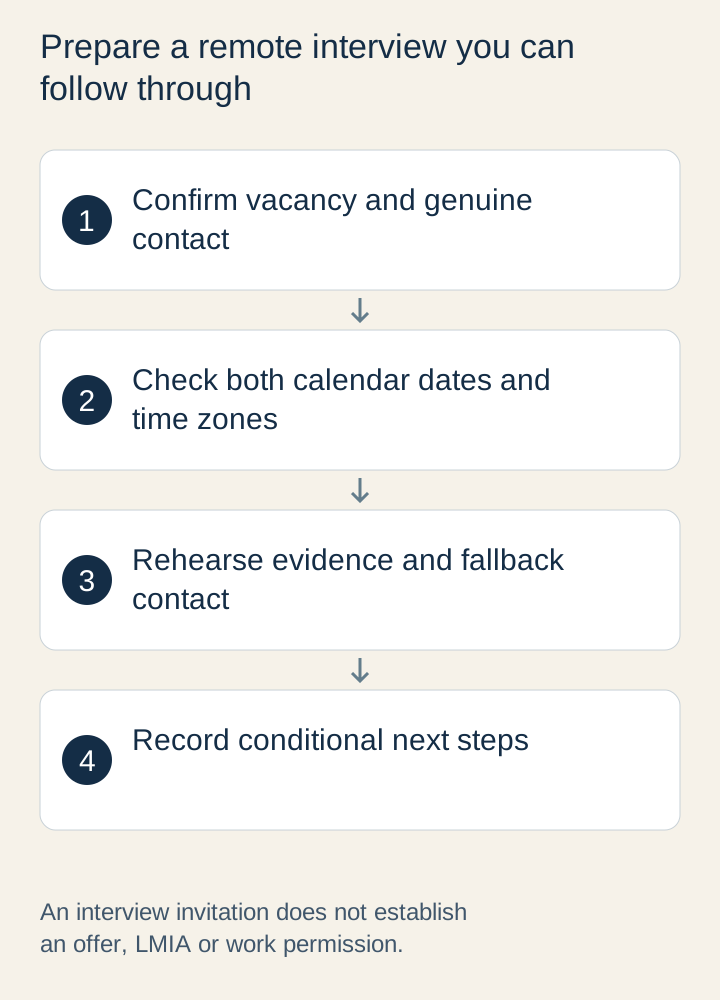
- 1. Confirm the vacancy and recruitment channel before scheduling
- 2. Confirm both calendar dates and the exact time zones
- 3. Prepare a small evidence set for the actual interview
- 4. Rehearse the call and agree a failure-recovery plan
- 5. Use a six-field appointment and evidence handover
- 6. Turn the follow-up into conditional next steps
- 7. Frequently asked questions
1. Confirm the vacancy and recruitment channel before scheduling
Save the original vacancy, job reference, duties and application method. Locate the employer’s published recruitment channel independently and follow its instructions. A message forwarded by another person can be a useful lead, but it should not be your only connection to the company. Ask whether the current vacancy and the person arranging the meeting are part of the employer’s actual recruitment process.
State your current location and work-authorization situation accurately. A short first enquiry can explain your relevant experience and ask whether the employer considers overseas applicants for this role. An unanswered question stays unanswered. The word LMIA in an advertisement does not establish that the employer has applied, received a positive decision or agreed to support your particular application.
Keep one contact log per genuine vacancy. A duplicate advertisement or a second recruiter does not create another job. Record the resume version you submitted, the contact method and what reply you actually received. Respect an instruction to use the company’s own application system instead of repeatedly contacting unrelated employees.
The Canada employer-search guide handles the broader search. The additional value here is an organized remote interview and evidence handover. This article does not list verified vacancies, identify partner employers or describe an actual candidate appointment arranged by HKJobHunt.
2. Confirm both calendar dates and the exact time zones
Ask the organizer for the meeting date, local time, named time zone, expected duration, platform and participant names or roles. Canadian cities do not all share one time zone, and the conversion can depend on the actual date. Use a calendar invitation showing the intended zones, check your own displayed date and reply with the complete appointment rather than a bare “confirmed.”
A useful original reply is: “Thank you. Please confirm the appointment date and time in your location and the corresponding date and time in mine, together with the meeting link and a fallback contact.” Fill in the actual details after checking them. This is a communication template, not a verified time conversion, meeting invitation or instruction to assume a fixed difference throughout the year.
Check the organizer and link through the known recruitment contact if anything is inconsistent. An unfamiliar invitation does not become genuine simply because a calendar accepts it. Equally, do not conclude that every change is fraudulent: ask who changed the arrangement and why, and retain the earlier version. The important result is a clear, independently connected appointment.
Keep the agreed details in one place. Avoid using a phone alarm labelled with only a city name, especially when the appointment falls on a different date at home. If family or work commitments affect your availability, propose alternatives with dates and zones. A professional discussion can acknowledge those constraints without disclosing unrelated personal information.
3. Prepare a small evidence set for the actual interview
Build a short index around the role’s main tasks. Include the resume submitted, one or two relevant work examples, qualification status where relevant and the questions you need answered. Identify the file version and purpose. A folder containing every document you own is harder to explain and can expose information that the interviewer does not need.
For each example, prepare the context, your responsibility, what you did and the result you can substantiate. Distinguish your contribution from team output. If a number is not supported, describe the observation and its limits instead of inventing a percentage. A reference contact can support factual employment enquiries, but obtain permission and explain the person’s actual role before sharing details.
An original teaching example is an applicant who helped resolve recurring dispatch errors. The applicant can explain the part they handled and how they checked the change, using an authorized summary. They should not present a former employer’s customer list, confidential system access or an invented improvement figure. The example illustrates preparation; it is not a client story, a verified result or a job offer.
Use only material you have permission to share. For an initial recruitment meeting, ask why any unusually sensitive document is needed and through which appropriate channel it should be provided. You do not need to place passport scans, bank records or unrelated family files inside the portfolio screen you plan to share. Keep evidence collection proportionate to the actual stage.
4. Rehearse the call and agree a failure-recovery plan
Test your microphone, camera, headphones and connection using your own equipment before the appointment. Check the display name, background and lighting, and close unrelated windows and notifications. Place the relevant evidence where you can find it without exposing private folders. A clean screen-sharing setup is a practical preparation choice, not proof that the interview platform or employer has been certified.
Prepare a concise introduction and one task example aloud. Use notes as prompts rather than reading a long script. Practice saying when you need a question repeated or clarified. If language communication is part of the role, describe your actual ability; do not let someone answer on your behalf or claim that an interview shortcut removes the employer’s requirements.
Agree a fallback contact and what to do if the link fails. An original message is: “I am unable to reconnect through the agreed link. I am available through the confirmed contact; please let me know whether to reconnect or reschedule.” Send it only through the genuine channel when needed. Do not create a second appointment or assume a change of platform without checking with the organizer.
Clarify any requested demonstration: its purpose, expected output, use and time arrangement. A discussion of skills is not automatically permission to undertake productive work. If the request resembles a live delivery task, identify the actual activity and conditions before proceeding. Do not share a previous employer’s login or perform unsafe procedures to keep an interview moving.
5. Use a six-field appointment and evidence handover
This topic’s original record has six fields: vacancy reference and independent channel; meeting dates and time zones on both calendars; participants, purpose and fallback contact; evidence versions and sharing limits; unresolved employment or work-right question; and the next action, owner and date. It is a private preparation tool, not a government form or a record of an interview we have arranged.
Write the next action as something a named participant has actually agreed to do. “Company to confirm worksite through the recruitment contact” is more useful than “sponsorship underway” when that is all the conversation established. If no update date has been agreed, record that gap and ask. A target in your own task list is not the employer’s promise or a government processing standard.
| Recruitment event | Useful record | Do not report it as |
|---|---|---|
| Invitation received | Meeting details and known organizer | A job offer |
| Technical or experience discussion | Actual questions and evidence shared | Approval of every qualification |
| Positive verbal feedback | What was said and the next contact | A signed employment agreement |
| Employer-process update | The actual document or stage | Personal permission to begin work |
| Proposed start date | Its written conditions and dependencies | A guaranteed approval deadline |
After the meeting, write a brief factual summary while it is fresh. Separate confirmed terms, your own understanding and questions awaiting a reply. Correct a misunderstanding through the established contact instead of silently changing the record to match your expectations. Keep the evidence version you shared so that a later request can be answered consistently.
If you need help presenting your background, submit your candidate details to discuss resume preparation, interviews and practical employer-contact directions. The actual service scope and contractual arrangements are confirmed separately. Consultation does not create a vacancy, an employer relationship or an approved immigration application.
6. Turn the follow-up into conditional next steps
Ask for written duties, employer entity, work location, pay basis and any remaining conditions before making commitments. IRCC’s employer-obligations guidance addresses employment terms, permit conditions and recruitment-fee responsibilities. Use the appropriate official guidance for the actual arrangement rather than accepting an unexplained payment or a verbal label as the answer.
ESDC’s TFWP worker-rights guide warns against charging workers to obtain or keep a job and recovering employer recruitment fees. Its scope is the Temporary Foreign Worker Program. This does not certify any agency’s conduct or mean every separately chosen personal service has the same purpose; identify the item and applicable rule instead of accepting an undefined “sponsorship package.”
IRCC’s employer-specific work-permit information keeps employer steps separate from your own authorization. If you need a permit and do not hold it, do not claim existing Canadian work permission. An interview, planned onboarding or a recruiter’s confidence cannot settle that condition for you.
Use a dependency-based plan. First confirm whether recruitment will continue; then obtain the documents relevant to the agreed stage; then identify the appropriate application and lawful start conditions. The steps need not have equal durations, and some may require another decision before they can proceed. Do not turn an illustrative personal schedule into a typical LMIA or work-permit timeline.
Before resignation, travel or relocation, review what remains unresolved and who will update you. The offer-to-work-permit guide supports the document handover; the Canada interview guide helps with the substantive recruitment discussion. For separate immigration background, consult PremierVisa Group’s Canada information under an appropriate individual engagement. This guide does not assess a particular immigration route or guarantee a start date.
7. Frequently asked questions
Must I travel to Canada before an employer can interview me?
Ask whether remote recruitment can address the employer’s needs. An invitation does not require you to assume a travel commitment or create work permission. If an in-person meeting is proposed, clarify its purpose and your actual entry and activity conditions separately.
Can I use one fixed time difference for every Canadian city?
No. Confirm the city, named time zone and actual date, then check both calendar dates. A remembered conversion is not a substitute for the agreed invitation and a complete confirmation.
Should I send all my identity and financial documents before a video call?
Keep initial material relevant to recruitment. Ask about the purpose, recipient and appropriate channel for further documents. An interview invitation alone does not explain why unrelated private information would be needed.
Does a successful interview mean the LMIA is approved?
No. Record the recruitment outcome actually communicated and the evidence for any separate employer-process update. Positive feedback, an offer, employer progress and personal authorization are different events.
What if the employer cannot give a start date yet?
Ask which conditions remain and who will provide the next update. A conditional plan can still guide your preparation; do not replace missing decisions with an invented processing duration or promise that you will resign by a particular date.
Prepare one genuine appointment record, rehearse your evidence and ask the unresolved next-step question. Submit your candidate background if you need help with your resume, interview preparation and realistic employer-contact directions. No job, employer support, LMIA, work permit or immigration result is guaranteed.