
Answer an employer's LMIA question by separating your current work authorization, the support this particular job may require and the next check needed. Do not say you can start immediately because you expect a permit, and do not declare yourself LMIA-exempt without a confirmed basis. This guide provides original interview responses, a preparation card and a follow-up method. It helps you explain a genuine situation without promising government approval or turning a recruitment conversation into an immigration assessment.
- 1. Establish what the interviewer means by “sponsorship”
- 2. Prepare an evidence-based answer before the call
- 3. Use a short answer that matches your real circumstances
- 4. Turn the reply into a practical next question
- 5. Build your interview answer card and rehearse the handover
- 6. Follow up with an accurate record, not a new promise
- 7. Frequently asked questions
1. Establish what the interviewer means by “sponsorship”
An interviewer may use sponsorship to mean several things: whether you can legally do the job now, whether the company must undertake an employer process, or whether you may need support later. These are different questions. Before giving a confident yes or no, ask which period and which part of the arrangement they mean. You are clarifying an ambiguous business question, not avoiding it.
Try this original wording: “Are you asking about my current authorization for this role, or whether an employer process may be needed for a future permit?” Then state the facts you know. If a form has already asked a narrower question, read that wording back rather than treating every use of sponsorship as an identical government category. Keep your interview explanation consistent with the application you submitted.
The IRCC employer-specific permit page distinguishes employer steps from the worker's requirements. If you need a work permit and do not have one, you cannot claim in an application that you are legally authorized to work. Being shortlisted does not change that position. The same care belongs in spoken answers, even when an interviewer seems keen to move quickly.
Read the advertisement wording guide if the confusion began with a posting accepting international applicants. This article starts at the interview: what to say, what evidence supports the answer and what to send afterwards. It does not reproduce a full vacancy search or assess every possible Canadian permit route.
2. Prepare an evidence-based answer before the call
Write a private summary of your present location, whether you actually hold work authorization, its relevant conditions and the employment change being discussed. Identify what you have already checked and what needs an appropriate reviewer. Do not substitute a planned application, a friend's experience or an expected family permit for your own current position. If something is unknown, label it unknown rather than filling the gap with a reassuring assumption.
For an employer-specific permit, IRCC explains that the permit contains employer, location and occupation details, numbered conditions and possible remarks. Read the relevant parts together. A permit for a different employer is not evidence that a new company can simply put you on its roster. Refer an unclear restriction before promising a start.
The official open-permit guidance describes a different arrangement, with eligibility limited to particular situations and possible work or location restrictions. Holding one and expecting to become eligible for one are different facts. Do not select open permit because it sounds easier to explain; use the actual document and applicable conditions.
Prepare an evidence reference rather than placing complete identity documents in your interview notes. For example, your private card can identify the document and relevant condition, with the original available through an appropriate secure process. The interviewer initially needs a clear employment answer. Full personal identifiers, banking information and unrelated family records do not make that answer more convincing.
3. Use a short answer that matches your real circumstances
For an overseas applicant without the required permission, an original practice response is: “I do not currently hold authorization for this Canadian job. I would need the appropriate work-permit process before starting. Could your recruitment contact confirm whether the company will consider an applicant needing employer support?” This is honest without claiming that an LMIA is definitely the only available route.
For someone with a current open permit whose conditions have been checked for the proposed work, a conditional practice answer is: “I hold an open work permit. We should verify its validity and conditions against this role; I can provide suitable evidence securely.” Use this only when it describes your actual position. It is not a declaration that every open-permit holder can do every job or needs no future planning.
For a person holding an employer-specific permit for a different employer, say that the proposed change needs review before a start can be confirmed. Do not present the existing permit as unrestricted permission. The detailed change-of-employer questions belong in the permit comparison guide, rather than being answered by an improvised interview promise.
| Your confirmed position | A useful interview emphasis | Avoid implying |
|---|---|---|
| Required permission not held | State the gap and ask about employer support | Application or interview equals permission |
| Current open permit | Explain the actual permit and relevant conditions | Unlimited occupations or indefinite validity |
| Permit names another employer | Identify the proposed change and needed review | Existing permission transfers automatically |
| Meaning remains unclear | Ask which question or period the employer means | Uncertainty can be solved by guessing |
These are original teaching examples, not verified client cases or scripts for a government application. If you need help making a concise explanation and preparing relevant achievements, submit your candidate background. Discuss the actual support available without assuming an employer partnership or guaranteed interview.
4. Turn the reply into a practical next question
Once you have answered, ask who will confirm the employer's process and what information is needed at the next stage. A hiring manager may understand the role but not administer immigration matters. A named operational contact and a specific question are more useful than a general promise that human resources will sort everything out. Do not treat an introduction to another department as approval.
IRCC's employer LMIA guide separates determining whether an LMIA is needed from determining whether the worker needs a permit. An LMIA exemption does not generally mean that no work permit is required. The employer should identify the applicable basis; the applicant should not invent an exemption code to make the interview proceed.
The same guide explains that hiring a worker who already has an open permit does not require an LMIA. That is a statement about that actual arrangement, not a guarantee of future eligibility or continued permission after the permit changes. Ask about present employment and future planning separately. Do not advertise a personal future outcome as an automatic consequence of being hired.
Keep the job discussion moving. Explain relevant duties you have performed, your own contribution and a concrete example you can substantiate. A truthful work-right answer need not become a lengthy speech about every immigration program. Equally, a strong skills example cannot remove an authorization problem. Let each part of the interview do its own work rather than using one to disguise the other.
5. Build your interview answer card and rehearse the handover
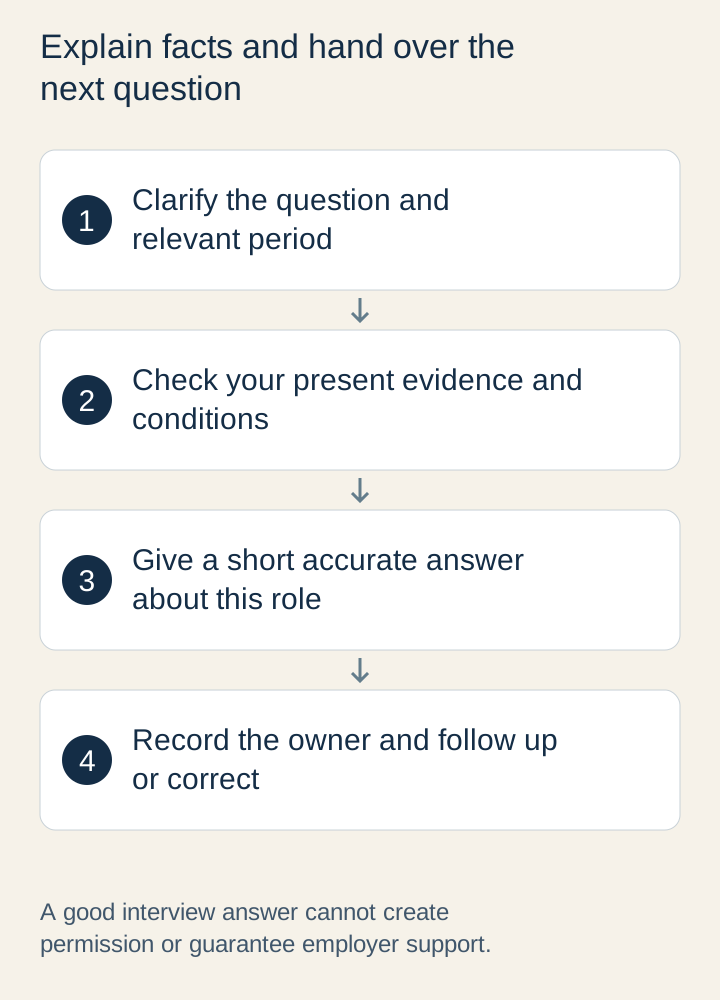
The original six-field answer card records: the interview question and time horizon; your current documented position; the role or change being discussed; the answer you can support; the unresolved question and responsible contact; and the follow-up action. Keep it in your own secure copy. It is a preparation tool, not an official form, eligibility certificate or list of cooperating employers.
In a fictional rehearsal, an applicant says “I won't need anything” because they expect an open permit later. Their card reveals that the permit has not been issued. Rewrite the answer to distinguish today's position from an anticipated application and ask whether the employer considers applicants needing a process. This correction improves accuracy; it does not make the permit more likely to be approved.
Practise saying the answer aloud in straightforward English. Remove unexplained acronyms, claims that processing is easy and promises of an exact start date. Ask a practice partner to repeat what they understood: do they think you have permission now, or understand that a step remains? If their interpretation is wrong, revise the wording rather than merely memorizing it more fluently.
Prepare a second sentence for uncertainty: “I need to verify that point against my conditions before confirming it.” Then identify how the question will be resolved. Do not use this as a permanent substitute for checking. A useful card has an owner and a next action; a growing collection of unresolved notes is not a completed readiness assessment.
6. Follow up with an accurate record, not a new promise
After the interview, summarize the relevant exchange: what you stated, what the employer said and what remains to be checked. An original follow-up might say: “Thank you for discussing the role. As noted, I do not currently hold the required authorization. Please confirm whether the recruitment process can continue for an applicant requiring employer steps, and who should receive any appropriate supporting information.” Adapt it to the truth, not to the most attractive scenario.
If your answer was inaccurate, correct it promptly and identify the specific point. Do not quietly send a different version of the same claim or hope that an informal conversation will be forgotten. Preserve the correction and the reply in your private record. A corrected explanation is still not government approval; it simply gives the employer a more reliable basis for recruitment decisions.
When an offer or supporting document arrives, move to the offer, LMIA and work-permit handover guide. Keep recruitment interest, employer documents and personal authorization separate. Do not resign, book non-refundable travel or accept an immediate work assignment solely because the interview went well. The appropriate commitments depend on the actual evidence and unresolved conditions.
For immigration background, use PremierVisa Group's Canada information and seek an appropriate individual assessment. This article does not determine permanent-residence eligibility, quote future Express Entry arrangements as current rules, or promise that employer support will continue indefinitely. Recruitment preparation and regulated immigration advice need clear scopes and actual engagement arrangements.
7. Frequently asked questions
Should I simply answer yes when asked whether I need sponsorship?
Clarify what the employer means, then state your actual position. A yes or no without the relevant time period or work-right context can mislead. Do not use a longer answer to conceal a definite lack of required permission.
Can I say I have an open permit because I expect one soon?
No. Expected eligibility or an application is not a permit already held. Explain the pending stage accurately and avoid promising a start based on an anticipated decision.
Does an LMIA exemption mean the employer needs to do nothing?
Do not assume that. The official guide separates LMIA and work-permit requirements. Applicable employer steps and any exceptions require their own basis; identify who will confirm the arrangement.
Must I email my complete passport before explaining my position?
This preparation method does not require that. Begin with accurate relevant information and arrange any necessary evidence through an appropriate secure process. Do not scatter private documents among unverified contacts.
What if I gave the wrong answer during the call?
Send a clear correction identifying the point and the current facts, then ask about the next decision. Do not hide the difference in a new resume or describe a corrected message as proof that the employer has accepted the process.
Submit your candidate background to discuss your resume, interview explanation and practical employer-contact direction. Start with experience, the role sought and the question needing clarification. No job, LMIA, work permit or immigration result is guaranteed.
Prepared with AI assistance. General career information; no named professional review has been confirmed. AI cover illustration does not depict our staff, clients or partner employers.