
An approved Labour Market Impact Assessment does not, by itself, authorize you to start a Canadian job. A job offer describes proposed employment; an LMIA concerns an employer-side assessment where required; your right to work depends on the applicable authorization and its conditions. For an applicant outside Canada, even an approval letter may still precede the actual permit issued on arrival. For someone already in Canada, existing rights and specific continuation rules can matter. Use a document handover record before promising a start date.
- 1. Give each document a separate job
- 2. Compare what the papers prove and what they leave unresolved
- 3. If you apply outside Canada, distinguish approval from arrival
- 4. If you are already in Canada, check the actual basis for continuing or changing work
- 5. Build a document handover record and a lawful-start checklist
- 6. Reconcile the offer without turning fees or timelines into promises
- 7. Frequently asked questions
1. Give each document a separate job
An offer answers employment questions: who proposes to hire you, for what work, where, on what pay and under which stated terms. It can support a permit process, but a signed offer is not the government's permission to work. An employer's proposed start date is a planning term, not a rule that overrides immigration conditions.
A positive LMIA is an employer-side assessment used for employment requiring that process. It does not replace the worker's application, admissibility checks or applicable permit conditions. The Temporary Foreign Worker Program explains the employer framework; do not turn its employer decision into a personal immigration approval.
IRCC's employer-specific work-permit guidance separates employer requirements from the applicant's requirements. Where an LMIA is required, the applicant needs the relevant employer documentation. Where a valid LMIA exemption applies, different employer steps may be relevant. “LMIA-exempt” does not automatically mean “work-permit-exempt”.
Finally, the actual permission must fit the person and work. A permit may limit employer, occupation or location, and other remarks may matter. Some people have open permits or an applicable authorization to work without a permit. Identify the real basis in your case rather than assuming that everyone needs the same three documents or that one document replaces all the others.
2. Compare what the papers prove and what they leave unresolved
Keep the following original comparison beside your offer. It is a preparation tool, not a determination of anyone's immigration status.
| Item | What it helps establish | What it does not establish by itself |
|---|---|---|
| Written offer or employment agreement | Proposed employer, work and employment terms | Personal authorization to begin the work |
| Positive LMIA, where required | Employer-side assessment for the relevant employment | Approval of the worker's permit or admission to Canada |
| Port-of-entry letter of introduction | Approval information for an outside-Canada permit application | The actual work permit or guaranteed entry |
| Work permit or other applicable authorization | The person's authorized work, subject to its conditions | Permanent residence or permission for every possible job |
| Travel visa or eTA, where applicable | A separate travel requirement | Permission to perform the proposed work |
Record a document's issuer and purpose before copying its reference number into a form. An employer's offer reference, LMIA number, employer-portal offer number and a personal application number are not interchangeable. A recruiter saying “the number is ready” should identify which number, for which process, and what evidence you may properly receive.
Compare the employing entity, occupation, workplace and dates across the relevant documents. A trading name can differ from a legal employer name, but the relationship should be explained rather than guessed. A changed workplace or significantly different role is a question to resolve with the responsible parties, not something to correct casually in a PDF.
Avoid modifying government or employer documents yourself to make them match. Save the version received, list the discrepancy and ask the issuer or the appropriate application contact how to address it. Never send another applicant's personal papers as a supposed example of your own authorization.
3. If you apply outside Canada, distinguish approval from arrival
IRCC explains in its outside-Canada decision guidance that an approved application leads to a port-of-entry letter of introduction. That letter is not the work permit. Travel documentation, where required, is another part of preparation. Neither an airline booking nor permission to travel establishes that work may begin.
Before travelling, use the current arrival instructions to identify documents applicable to your case. These can include your passport, introduction letter, relevant employment and LMIA documents and other required evidence. Requirements depend on the route; do not use a generic checklist to claim every item is mandatory for every applicant.
The border officer decides whether you meet the requirements and, if satisfied, issues the work permit. Check the printed employer, occupation, location, dates and remarks before leaving the inspection area. If something appears wrong, ask the officer immediately rather than assuming an employer can amend it later. An approval letter does not guarantee admission or a different set of permit conditions.
Ask the employer for a conditional onboarding plan. Separate a tentative travel date, document checks and the lawful start of productive work. Housing and relocation commitments should reflect the uncertainty that remains. This guide does not suggest that visitors can simply travel to Canada and obtain permission at the border; eligibility and the application route must be assessed separately.
4. If you are already in Canada, check the actual basis for continuing or changing work
Your existing status may change the answer, so start with the permit and current circumstances rather than with a new employer's LMIA. A valid open work permit can allow changes of employer, subject to the permit's conditions and applicable restrictions. Open permits are available only in specified situations; an offer alone does not create one. Read IRCC's open-permit guidance rather than relying on the word “open”.
For an eligible person who applied to extend before expiry and meets the continuation requirements, maintained status may allow work under the existing conditions while the application is decided. It is not permission to disregard the old employer, occupation or location restrictions. Being in a pending application process, without the required circumstances, is not a universal right to work.
IRCC's after-application instructions describe proof for eligible continuing workers. They also distinguish an in-Canada approval notice: eligible applicants need not necessarily wait for a physical permit in the mail after the relevant approval. Do not confuse that situation with an overseas applicant's introduction letter.
Someone on an employer-specific permit who wants to change jobs or employers normally needs the appropriate new permit. IRCC's changing-employers instructions describe an authorization request for eligible workers while the application is processed. Filing the application or web form is not the authorization itself; follow the actual response and conditions. A new offer or LMIA alone cannot resolve this question.
These distinctions warrant individual advice where your permit is expiring, you have stopped working, travelled or changed circumstances. Use the official instructions for your precise situation; this comparison is not an instruction to continue working regardless of status.
If you need help organizing the employment side, submit your candidate background to discuss your experience, interview preparation and employer questions. Immigration and work-authorization issues can be referred for an individual assessment within the PremierVisa Group service framework. A discussion does not certify your status or promise an outcome.
5. Build a document handover record and a lawful-start checklist
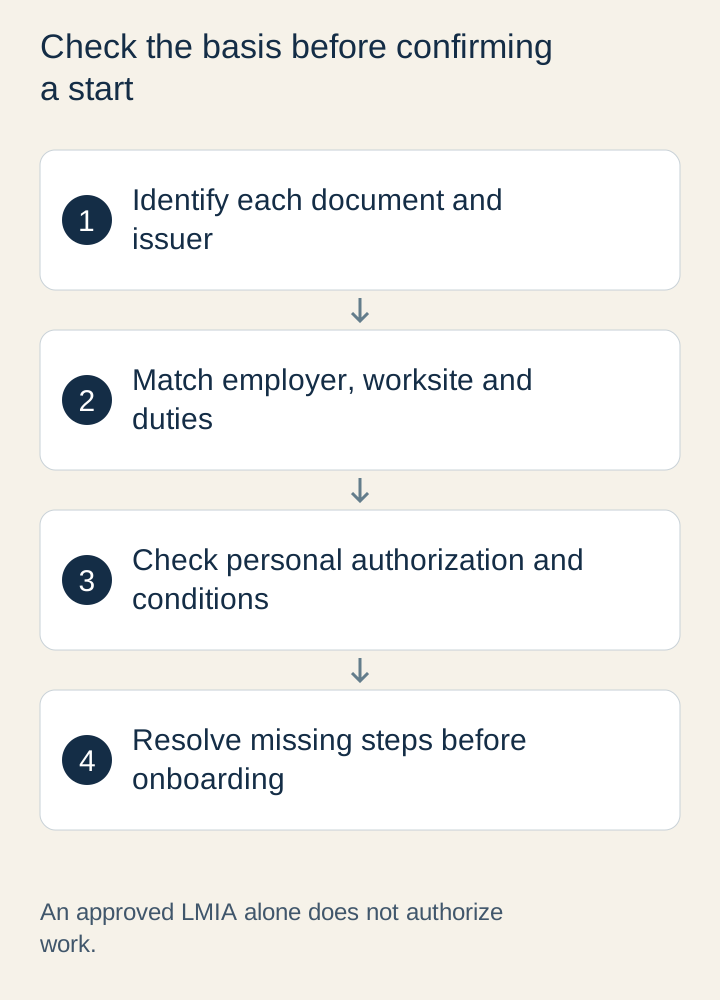
Create a private record with six columns: document, issuer and intended holder, what it supports, missing information, conditions and dates, and the person responsible for the next action. Store sensitive originals securely. The record should point to documents rather than reproduce passport details in a shared spreadsheet or public message.
For an original hypothetical example, record: “Offer from employer A; role and worksite stated; permit basis unresolved; ask the employer's named contact which process applies.” The next entry might be “LMIA described as positive; relevant copy and correspondence not yet reviewed.” Neither row should say “authorized to start”. The example is not a real vacancy, client or immigration case.
Use precise status words: received, not received, clarification requested, application submitted, decision received and conditions checked. These are internal document-control labels, not official approval categories. Never promote “submitted” to “approved” because an agent confirms receipt, and never promote “approved” to “work may start” without identifying the relevant authorization and circumstances.
Before agreeing to a start date, ask: What is my current legal basis to perform this work? Does it cover this employer and job? Are dates, medical restrictions and other remarks compatible? If approval or issuance remains pending, who will check the evidence before onboarding? If the role changes, who will reassess it? Save the written answers and distinguish professional advice from an employer's operational preference.
Prepare an employer question such as: “I have received the offer and understand the employer-side stage described to me. Please confirm the proposed employing entity, duties and workplace, and the contact responsible for employment documents. I will confirm a start date after the work-authorization requirements applicable to me have been checked.” This is original recruitment wording, not an official application template.
6. Reconcile the offer without turning fees or timelines into promises
Use the same handover record to compare pay, hours and duties in the offer with the role being discussed. Record wages in Canadian dollars and the stated pay unit; do not infer guaranteed overtime or take-home pay. A delay in a permit process may require a revised start plan, but it should not be hidden by changing the record to suggest approval already exists.
Job Bank's temporary-foreign-worker guidance warns against paying an employer for a job and shifting LMIA costs to the worker. Treat a request to buy a “ready LMIA” or guarantee approval as a reason to pause and obtain a clear explanation, not as a shortcut through missing authorization. Other personal application or professional-service costs require their own lawful basis and written terms.
For the earlier vacancy-screening stage, use the Job Bank search and employer-contact guide. For a broader comparison of immigration options, consult the verified PremierVisa Group Canada overview. That overview is not the authority for a personal start date. A temporary job or permit also does not establish permanent residence; any settlement route requires its own assessment.
7. Frequently asked questions
My employer says the LMIA is positive. Can I resign and book a flight?
Do not treat that message as personal work authorization. Check the actual documents, your application stage and the requirements for travel and starting work. Keep relocation and resignation decisions separate from an employer-side result; nobody can remove uncertainty by calling the LMIA a guarantee.
Is a port-of-entry introduction letter the same as my permit?
No. IRCC distinguishes the letter from the permit issued following the arrival examination. Carry the applicable evidence and check the actual document. This is different from the approval arrangements for certain applications made inside Canada.
Does an LMIA exemption mean I do not need a work permit?
Not necessarily. It concerns the LMIA requirement under an applicable route. Establish whether a work permit or another specific authorization is required and what employer steps apply; do not replace that assessment with a label in a job advertisement.
Can I join a new employer while my application is pending?
That depends on your current rights and any applicable authorization. Existing employer-specific conditions, maintained status and a change-employer authorization are different matters. Follow the current IRCC process and actual response; submitting paperwork alone does not authorize the new job.
Should I send the recruiter all my immigration records?
Share only what is necessary through an appropriate channel after verifying the recipient and purpose. Explain your work-right position accurately, but avoid unnecessary circulation of personal identifiers or unrelated family records. A document checklist is a preparation tool, not a reason to disclose everything.
Bring your offer, a redacted document inventory and unresolved employer questions when you submit your background for a discussion. Begin with the employment facts, then identify any individual work-permit assessment needed before a commitment.
Prepared with AI assistance. General career information; no named professional review has been confirmed. AI cover illustration does not depict our staff, clients or partner employers.
Sources: IRCC employer-specific permits, outside-Canada decisions and arrival, open permits, in-Canada extensions and changing employers; ESDC Temporary Foreign Worker Program; Job Bank temporary foreign workers. Exact URLs, dates and supporting claims are recorded in sources.json.