
Start a Canadian LMIA-related job search by checking your present work-right position and choosing vacancies that accept applicants in that position. On Job Bank, distinguish employers recruiting international candidates from advertisements limited to people already authorized to work. Record whether an LMIA is requested, approved or not stated, then ask the employer about the specific vacancy. None of those labels is your work permit. This guide helps overseas candidates build a useful search record and a focused first approach without buying a supposed LMIA job.
- 1. Choose the search entry point that fits your situation
- 2. Search by duties and location before interpreting LMIA labels
- 3. Keep recruitment openness and LMIA stage in separate fields
- 4. Write a first approach around the vacancy and your evidence
- 5. Use a Canadian vacancy-and-status record to choose the next action
- 6. Check the offer and work permission before money or relocation
- 7. Frequently asked questions and your next action
1. Choose the search entry point that fits your situation
If you are outside Canada without Canadian work authorization, begin with Job Bank’s foreign-candidate guidance. It explains how to identify employers recruiting internationally and recommends checking permit eligibility and professional recognition. A general search returning a familiar job title is not enough to establish that the employer accepts you as an applicant.
Write a short search profile: current location, actual work-right position, principal duties, relevant qualifications, language abilities and places you can realistically consider. Keep a separate note of any regulated-profession questions. A qualification used in Hong Kong, Taiwan or mainland China is not automatically permission to practise in every Canadian province.
If you already have a Canadian permit, start with its actual conditions. Someone holding an open permit may have different search options from someone holding an employer-specific permit. Do not select an overseas-applicant script merely because it mentions LMIA, or tell a recruiter you have unrestricted rights based on an expected extension. The correct entry point depends on your present circumstances.
This article focuses on finding and screening employment leads. It does not decide whether an LMIA-based route is suitable for you. IRCC’s employer-specific permit guidance explains that employer steps and applicant requirements are separate. Some employment is LMIA-exempt; that question needs a valid route, not a marketing label.
2. Search by duties and location before interpreting LMIA labels
Use a job title or skill phrase and a location, then examine the international-recruitment information in each full advertisement. Try related titles only where the actual work overlaps your experience. “Administrative assistant” and a more specialized coordination role may look similar but require different responsibilities. Do not broaden a search by claiming tasks you have not performed.
Start with a manageable group of vacancies and compare the duties, language requirements, education, experience, location, employment pattern and application method. A search example might combine “maintenance technician” with a province or city. This is an illustrative method, not a claim that a suitable vacancy currently exists or that the occupation is eligible for every immigration program.
Open the complete posting rather than relying on the result preview. Check who may apply and how the employer wants applications submitted. A search filter narrows results but does not replace reading the vacancy. The employer may require particular experience or an existing authorization that your profile does not satisfy.
Use the Job Bank wage-reading guide if you need to interpret published wage measures, and keep them separate from the actual offer. A national or regional statistic is background information, not a salary an employer has promised you. Record the advertised currency, hourly or annual unit, hours and any missing pay components before comparing opportunities.
3. Keep recruitment openness and LMIA stage in separate fields
Job Bank’s temporary-foreign-worker page explains that postings can show an LMIA as requested or approved. The former indicates an employer-side application; it is not an approval. The latter does not settle the worker’s separate permission to start. That page also discusses workers already in Canada and changing employers, so do not lift a sentence about starting work out of its context and apply it to an overseas candidate.
Use the following original screening table. It organizes questions rather than certifying a job or immigration case.
| Information found | What to record | What to ask next |
|---|---|---|
| Open to international candidates | Recruitment audience and date checked | Does this particular vacancy accept a candidate based where I am? |
| LMIA requested | Employer application stage as stated | Is the application still pending, and what is the recruitment timetable? |
| LMIA approved | The stated stage, without assuming personal authorization | Which role and employing entity does it concern, and what remains for my permit process? |
| LMIA not mentioned | “Not stated”, rather than “not needed” | Is the role LMIA-based, exempt under a specific route, or restricted to existing work-right holders? |
Do not confuse an LMIA application number, a positive decision, an employer’s job offer and your work-permit application. Keep separate dates and evidence for each. If a recruiter uses only “LMIA available”, ask for the exact meaning before investing in travel or extensive documents.
A historic list of employers that received positive LMIAs is a research lead, not a list of businesses currently offering you a job. Likewise, one advertisement repeated on several sites is one possible vacancy until the employer confirms otherwise. Your record should prevent duplicated leads from looking like progress.
4. Write a first approach around the vacancy and your evidence
Follow the application method in the genuine posting. Identify the vacancy, explain the work you have done that matches it and describe your current location and work-right position accurately. Send a relevant resume rather than a generic request to be given an LMIA. The employer is recruiting for work, not simply allocating a document.
An original teaching example is: “I am applying for the advertised maintenance role. My experience includes scheduled servicing, fault records and shift handovers. I am currently outside Canada and would require the appropriate work authorization before starting. Does this vacancy accept overseas applicants, and is an LMIA process relevant to this position?” Replace the duties with your own and do not use the example as proof of eligibility.
For Hong Kong or Taiwan experience, explain unfamiliar internal job grades through duties. For mainland experience, avoid translating an internal rank into a more senior Canadian title. A short, factual description of responsibilities is more useful than an impressive label that you cannot support at interview. State practical interview availability with the correct time zone.
At this stage, share information proportionately. Do not send passport scans, bank records, confidential customer material or another person’s approval documents to an unverified contact. Independently locate the employer’s business channel when you need to confirm that the recruitment approach is genuine. A posting on a recognizable site is not a reason to ignore contradictory contact details.
If you need help preparing the application, submit your career background to discuss resume preparation, interviews and realistic employer-search directions. HKJobHunt confirms service scope separately; an enquiry does not create a vacancy, an employer partnership or a permit outcome.
5. Use a Canadian vacancy-and-status record to choose the next action
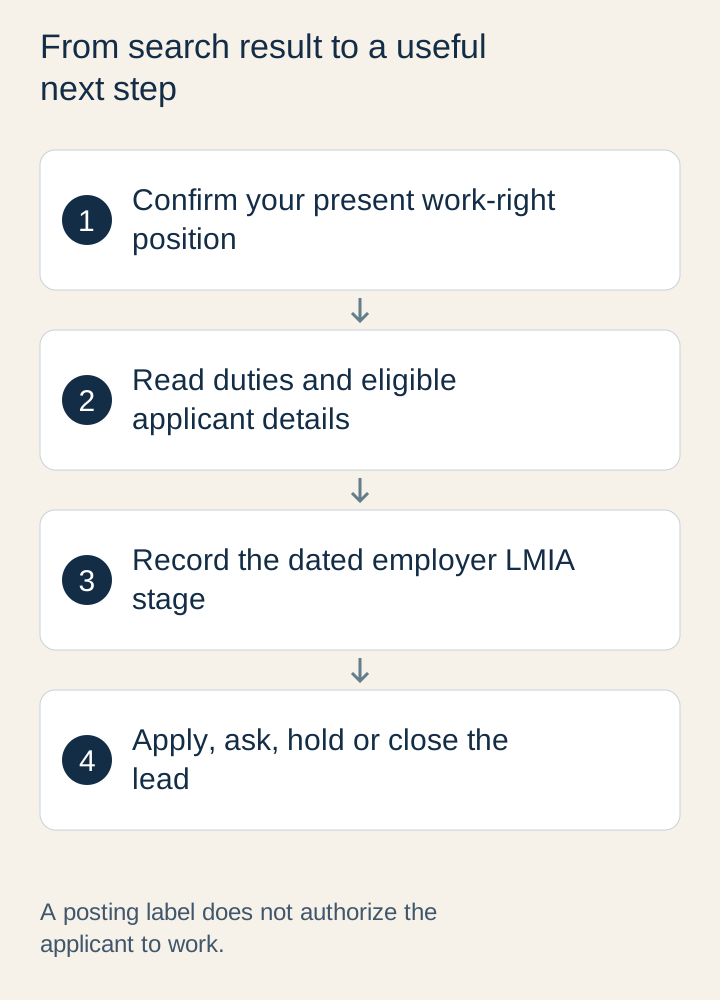
Create one row per original vacancy. Include the employer’s stated name, original Job Bank URL or other original posting, vacancy identifier, worksite, principal duties, applicant audience, work-right requirement, LMIA wording, date checked, application method, contact date, reply and unresolved question. Leave unknown information as “not confirmed”.
Add a decision field: apply, ask first, hold or close. These are your own workflow labels, not government eligibility categories. For a hypothetical record, the next action might be “Ask whether the international-candidate statement includes this offshore application; LMIA stage not yet confirmed.” No actual employer or job is implied by the example.
Record replies precisely. “We are considering applications” is not “we have offered employment”; “we applied for an LMIA” is not “the LMIA is positive”; and none of them means your permit has been issued. A reply that does not answer the question should remain unresolved. Store a link to the evidence rather than relying on memory of a phone call.
Review why applications stop. If most require qualifications you do not hold, refine the role or location. If they accept only current work-right holders, improve your first screening question. If the employer has stopped recruiting, close that vacancy rather than assuming its old advertisement is still available. The number of applications sent is less useful than a record showing that the matches are becoming clearer.
Keep a reasonable follow-up date based on the employer’s stated process. There is no universal message count that produces an LMIA or job. Send a concise reminder where appropriate, then redirect effort when the opportunity remains unclear. The accompanying worksheet is for your own preparation and does not submit an application or collect your information.
6. Check the offer and work permission before money or relocation
If an employer wishes to proceed, ask for written duties, employing entity, work location, hours, remuneration components and any conditions. Compare them with the original posting and your experience. If the job changes, request clarification rather than changing your history to fit it. A real interview should help both sides understand the work.
Job Bank states that searching and applying through its service is free and that an employer must not make you pay for the LMIA. Do not treat a requested payment to buy a job or employer approval as an ordinary search expense. Personal permit, document or independent professional costs need their own itemized explanation and appropriate review; changing a fee’s name does not establish that it is permitted.
IRCC’s employer-specific work-permit page distinguishes the employer’s LMIA or exemption steps from your application. If you need a permit and do not yet have permission to work, an offer does not authorize you to start. Applicants already in Canada must check their own current conditions and any applicable change-of-employer arrangements rather than following a blanket rule from another person’s case.
Use the offer, LMIA and permit comparison when you need to identify what a document actually establishes. For broader immigration and visa route planning, the PremierVisa Canada overview is separate reading; individual eligibility and current official requirements still need assessment. Neither a temporary job nor an LMIA is permanent residence.
7. Frequently asked questions and your next action
Can I apply from outside Canada without a work permit?
Use vacancies open to international candidates and state your actual situation. An employer’s willingness to read your application does not establish eligibility or work permission. Check the genuine posting and the appropriate permit route rather than applying indiscriminately.
Does “LMIA requested” mean the job is already approved?
No. It describes an employer-side application stage. Record it as stated and ask about the vacancy’s present recruitment process. Do not upgrade it to a positive decision or your own permit approval.
Can an approved LMIA let me start immediately?
Do not assume that. Your present work authorization and the actual role matter. An overseas applicant needing a permit has further steps, while an existing worker must examine their current conditions and any required changes.
Are all Canadian work permits based on an LMIA?
No. LMIA-exempt and open-permit situations exist, with their own requirements. A recruiter calling a role exempt is not enough; establish the actual route and your eligibility before relying on it.
Is a positive-LMIA employer list a current job list?
No. Historical employer records do not prove a live vacancy or an intention to hire you. Confirm the current job, employing entity and recruitment contact independently, and avoid counting repeated advertisements as separate opportunities.
Your next action is to prepare your search profile, screen a small set of suitable vacancies and record one clear question for each. If you need individual support, submit your career background to discuss your resume, interviews and realistic employer-search directions. HKJobHunt is part of the PremierVisa Group service network; employment, LMIA decisions, permits and permanent residence remain separate outcomes.
Prepared with AI assistance. General career information; no named professional review has been confirmed. AI cover illustration does not depict our staff, clients or partner employers.
Sources: Job Bank foreign candidates; Job Bank temporary foreign workers; Job Bank foreign-applicant FAQ; IRCC employer-specific work permits; ESDC Temporary Foreign Worker Program.