
To search beyond Toronto and Vancouver, compare a specific occupation and worksite with housing you could realistically obtain and transport that serves the actual shift. A smaller city is not automatically cheaper for your household, easier for an overseas applicant or more likely to produce an LMIA-supported offer. This guide gives you a city-to-shift evidence record and a practical sequence for testing alternatives before you move. It suits applicants comparing locations, rather than choosing an immigration route or relying on a national “best city” ranking.
- 1. Define a workable job before choosing a favourite city
- 2. Read demand evidence at the right geography and period
- 3. Compare housing evidence without turning averages into quotations
- 4. Test the journey against the actual shift
- 5. Complete a city-to-shift record and a transparent budget test
- 6. Keep a location preference separate from the right to work
- 7. Frequently asked questions
1. Define a workable job before choosing a favourite city
Write down the work you can demonstrate, the level of responsibility you seek and any qualification question that must be resolved locally. Separate your preferred city from your essential employment conditions. Someone who needs public transport for an early shift has a different location problem from someone considering an office role with a later start. A city name cannot resolve those differences.
Start with a manageable comparison. For example, Edmonton and Winnipeg can be two locations to investigate, not recommendations or confirmed hiring destinations. You do not need to label them the cheapest, the fastest-growing or the easiest for sponsorship. Choose them only if you can identify relevant work to investigate and a reason your household could consider living there.
Record your practical limits: household size, transport options, language needs, relevant qualifications and money available for a period without earnings. Keep private personal details out of initial employer enquiries. You can explain a location constraint without circulating financial statements or family documents. Unknown information remains a question, not a favourable assumption.
The Canada employer-search guide covers finding and contacting potential employers. This article adds a location decision: whether the actual job, home and journey can work together. A public occupation directory remains a reference resource, not evidence that HKJobHunt holds a vacancy or a relationship with the employer.
2. Read demand evidence at the right geography and period
Use occupation-specific information to guide investigation rather than treating a citywide headline as proof that your role is in demand. Alberta’s job-market forecast page describes projections with different horizons and says its outlooks do not reflect policy changes. That is a useful reason to keep a forecast separate from a current vacancy and an employer’s overseas-hiring decision.
For every item you save, record the occupation, location, reference period and what it actually measures. A regional projection is not necessarily a count for a municipality. A province-wide total cannot tell you whether a particular employer needs your skills this week. Do not place differently defined figures beside each other and call the larger number the better city.
The provincial alis discussion of employment outlook distinguishes location, seasonality, turnover and growth. Its older forecast figures are not used here as current results. As an application task, ask whether the work you are considering is ongoing or seasonal, why this vacancy exists and which duties account for the employer’s need.
Build your own dated vacancy sample from genuine advertisements. Save the role, employer, worksite and application conditions, then remove duplicates and closed listings from your active shortlist. An advertisement copied onto several platforms is still one lead. A result that mentions international candidates deserves an enquiry about that role; it is not a promise of support or government approval.
3. Compare housing evidence without turning averages into quotations
The CMHC Rental Market Report identifies its period, geography and rental segments. Use those definitions when reading it. A historical survey measure is not a current quotation for a home you can rent, and purpose-built apartments and condominium rentals should not be silently treated as one identical market.
For your own comparison, choose a consistent household requirement: for example, a particular number of bedrooms and an acceptable journey to the proposed worksite. Then collect dated listing evidence, what is included and any conditions requiring clarification. Do not compare a shared room in one location with an entire dwelling in another and present the difference as the city’s saving.
Separate recurring costs from one-off relocation costs. Your working list might include rent, utilities, transport, food, insurance questions, communications and household commitments. Set-up items belong in another section. Do not assume a deposit amount or tenancy rule from another province applies; check the actual provincial information and written arrangement before committing.
Use one currency and one period, normally Canadian dollars per month, and label estimates. If a figure comes from an advertisement, say so rather than calling it an official market average. If an item is unknown, keep it blank with an action to obtain evidence. An incomplete budget cannot establish that the move is affordable merely because a spreadsheet has calculated a balance.
4. Test the journey against the actual shift
Ask for the worksite address or a sufficiently precise location and the proposed start and finish times. A recruitment office, company head office and workplace can be different places. Confirm whether duties involve multiple sites and whether transport between them is part of the arrangement. “Near Edmonton” is not precise enough to test a daily journey.
Use the relevant transit operator’s current route information for the intended travel date and times. Check the outward journey, return journey, walking portions, transfers and what happens when the shift ends late. A route shown at midday does not establish an early-morning connection. Save the date and assumptions instead of treating a screen capture as a permanent timetable.
Consider a realistic fallback without assuming that you can drive immediately or that a colleague will provide a lift. Ask whether any employer transport is actually offered, where it departs, what conditions apply and whether it is in writing. If the only workable option depends on obtaining a vehicle or a licence you do not yet have, identify that dependency explicitly.
An original teaching situation is a candidate comparing a cheaper home farther from the workplace with a more expensive home on a usable route. The decision depends on the actual shift and total journey, not the rent headline alone. This is a hypothetical decision exercise, not a verified transit itinerary, local property offer or recommendation to accept a particular commute.
Before a location-focused interview, prepare the job description, your relevant evidence, the worksite question and a short list of household constraints you choose to disclose. Ask whether the location shown in the advertisement is the actual workplace, and whether the schedule is fixed or rotates. If the employer cannot yet confirm it, record the question as open and agree who will update you. A tentative schedule can support discussion without being treated as a final travel plan. Keep the comparison version you used, so that a change in duties, home location or transport assumptions is visible rather than silently absorbed into an old conclusion.
5. Complete a city-to-shift record and a transparent budget test
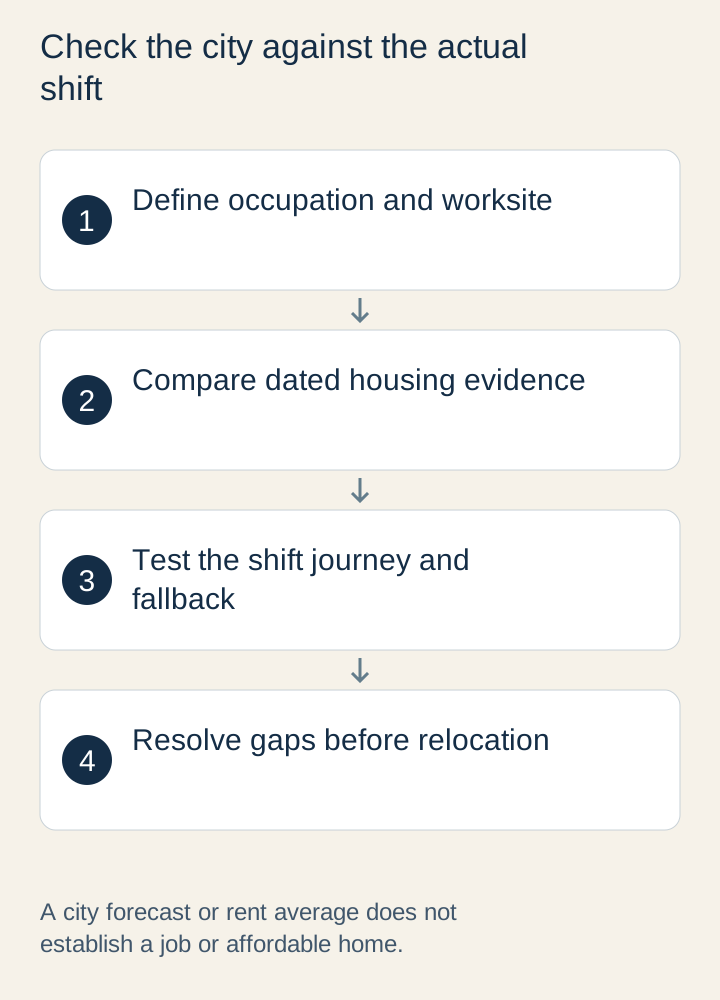
This topic’s original six-field record links: the job, worksite and province; occupation-demand evidence with its period and geography; comparable housing evidence and missing costs; shift-specific travel and a fallback; the unresolved question and contact; and the next decision. Keep one record for each meaningful location-and-role combination. It is not a government assessment or an approved-city list.
Use a simple comparison to reveal a dependency rather than manufacture a score. The figures below are entirely hypothetical, in CAD per month. They are not Canadian market rents, salaries or a tax calculation. They show why a lower rent can leave less room once transport is included.
| Hypothetical monthly input | Option A | Option B |
|---|---|---|
| Assumed income after tax | CAD 3,000 | CAD 3,000 |
| Assumed housing cost | CAD 1,300 | CAD 1,100 |
| Assumed transport cost | CAD 150 | CAD 450 |
| Balance before every other cost | CAD 1,550 | CAD 1,450 |
The arithmetic is income minus the two listed costs only. Food, utilities and other household or relocation costs have not been deducted, so neither balance is a savings estimate. The example does not establish that an actual offer produces that income. Replace assumptions with evidence and an appropriate personal tax estimate before using the record for a real decision.
You can ask an employer: “Which location and shift would this role actually use, and are those details fixed or subject to assignment?” Ask a housing provider separately about the dwelling and included costs. Each person answers the question within their role. A recruiter’s general assurance cannot verify a tenancy, a transport connection or your household budget.
If you need help presenting your experience and location limits, submit your candidate background to discuss your resume, interview preparation and practical employer-contact directions. The actual service scope and contractual arrangements are confirmed separately; no employer access, property availability or outcome is implied.
6. Keep a location preference separate from the right to work
A favourable location comparison does not settle an employer process or your individual authorization. IRCC’s employer-specific work-permit guidance identifies conditions concerning the employer, occupation and location. Check the actual permission relevant to your case; do not treat an offer or an LMIA as permission to begin.
Ask whether the company considers applicants in your current situation and who confirms the applicable employment and immigration steps. If you require a work permit and do not hold one, describe that truthfully. Neither a willingness to relocate nor a plan to rent locally creates existing Canadian work authorization. Do not change your answer simply because the advertisement appears attractive.
Before accepting a proposed start, write down remaining conditions and the person responsible for the next update. If the worksite or duties change during recruitment, revisit the location comparison and the appropriate authorization questions. A move from one province to another may also require fresh qualification enquiries; a previous answer should not be carried over without checking its scope.
The offer-to-work-permit handover guide supports the next document discussion, while the offer-pay guide handles written compensation. For separate immigration background, consult PremierVisa Group’s Canada information under an appropriate individual engagement. This city exercise does not choose a provincial immigration program or assess permanent-residence eligibility.
7. Frequently asked questions
Is a smaller Canadian city automatically easier for LMIA hiring?
No. Investigate the actual role, employer and applicant conditions. A city’s size or forecast cannot establish an employer’s willingness to consider you or the result of a government process.
Can I budget using a rental-report average?
Use it as defined background, with its reference period and market segment. Obtain comparable current housing evidence for your own requirements and check included costs. An average is not an individual rental quotation.
Should I choose the city with the highest advertised pay?
Compare the written pay basis and conditions alongside housing, travel and household needs. A headline package or incomplete budget does not establish the amount available after all relevant costs.
Can I assume I will buy a car after arrival?
Record that as a dependency with its real costs and licensing questions. Until those are resolved, test whether the job has a workable transport arrangement without treating a future purchase as already completed.
Should I move first to demonstrate commitment?
A move alone does not create an offer or work permission. Clarify the role, remote recruitment options, remaining conditions and household implications before committing to relocation. No particular city or move is guaranteed to produce employment.
Choose one genuine role and two plausible locations, then complete the missing evidence before ranking them. Submit your candidate background if you need help with your resume, interviews and practical employer-contact directions. Employment, housing, employer support, a permit and permanent residence remain separate outcomes.