
An LMIA wage-stream label does not tell you whether an offer is good, affordable or approved. Compare the offered hourly wage with the correct provincial or territorial threshold, then separately check the occupation's prevailing wage and the written employment terms. This guide provides an original offer-comparison record and a clearly hypothetical calculation. It helps you ask an employer useful questions without treating a high salary, an LMIA application or a recruitment promise as personal permission to work.
- 1. Identify the work location and the applicable threshold edition
- 2. Keep stream classification separate from prevailing wage
- 3. Separate guaranteed wages from the wider package
- 4. Ask about employer obligations without buying a stream
- 5. Use the six-field offer-comparison record
- 6. Compare affordability and authorization before committing
- 7. Frequently asked questions
1. Identify the work location and the applicable threshold edition
Start with the legal employer, actual worksite, duties and wage stated in the offer. A company's headquarters may be in a different province from the job. A salary headline without a location and pay basis cannot establish the appropriate comparison. Ask which position and application the employer is discussing before using a threshold table from an online guide.
The ESDC high-wage and low-wage page compares the offered hourly wage with the applicable provincial or territorial threshold: at or above goes to the high-wage stream; below goes to the low-wage stream, with the relevant stream requirements still to meet. Keep the application-receipt period with the table rather than selecting a number because it appears in a recent search result.
As checked on 25 October 2026, that official table lists CAD36.92 per hour for Ontario for LMIAs received from 17 July 2026. This is a dated stream reference, not Ontario's minimum wage, a universal chef wage or the amount every foreign applicant should request. Other provinces and earlier receipt periods have different entries. Recheck the actual edition before a decision.
Record the source URL, date checked, province and receipt-period heading. If the employer's application date is not known, leave it unconfirmed and ask the responsible contact. The date you received an offer is not automatically the date an LMIA was received. This simple distinction prevents a neat calculation from relying on the wrong policy column.
2. Keep stream classification separate from prevailing wage
A job can cross a stream threshold and still require a separate wage assessment. The high-wage requirements describe prevailing wage by reference to the relevant Job Bank median and the employer's comparable existing-employee wage range. Matching duties, location, skills and experience matters. The provincial stream figure is not a substitute for that occupational comparison.
Ask the employer how the duties and work location were selected for the wage check. If a title covers several different responsibilities, clarify the actual role before relying on a wage result. You do not need to demand colleagues' private payroll records during an initial conversation. A responsible explanation and an appropriate professional review can identify the basis without circulating confidential files.
ESDC also warns that simply raising the offered wage to fit a stream or avoid a requirement can lead to a negative LMIA decision. Do not accept a paper increase coupled with an understanding that the employee returns part of the pay. Compare what will actually be paid and performed, not just the number printed to make a recruitment package look attractive.
For Quebec, the requirements point to additional MIFI wage information. This article does not calculate a Quebec result or decide an industry-specific variation. If the general comparison is insufficient, record the specific missing rule and refer it. A useful offer review identifies where its own calculation stops rather than silently applying one province's example across Canada.
3. Separate guaranteed wages from the wider package
Write the guaranteed wage rate, paid-hours arrangement and employment period separately from tips, overtime, bonuses and benefits. ESDC's wage requirements exclude those additional components when determining the offered guaranteed wage for program purposes. A recruiter saying the total package reaches the threshold does not settle whether the actual guaranteed wage does. Ask for the components in writing and keep their units visible.
Here is an original hypothetical comparison, not a vacancy, wage recommendation or market estimate. Suppose two Ontario offers each guarantee 40 paid hours for a particular week. Offer A pays CAD35 per hour: 35 × 40 = CAD1,400 gross. Offer B pays CAD37 per hour: 37 × 40 = CAD1,480 gross. The difference is CAD80 before deductions for that assumed week, not a prediction of savings.
Against the dated Ontario stream reference above, A is below and B is above. That arithmetic alone does not establish prevailing-wage compliance, processability, employer eligibility or personal work authorization. Neither example assumes overtime, tips, unpaid breaks, annual paid weeks or a particular tax result. Change the hours or terms and the cash comparison must be recalculated from the actual arrangement.
| Offer information | What it helps you check | What it does not establish |
|---|---|---|
| Guaranteed hourly wage | A consistent rate comparison | Occupational wage compliance by itself |
| Stated paid hours | Conditional gross-pay calculation | Overtime entitlement or guaranteed savings |
| Tips, bonuses and benefits | Wider package and uncertainty | A substitute for guaranteed program wages |
| Stream label | Applicable employer route question | Approval, personal permit or permanent residence |
If you need help preparing the questions and presenting your relevant experience, submit your candidate background. Discuss the actual support available. A consultant conversation does not certify a wage, create a vacancy or guarantee an employer will proceed.
4. Ask about employer obligations without buying a stream
The low-wage requirements include additional processability, workforce-proportion and other employer conditions. A below-threshold job is not automatically illegal, but being below the threshold does not establish that its LMIA can be processed. Location, application timing, the actual stream and any applicable exception need checking. This guide does not publish a city list as a permanent rule.
The same official requirements distinguish employer responsibilities for transportation and ensuring suitable, affordable housing is available. That does not mean every employee receives a free home. Ask what is provided, what is a separate living expense and what the written arrangement says. Do not let an accommodation headline conceal deductions, an unclear location or a condition that has not been assessed.
ESDC prohibits recovering the LMIA processing fee from temporary foreign workers and prohibits employer-side recruitment-fee recovery, directly or indirectly. Do not treat a payment described as a stream upgrade or guaranteed job as a legitimate way to solve an unsuitable offer. Identify the payer, purpose and basis of any charge; individual professional services require their own lawful scope and agreement.
For high-wage roles, ask who is confirming the applicable recruitment and transition-plan requirements, including any relevant exceptions, rather than assuming a higher figure removes all employer work. You are not expected to audit the employer's complete application. You do need enough reliable information to understand which unresolved matters affect your next commitment and who will answer them.
5. Use the six-field offer-comparison record
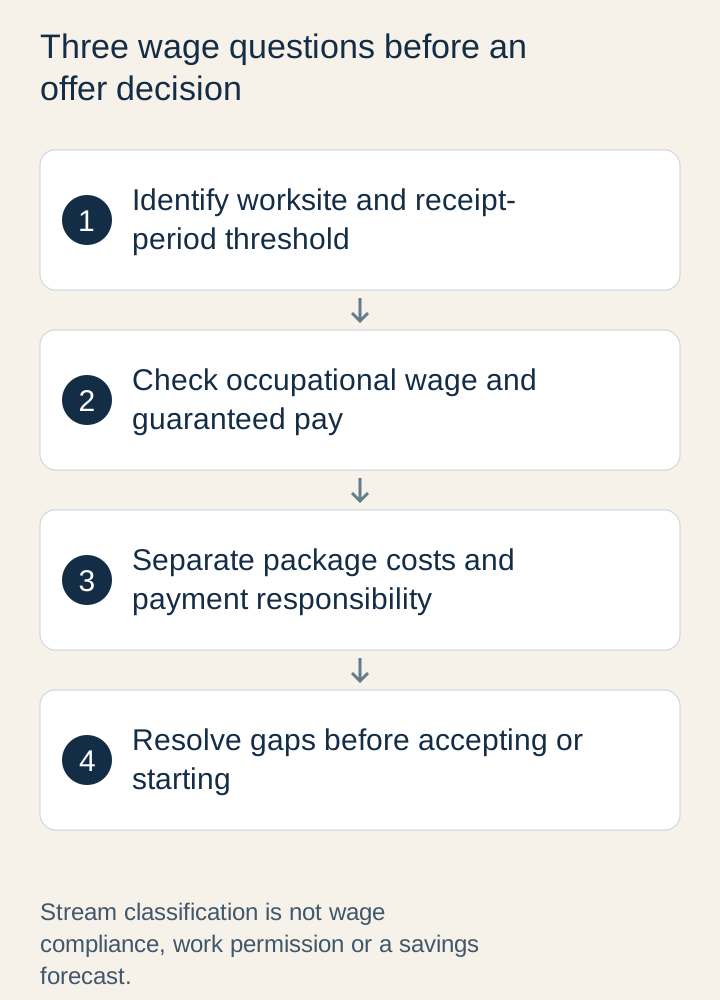
The original record contains: position, worksite and evidence date; guaranteed rate and paid-hours basis; stream threshold and receipt-period edition; prevailing-wage question and supporting reference; cost responsibility and uncertainty; and the employer question, owner and next decision. Complete a separate record for each offer. This is a private teaching worksheet, not an official LMIA form or an approved-employer list.
Begin with the exact written offer rather than an edited message summarizing it. Put quoted wording and your interpretation in different places. If an amount is missing, write unconfirmed, not zero. If hours are a range, do not quietly use the highest figure for your household budget. Preserve whether a benefit is guaranteed, conditional, discretionary or not offered.
An original employer question could read: “Please confirm the guaranteed hourly wage, the paid-hours arrangement and which wage-stream reference applies to this position. Which contact can explain the occupational wage basis and any unresolved employer steps?” This requests a specific explanation. It does not demand personal records from other employees or ask the recruiter to give an immigration decision.
In a fictional discrepancy, the advertisement includes tips in a total hourly claim while the offer states a lower base rate. Record both versions and ask what is guaranteed. Do not rewrite the base wage to match the advertisement. A clarified package may resolve the pay-description issue while leaving wage compliance or the employer process open; record each outcome separately.
Before the next call, send the specific missing question rather than a general request for more information. Agree whether the answer should come from recruitment, payroll or the person handling the employer process. Keep their responses with the dated offer so a later revision does not erase what you originally compared.
6. Compare affordability and authorization before committing
After the wage facts are clear, prepare a separate personal budget using actual costs or clearly labelled assumptions. Rent, commuting, food and relocation timing belong here. Gross pay is not take-home pay, and a stream threshold is not a cost-of-living standard. This article does not provide a tax calculation or invent a Canadian household budget from missing numbers.
Compare offers on the same assumptions, then identify differences you cannot yet price. A higher rate with uncertain paid hours cannot be treated as automatically more affordable than a lower rate with a different arrangement. State the uncertainty rather than predicting a winner. Check what happens if the proposed start is delayed before making non-refundable travel or resignation commitments.
IRCC's employer-specific guidance keeps the employer's steps and personal permit conditions separate. A high-wage offer is not a work permit. Use the offer and permission handover guide and the permit comparison guide to identify the actual basis for beginning work.
Immigration background is available through PremierVisa Group's Canada information. This article does not determine permanent-residence eligibility, calculate Express Entry points or apply future arrangements as current rules. An employer-process label, a satisfactory personal budget and an immigration outcome are three separate findings. Each needs its own evidence before it becomes a commitment.
7. Frequently asked questions
Is the high-wage threshold the legal minimum wage?
No. It is the dated stream-classification reference described by ESDC. Applicable employment standards and prevailing-wage requirements are separate questions; do not use one number to answer all three.
Can tips or a housing benefit lift the base wage into the high-wage stream?
Do not treat the package total that way. The official program-wage rules focus on guaranteed wages and exclude the additional components described above. Ask for the actual rate and its basis.
Is a low-wage offer automatically a fake job?
No. The label does not decide authenticity or processability. Verify the real employer, duties, wage basis and applicable employer requirements instead of accepting or rejecting a job from the label alone.
Does an offer above the threshold guarantee a positive LMIA?
No. Other wage and program requirements remain, and ESDC warns against artificial adjustments to avoid requirements. A printed figure is not approval or evidence of what will actually be paid.
Should I compare annual salaries without checking paid hours?
Not as a complete decision. Establish the actual employment and paid-hours basis first. Any conversion must state its assumptions and should not be presented as guaranteed take-home income or savings.
Submit your candidate background to discuss your resume, interview preparation and practical employer-contact direction. Include relevant experience and the offer questions needing clarification, without unnecessary identity or financial documents. No job, LMIA or immigration result is guaranteed.
Prepared with AI assistance. General career information; no named professional review has been confirmed. AI cover illustration does not depict our staff, clients or partner employers.