
Before accepting a Canadian job offer, compare the written role with the work you have actually discussed: the employing entity, duties, pay basis, deductions, worksite and conditions for starting. A signed offer does not establish work authorization. This guide helps overseas candidates and temporary workers record inconsistencies, request a corrected version and distinguish employment questions from permit questions. It is a practical review method, not a finding that a particular employer is compliant or a substitute for individual legal advice.
- 1. Identify exactly which document you are being asked to accept
- 2. Separate the pay rate, working pattern and deductions
- 3. Check the place and duties of the real job
- 4. Build an offer-difference record instead of collecting verbal reassurances
- 5. Keep recruitment charges and job permission out of the promise column
- 6. Make the decision and keep a useful handover record
- 7. Questions candidates commonly need answered
1. Identify exactly which document you are being asked to accept
A vacancy advertisement, recruiter message, offer letter and employment agreement may describe different stages of a hire. Start by identifying the document in front of you. Record its date, version, sender and stated employing entity. An attached file described as “final” in a message is not enough if its contents still refer to an earlier worksite or a different role.
Ask who will employ you, who is authorized to clarify terms and which document supersedes previous correspondence. A recruiter can arrange a conversation without being the employer. A group brand, trading name and employing entity may also differ. An unexplained difference is a question to resolve; it is not, on its own, proof of fraud. Keep the correspondence that connects the names and responsibilities rather than silently choosing whichever name seems most reassuring.
Make a private working copy and mark the clauses you do not understand. Keep the original unchanged. If the employer sends a replacement, retain both versions and note what changed. Do not edit the employer's wording yourself and present your edit as an approved agreement. You need a shared record of what was actually agreed, not merely a cleaner document in your own folder.
The IRCC worker-rights guidance identifies important employment-agreement information, including the job, conditions, maximum weekly hours and pay rate for employer-specific permit holders. This article's additional version-control steps are original practical suggestions. They are not a universal statutory contract form.
2. Separate the pay rate, working pattern and deductions
Read the currency and pay unit before comparing an offer with your present income. An hourly rate, annual salary and estimated monthly take-home figure answer different questions. Ask which amount is guaranteed, which depends on hours actually worked and which is conditional on performance or another event. A possible bonus should not be treated as cash already available for rent.
Check the expected working pattern, how hours are recorded and who can approve changes. If an offer says “hours according to business needs,” ask what the employer expects that to mean for this role. Do not infer that every advertised hour is guaranteed. Overtime rules and other employment standards depend on the applicable jurisdiction; a recruiter saying “standard Canadian terms” does not identify that jurisdiction or the relevant rule.
List deductions separately from earnings. Ask what each item is for, how it is calculated, who receives it and where its basis is documented. A gross pay rate is not a take-home promise. This article does not calculate your tax, certify a lawful deduction or quote a current minimum wage. For a fuller pay comparison, use the Canada wage and offer guide.
A provincial example shows why a signature is not the whole answer. British Columbia's official deductions guidance distinguishes required deductions from allowable deductions approved in writing, while prohibiting charging employees for business expenses even if they agree. This is a BC example, not a nationwide consent rule. Identify the actual province and applicable employment regime before applying it to your offer.
3. Check the place and duties of the real job
A company address is not necessarily your worksite. Clarify where you will normally report, whether work moves between sites, who gives instructions and whether travel or remote work forms part of the role. A familiar city name can hide a distant site or a shift that public transport does not serve. These are practical employment questions even before immigration conditions are considered.
Compare duties across the vacancy, interview notes and offer. If the interview described order coordination but the written offer describes unrelated physical production, ask which job is actually available. A broad title does not remove the need to understand daily tasks, training and supervision. For regulated work, identify who must confirm the relevant authorization rather than treating a job title as evidence that you can practise.
An employer-specific work permit contains employer, location, occupation, conditions and potentially additional remarks. Read the actual permission. Do not assume that a contract sentence allowing transfers also changes the conditions imposed on you. Equally, do not decide that every change of street address automatically has the same immigration consequence: the wording and circumstances need assessment.
Ask about a proposed change before it happens. Who will assess its effect on the agreement, any employer-side documents and your permission? Which evidence will confirm that the change can proceed? A practical commute concern and a permit restriction may both matter, but they require different answers. Use the city and shift comparison guide for the transport side of the decision.
4. Build an offer-difference record instead of collecting verbal reassurances
Use one row per unresolved issue. The purpose is to make a question answerable and traceable, not to score an employer or manufacture a compliance certificate. This original six-field record can be kept privately and summarized in a hiring discussion.
| Field | What to record | What closes the issue? |
|---|---|---|
| Document and version | Exact offer date and relevant clause | Everyone can identify the same text |
| Written term versus actual plan | The two descriptions and their sources | The employer confirms the real arrangement |
| Employment or permit implication | Pay, site, duties or authorization question | The appropriate person assesses the right question |
| Clarification and evidence | Your specific question and requested record | A relevant answer, not a broad promise |
| Contact and review point | Responsible person and agreed follow-up | A practical update or an explained delay |
| Corrected version and decision | Replacement clause, remaining conditions and your decision | The unresolved difference is explicitly recorded |
Consider a fictional example. A candidate's interview concerned one daytime worksite, but the written offer allows assignments across unspecified locations. The candidate records the difference and asks for the normal site, possible travel and shift arrangements. The employer may clarify a genuine operational need. The candidate then considers transport and asks the appropriate person to review any permit implication. This example is not a real vacancy, a customer story or a conclusion that multi-site employment is unlawful.
A useful question is: “The offer dated [date] describes [term], while our discussion described [arrangement]. Could you confirm the intended worksite and schedule, identify who will assess any permission issue, and send a revised offer or written clarification before I decide?” Use accurate facts and proportionate evidence requests. Do not demand unrelated financial or personal records simply because you have a checklist.
If you need help organizing your questions, submit your job-search background to discuss your resume, interview preparation and practical employer directions. The checklist remains openly available; submitting a form is not required to use it.
5. Keep recruitment charges and job permission out of the promise column
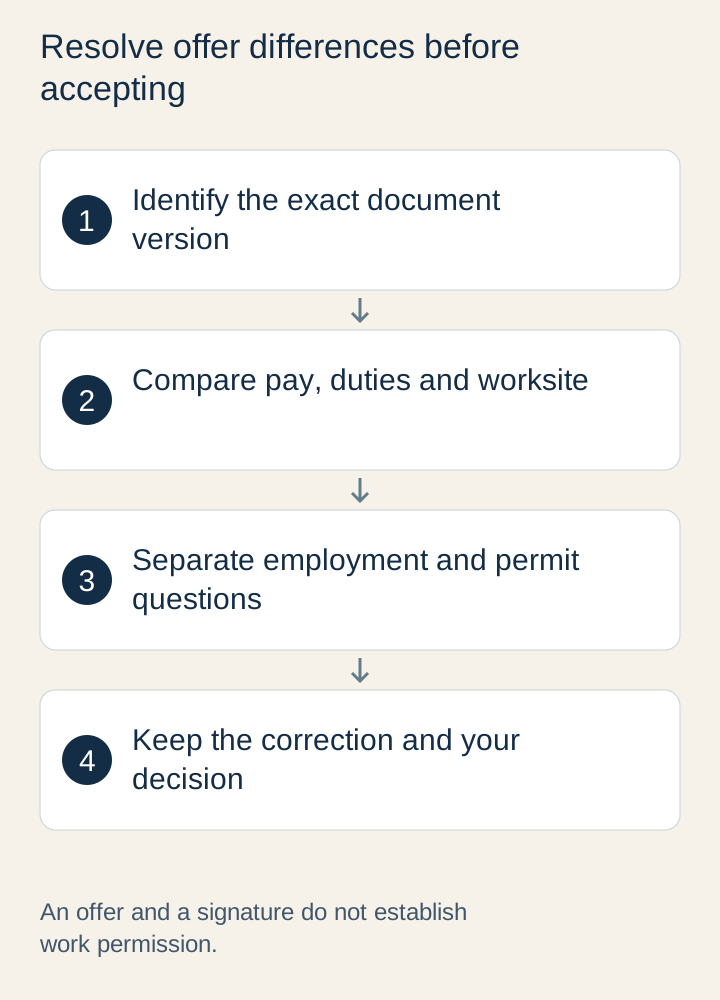
An offer should not be treated as a product that guarantees employment or immigration approval when paid for. The ESDC rights guide for Temporary Foreign Worker Program workers addresses prohibited job and recruitment-cost charges. It also says the employment agreement should match the approved LMIA's occupation, wages and conditions. Its program scope matters; do not convert a particular rule into a statement about every possible service supplied by every party.
If someone requests a payment, identify the charging party, service, contractual basis and responsibility before proceeding. Calling a charge an administrative package does not explain what it covers. A receipt alone does not establish that a charge is appropriate. Do not describe a payment as buying an employer's sponsorship, a successful permit or a guaranteed place in a recruitment process.
A hiring decision, an employer-side assessment and your own authorization are separate. Ask what has actually been completed and what evidence can appropriately be shared. A job offer can be genuine while work permission remains unresolved. Conversely, a permit document does not establish that all current employment terms match the role you were offered. The offer, LMIA and work-permit guide explains that handover in more detail.
For someone already holding an employer-specific permit, a new offer does not automatically permit a new job. IRCC's changing-employer guidance describes an authorization request for eligible situations. Submitting an application or request is different from receiving permission. Do not start work on a general assurance that the paperwork will catch up.
6. Make the decision and keep a useful handover record
Before deciding, separate resolved terms, understood conditions and unanswered questions. A corrected clause should be identifiable by version and date. If the answer remains “we will sort that out after you arrive,” record what is still unknown and what commitment you are being asked to make before that answer exists. You do not need to call the employer dishonest to recognize that a material question remains unanswered.
Keep a compact document index: the vacancy reference, current offer, previous version, clarification messages and relevant permit or application evidence. Share personal documents only through an appropriate process with the genuine recipient. Do not circulate passport scans in a public worksheet or append them to every request for clarification. The record is useful when different people handle hiring, payroll and immigration-related steps.
Discuss a realistic start condition rather than treating the printed start date as automatic work permission. Clarify who will update the candidate if a condition is delayed, whether the role and site remain available and what must be reconsidered before relocation. Employment terms and lawful start conditions should be understood together, without pretending one guarantees the other.
If a legal or immigration question determines the decision, refer it for an appropriate individual assessment. PremierVisa Group's Canada information provides further immigration reading. HKJobHunt's preparation support does not by itself certify a contract, an employer's compliance or an applicant's future immigration result.
7. Questions candidates commonly need answered
Does signing an offer mean I can start immediately?
No. Check your actual authorization and any conditions relevant to the employer, job and location. The offer records an employment proposal or agreement; it is not a substitute for permission required to perform the work. Resolve the lawful start condition before beginning duties.
Is a deduction lawful simply because it appears in the contract?
Do not assume that. Identify its purpose and applicable jurisdiction. The BC example shows that consent does not permit charging employees for prohibited business expenses. Other situations need their own applicable rules; the article does not approve your particular deduction.
Must the job be at the company's registered address?
Not necessarily. Ask for the actual worksite and any travel or remote arrangement. Then compare the employment terms with relevant permit wording. A business address, practical reporting point and authorized work location are separate facts to reconcile.
Is every discrepancy a scam?
No. A clerical error, recruiter handover or genuine change may explain a difference. Ask for a specific correction and preserve the answer. If the issue remains unresolved, do not replace missing evidence with reassurance or claim that the employer has been verified.
What should I send a consultant first?
A summary of your background, the proposed role and the precise unresolved question is a useful start. Identify the document version and omit unnecessary identifiers. Confirm the service scope and secure document process before sending sensitive records or assuming a legal review is included.
Submit your job-search background to HKJobHunt to discuss your resume, interviews and practical employer directions. Employment, work authorization and permanent residence remain separate outcomes.