
If your Canadian work permit names an employer, finding another job does not make that permit transferable. Search and interview with a clear account of your current conditions, then separate the new employer’s documents from your own application and permission to start. This guide is for employer-specific permit holders planning a move within Canada. It includes a transition record and original employer questions; it does not determine whether you qualify for a particular application or early-work authorization.
- 1. Read the permission you actually hold before contacting employers
- 2. Search for a real role and explain availability accurately
- 3. Separate the offer, employer documents and personal application
- 4. Use a six-field transition record instead of a promised start date
- 5. An early-work request is separate from permission received
- 6. Keep current work, expiry and leaving the old job on separate tracks
- 7. Questions that commonly arise during an employer change
1. Read the permission you actually hold before contacting employers
Start with the document, rather than the label someone used when you were hired. The IRCC employer-specific permit guide explains where employer, occupation, location, conditions and remarks appear. Read the expiry date alongside those entries. A permit that remains valid for your existing employment is not evidence that you can perform a different employer’s job immediately.
Make a private summary of the restrictions relevant to the proposed move. Record the employing entity and worksite as they appear, and flag anything you do not understand for an appropriate individual assessment. A familiar trading name, a related company or a similar job title does not resolve a difference in the actual documents. Do not change your interpretation simply because the recruiter calls the move an internal transfer.
Keep three questions apart: what you can currently do; what the proposed job would involve; and what permission would cover that proposed work. This makes the first recruitment conversation more useful. It also prevents a broad statement such as “I have a Canadian permit” from becoming an unintended promise of immediate availability.
This article is not an open-permit comparison. If you are unsure which document you hold, first use our open and employer-specific permit comparison. IEC participants should check the separate instructions linked by IRCC before assuming that the general employer-change process applies unchanged.
2. Search for a real role and explain availability accurately
Build your shortlist around duties, required experience, worksite and the employer’s actual hiring needs. Look for a job you can perform and substantiate, not just an advertisement containing “LMIA.” A public advertisement is a lead for investigation; it does not prove that its employer has completed an immigration step or that you will be selected.
For each lead, retain the original advertisement, date, contact channel and employing name. Compare the role with your experience and prepare a short explanation of relevant results. Ask whether the person you are speaking to can clarify the company’s hiring procedure or introduce the responsible HR contact. A recruiter’s enthusiasm and an employer’s documented decision are different evidence.
An original first-contact message could read: “My experience in [accurate function] matches your advertised [role]. My current permit is tied to my present employment, so I cannot promise an immediate start with your company. Is this vacancy open to discussing the employer documents and conditional timing that a move could require?” Replace the brackets with true information. This is an employer conversation example, not wording for an immigration application.
If a form asks whether you are authorized to work, answer the question in relation to the actual position and your current conditions. Where a yes/no box cannot describe the situation, use the available explanation field or ask the recruiter how to record it accurately. Do not select “unrestricted” simply to pass an automated filter, and do not invent a future approval date.
Record the answer as precisely as it was given. “HR will review the vacancy” is not “the company will obtain an LMIA.” A refusal to consider the necessary process is useful information for narrowing your search. It is not a reason to conceal your position or offer to purchase sponsorship.
3. Separate the offer, employer documents and personal application
Under the IRCC change-of-employer instructions, an employer-specific holder seeking to change jobs or employers must apply for a new work permit if eligible. The old permit does not automatically follow you to the next company. Eligibility and application instructions still depend on the circumstances.
Ask the proposed employer which employer-side route has actually been identified and what documents it can supply. The official employer-specific guide separates the assessment of whether an LMIA is needed, any required employer action, and documents supplied to the worker. Do not treat an LMIA-exempt possibility as a self-declared exemption, or an LMIA application as a positive decision.
Compare the proposed employing entity, duties and location across the offer and supporting material. If two documents differ, request clarification and a corrected version before letting the discrepancy spread into later paperwork. Our offer checklist covers that document comparison in more detail. Keep this transition record focused on the move and the permission needed for it.
Assign responsibility explicitly. The company can explain its vacancy and the employer documents it controls; an appropriate reviewer can assess your individual application situation. You remain responsible for truthful information about your experience and circumstances. Neither an agency contact nor a job offer can issue Canadian work permission.
4. Use a six-field transition record instead of a promised start date
Create one private row for each proposed move. The six fields are: current permit conditions and expiry; proposed employer, job and site; employer-side evidence and status; personal application and any separate authorization request; authorization actually received and its scope; and the start condition, update owner and fallback. Link each entry to a dated document rather than an optimistic recollection.
| Evidence or activity | Useful next action | What remains unresolved |
|---|---|---|
| Suitable vacancy and interview invitation | Discuss duties and hiring procedure | Selection and new-job permission |
| Written offer | Compare entity, duties and location | Employer and personal application requirements |
| Employer documents available | Check the appropriate application instructions | Approval or separate early-work authorization |
| New permit application submitted | Retain submission evidence and assess any separate request | Permission to start merely from filing |
| Authorization email actually received | Read the authorized work and conditions carefully | Whether a different role or change is also covered |
For an illustrative situation, suppose a worker interviews for a similar technical role at a different company. The prospective supervisor says recruitment can continue while HR checks the documents. Record “HR review pending,” keep the new role separate from the current permitted work and identify who will update the offer. This invented teaching scenario is not a partner employer, a client result or evidence of eligibility.
Use a conditional planning statement: “The start will be confirmed after the applicable permission is evidenced and the employer confirms the role.” A tentative date can help internal planning if everyone understands the condition. It must not turn into an instruction to begin work regardless of the outcome. Distinguish your follow-up reminder from an official deadline or a government commitment.
If you need help presenting your experience and explaining availability, submit your career background. HKJobHunt can discuss resume preparation, interview communication and realistic employer-contact directions within an agreed service scope. Individual immigration questions may be referred for assessment; a consultation cannot create permission or oblige an employer to support an application.
5. An early-work request is separate from permission received
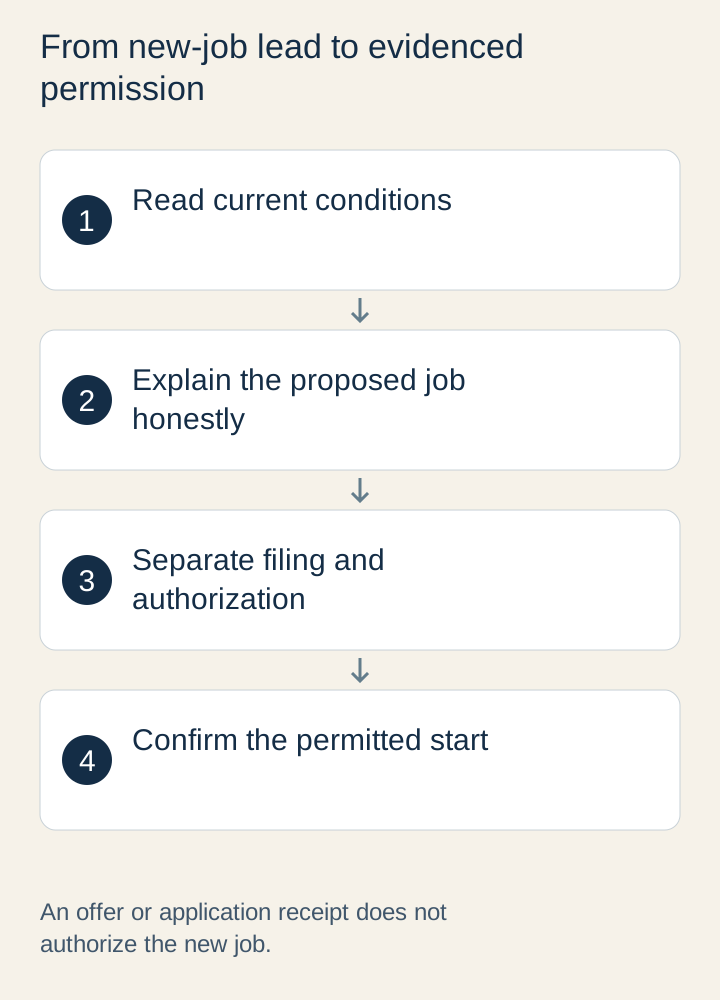
IRCC describes a process through which eligible applicants may request authorization while a new employer-specific permit application is being processed. The conditions include an in-Canada application for a new employer-specific permit and a qualifying current work situation. This is not a general shortcut for every visitor, permit holder or person considering a new job.
Read the live eligibility list and instructions before using the process. IRCC excludes business visitors and certain short-term Global Skills Strategy workers from the listed work-without-a-permit category, and points IEC participants to separate instructions. A familiar phrase such as “change employer policy” does not establish that your case is included.
Submission of the permit application and submission of a web form are not the authorization email. Follow the current official instructions directly; this article does not reproduce the government’s request template. Retain the request and response privately, and check the actual decision before agreeing to perform the new work. The email itself is not the new work permit.
When a response arrives, compare the employer and proposed employment with the work covered, and ask an appropriate reviewer about uncertainty. Do not reuse someone else’s authorization, a generic screenshot or an acknowledgment as your own evidence. If the company changes the job or the application changes, reassess rather than assuming that an earlier conclusion travels with every later version.
6. Keep current work, expiry and leaving the old job on separate tracks
Searching for another job does not by itself establish that your existing lawful work must stop. Equally, the continued validity of an old permit does not authorize a new company’s work. Before deciding what you can do during a transition, check your actual conditions, employment facts and any applicable authorization.
The IRCC expired-permit guidance describes when a timely application and remaining in Canada may allow continued work under the original conditions. For an employer-specific permit, those original conditions include the same employer, job and location. Maintained status is not a universal permission to start with a different employer.
The same guidance distinguishes applications for a visitor record or study permit: these do not extend work permission beyond the current work permit’s expiry. Do not use “I submitted something” as your explanation to HR. Identify the actual application, timing and evidence, and obtain an individual assessment where needed. Travel also needs separate consideration before departure; do not assume work can resume after any trip.
If you have lost the job tied to your permit, read IRCC’s specific lost-job instructions. They require the relevant new offer and application, remaining in Canada, and waiting for a new permit approval or work-authorization email before working. Do not confuse this situation with a person still lawfully doing the old job while exploring options.
Keep resignation and relocation decisions conditional on verified facts and any employment obligations relevant to you. We do not supply a universal notice period or recommend that everyone resign at a particular application stage. For the wider handover, see offer, LMIA and work-permit stages; for immigration context, use PremierVisa Group’s Canada information. Record unanswered questions instead of filling them with an assumed approval.
7. Questions that commonly arise during an employer change
Can I say I am available immediately because my permit has not expired?
Only if the proposed work is actually permitted under your circumstances. An unexpired employer-specific permit does not establish permission for another employer. Explain the restriction and any condition on starting accurately, rather than offering an unconditional date.
Does a new employer’s positive LMIA let me start?
It is employer-side evidence, not your personal work permit or a separate early-work authorization. Confirm the applicable personal steps and permission. The company’s willingness to hire and a government decision about your work are separate events.
Is requesting early authorization enough?
No. The official process distinguishes requesting it from receiving an email that authorizes the work. Check eligibility first, follow the live instructions and read the actual response; an acknowledgment or filing receipt is not a substitute.
Can I continue the old job while waiting?
That depends on your existing permission and circumstances. Timely applicable applications may preserve work under the original conditions while you remain in Canada. This does not automatically cover a new employer, and lost-job situations require their own checks.
Should I send my complete immigration file with every resume?
Use a concise, truthful explanation first, then provide relevant evidence through a verified recruitment or HR channel when needed. Avoid sending unrelated identifiers and documents to unverified contacts. Keep the transition worksheet private; its purpose is to track evidence, not to publish your immigration history.
Prepare the six-field record and choose the next question a real employer can answer. Submit your career background to discuss resume presentation, interviews and practical employer-contact directions. Employment, employer support and permission to start remain separate decisions.