
Before choosing Canadian jobs, check the permission you actually hold and match its conditions to the proposed employer, duties and location. An open permit offers different employer flexibility from an employer-specific permit, but open does not mean unrestricted work or automatic eligibility. This guide provides a permit-to-job comparison worksheet and a practical search workflow. It separates applying, receiving an offer and being authorized to start, without assessing your private documents or guaranteeing a future permit.
- 1. Identify your present permission before choosing a search route
- 2. Understand what open does, and what it does not do
- 3. Read an employer-specific permit against the new job
- 4. Build the permit-to-job worksheet before filtering vacancies
- 5. Search and apply using the position you can substantiate
- 6. Handle changes and pending applications before promising a start
- 7. Frequently asked questions
1. Identify your present permission before choosing a search route
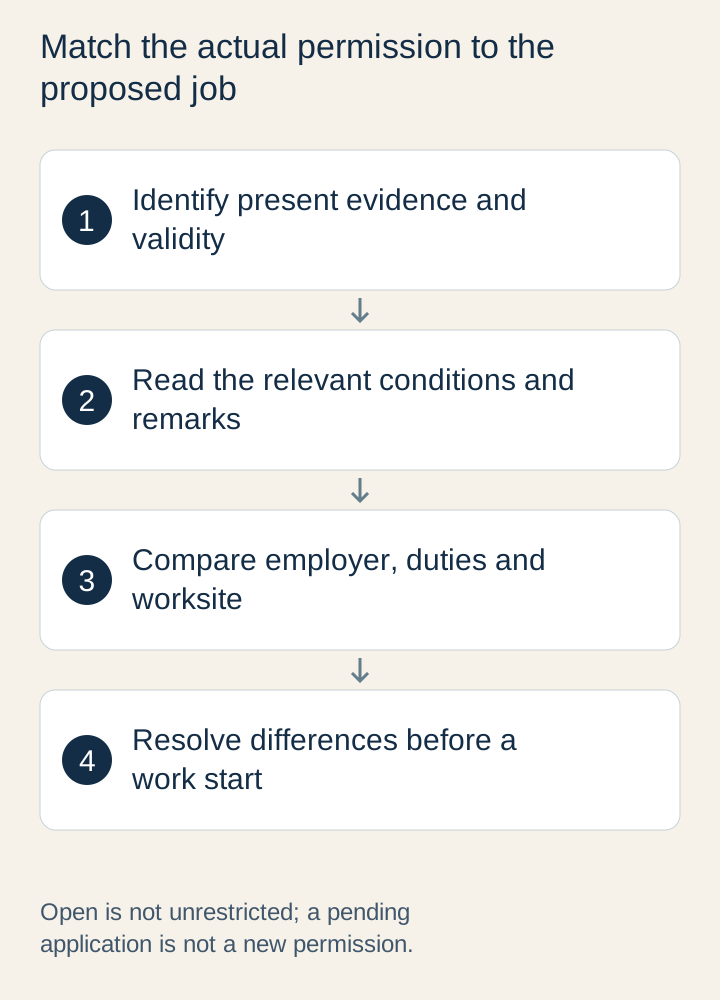
Start with your current document, its validity, the conditions and any later decision affecting it. Write down whether you hold a permit, have applied for a different one or are only considering an application. Those are three separate positions. A planned route belongs in your preparation notes, not in a declaration that you already have its work rights.
The IRCC permit-type guide says the type available depends on eligibility. An employer-specific application involves a job offer and may require employer LMIA steps. Open permits are available only in particular situations. The distinction is a starting point for finding the relevant instructions, not a menu from which every overseas applicant can freely choose.
Record your own circumstances, not a family member's permit or a former colleague's experience. Being in Canada is not itself authorization for any job, and living abroad does not tell an employer what permission you hold. A useful preparation summary states current location and documented position separately. This also prevents a recruiter from interpreting your available relocation date as a lawful work-start date.
Do not enter personal identifiers into a public comparison tool. Keep a private document reference and the relevant wording, with the complete evidence available through an appropriate secure channel when needed. This article has not accessed an immigration account or checked an individual's permit. Its worksheet helps organize the questions an appropriate reviewer would need to answer.
2. Understand what open does, and what it does not do
IRCC's open-permit page explains that these permits are not job-specific, but lists employer exclusions and possible work-type or location restrictions. Read the actual conditions before targeting a role. The word open should not become “any employer, any occupation, anywhere, forever” in your resume or a recruiter's description.
Check the duties behind the job title. A general assistant role could include tasks that raise a restriction question; a job with a familiar title may be performed at a different location or in a regulated setting. Ask for the actual work description rather than deciding from a search-result heading. Occupational qualifications and the employer's requirements also need separate attention where relevant.
Open-permit eligibility is not created by finding a company willing to hire. If you do not already hold one, establish the applicable route before using open-permit language in an application. Do not assume a spouse's situation, a school credential or an old online announcement is sufficient. This comparison does not determine eligibility for a particular family, graduate or other category.
For a permit you actually hold, prepare a proportionate employer explanation: identify the permit type and offer appropriate evidence of its relevant conditions. Keep current hiring and future expiry planning separate. The employer may need to understand both, but an honest answer about today's permission cannot guarantee renewal, permanent residence or support for a later application.
3. Read an employer-specific permit against the new job
The official employer-specific guidance identifies employer, location and occupation information, conditions and possible remarks. Read these together with the actual expiry date. Do not check only the company name and ignore the rest, or assume that two related companies are automatically the same authorized employer.
Compare the proposed legal employer, duties and worksite with that evidence. If the role differs, record the difference for review rather than rewriting it as a match. Ask the employer to explain unclear job details. A commercial title such as consultant, trainee or contractor does not, by itself, establish that the work is permitted under your conditions.
Employer-specific does not always mean an LMIA was required, and LMIA-exempt does not mean open. Keep the permit type, the employer process and the personal conditions in separate fields. The offer and permission guide addresses supporting documents in more detail. Here the immediate question is how the actual restrictions affect the jobs you target and the start you can discuss.
| Check | Current open permit | Employer-specific permit |
|---|---|---|
| Employer flexibility | Broader, with applicable exclusions | Read the named employer and all conditions |
| Duties and worksite | Still check restrictions | Match actual occupation, location and conditions |
| New-job discussion | Explain the actual current basis | Identify any change needing review |
| Future permission | Not guaranteed by present validity | Not guaranteed by a new offer |
This table is a comparison prompt, not a complete legal assessment. If you need help organizing your resume and employer questions, submit your candidate background. The discussion can identify preparation gaps and practical contact directions without promising that a vacancy or permit is available.
4. Build the permit-to-job worksheet before filtering vacancies
The original worksheet has six fields: present permit and evidence date; relevant condition wording; proposed employer, task and worksite; match or unresolved difference; the question and responsible reviewer; and the next action before a start. Keep the actual wording separate from your interpretation. “Looks fine” is not a useful substitute for identifying which condition has been checked.
In a fictional example, a candidate holds an open permit but notices a work-type restriction while reading a vacancy with mixed duties. The worksheet records the exact concern and asks the employer to clarify those duties before a suitable reviewer assesses the permission issue. It does not mark every open-permit role as prohibited or assume the restriction disappears because the employer is interested.
In a second fictional example, a permit names one employer while the new offer uses another legal entity in the same business group. Record the entity difference and refer it before agreeing to begin. Branding alone is not the match you are trying to establish. These teaching examples explain how to preserve a question; they are not real client stories or findings about an actual employer.
Use separate outcomes: information requested, job detail clarified, permission question reviewed and start basis confirmed. An employer replying with the worksite may close the location question while leaving authorization unresolved. Keep the remaining issue visible. A six-field table filled with text can still contain outstanding work; completeness of a document is different from resolution of its contents.
5. Search and apply using the position you can substantiate
If you hold an appropriate open permit, search for genuine roles matching your skills while checking applicable conditions. Do not unnecessarily restrict every search to the words LMIA approved. Conversely, if the job needs employer steps for your circumstances, check that the recruitment process considers applicants in that position. The Canadian employer-search guide explains the broader search workflow.
Read the original advertisement and its application questions. A posting accepting international applicants does not settle your work-right position; a posting aimed at people already authorized may not fit someone awaiting permission. For contradictions between a heading and a form, use the advertisement statement guide. Do not give a false answer simply to reach the next screen.
Keep two application notes: evidence that you can perform the duties, and the accurate explanation of your present authorization. Tailor your resume with real achievements and a clear account of your contribution. The permission check does not replace a skills match, just as strong experience does not remove a restriction. A useful shortlist meets both the job requirements and the appropriate permission pathway.
When asked about sponsorship, clarify the employer's meaning and explain the facts you can support. The interview answer guide provides original practice wording. Avoid turning your expiry date into a promise that the company can obtain another permit by then. No search filter, interview result or government page establishes an individual processing timetable.
6. Handle changes and pending applications before promising a start
IRCC's changing-employer instructions distinguish open-permit flexibility during validity from employer-specific changes. For an employer-specific change, eligible applicants need the appropriate new application; a separate request for interim work authorization may be possible. Eligibility and the actual authorization matter. Sending a request is not the same as receiving permission to work for the new employer.
Do not treat maintaining permission for existing work as automatically authorizing a new employer. The after-application guidance describes eligible continuation under original conditions. Read that scope carefully and obtain advice on your actual situation. A pending open-permit application does not simply replace the conditions of an employer-specific permit with the conditions you hope to receive.
Agree a practical handover question: “What evidence will we use to confirm I can begin this particular job, and who will check it before the first shift?” Record the proposed date as conditional while a required answer remains outstanding. Keep work scheduling, travel and employment commitments coordinated without allowing one department's calendar invitation to become an assumed authorization decision.
Immigration details can be discussed through PremierVisa Group's Canada information and an appropriate individual engagement. This article does not calculate status after expiry, determine restoration, advise on travel during a pending application or reproduce special-category instructions. Refer those facts rather than applying a broad comparison to a case outside its scope. No permanent-residence result follows automatically from finding a job.
7. Frequently asked questions
Can everyone overseas choose an open permit to simplify job hunting?
No. IRCC limits open permits to particular eligible situations. A preferred recruitment strategy does not create eligibility, and an expected application should not be described as permission already held.
Does open mean there are no restrictions on the jobs I can do?
No. Check the actual document and applicable employer exclusions, work-type and location conditions. A general label does not answer every task or worksite question.
Is every employer-specific permit based on an LMIA?
Do not assume so. Permit type and LMIA requirements are different questions. Establish the employer process that actually applies, then read the personal conditions rather than inferring one from the other.
Can I start with a new employer after requesting interim authorization?
The request alone is not authorization. Check eligibility and wait for the actual permission required by the official process, or the appropriate new permit basis, before starting the proposed work.
Does a pending open-permit application free me from my old conditions?
Do not presume that. The official continuation guidance concerns eligible work under original conditions. Obtain a review of your current basis, pending stage and proposed job instead of treating the future permit as issued.
Submit your candidate background to discuss a resume, interview preparation and practical employer-contact direction that reflects your current position. Begin with relevant experience and the question needing clarification; do not include complete identity documents in a general enquiry. Work, permits and immigration outcomes are not guaranteed.
Prepared with AI assistance. General career information; no named professional review has been confirmed. AI cover illustration does not depict our staff, clients or partner employers.