
A Canadian employer should identify the worker’s actual permission and the proposed job before choosing an LMIA or an LMIA-exempt process. An exemption must fit the relevant conditions; it is not created by a job title, an agency promise or a preference for less paperwork. This guide provides a six-field route record for hiring discussions. It separates existing open permission, employer-specific applications and other exemptions without determining any individual’s eligibility or guaranteeing a start date.
- 1. Begin with the worker and job, not the preferred route name
- 2. Distinguish existing open permission from an application still to be made
- 3. Test a proposed LMIA exemption against its actual conditions
- 4. Use a six-field route-and-responsibility record
- 5. Prepare the employer actions without confusing them with the permit
- 6. Carry the route decision into employment and future changes
- 7. Employer questions about LMIA and exemptions
1. Begin with the worker and job, not the preferred route name
Write a short factual hiring brief: the employing entity, real duties, work location, terms and the person responsible for confirming them. Separately record what the proposed worker actually holds, where they are applying from and what remains to be assessed. A future intention to obtain permission is not the same as permission already issued.
The official IRCC guidance on who can be hired through the International Mobility Program distinguishes several situations, including open work permits and employer-specific LMIA-exempt categories. It also separates cases that require an LMIA and therefore use the Temporary Foreign Worker Program. Do not collapse those distinctions into a single label such as “overseas sponsorship.”
Ask for a proportionate summary of relevant permission first, then obtain the necessary evidence through a verified HR process. Do not ask everyone involved in advertising to receive a complete immigration file. Keep unrelated identifiers outside the general hiring brief, and identify the appropriate person who will assess the individual questions.
The employer’s task at this stage is to state accurate employment facts and identify the unresolved route question. It is not to select an exemption from a menu because another company used it. A similar business, nationality or occupation can still involve different conditions and evidence.
2. Distinguish existing open permission from an application still to be made
If the worker already holds a valid open work permit, read its actual restrictions and expiry against the proposed work. The IMP hiring guidance says an employer hiring a worker with an open permit does not need the Employer Portal offer submission or employer compliance fee for that hire. This does not remove ordinary employment responsibilities or turn an expired or unsuitable document into valid permission.
Keep “holds an open permit” and “may qualify to apply for an open permit” in separate entries. A plan to apply, a study history or a family relationship is not proof that the worker currently has that permission. Do not assume everyone in a broad group automatically qualifies; the individual category and current conditions still matter.
If permission is tied to another employer, it is not an open permit merely because the person is already in Canada. Our open and employer-specific comparison explains that distinction, while the employer-change guide deals with a proposed move. Keep the new-job start question open until the applicable evidence is established.
Some situations involve a work-permit exemption rather than an LMIA exemption for a permit application. They require their own specific conditions. Do not use the word “exempt” alone in a recruitment note: state what requirement is said to be exempt, the official basis to be checked and which facts remain unverified.
3. Test a proposed LMIA exemption against its actual conditions
For an employer-specific LMIA-exempt proposal, identify the official category and read the requirements for the worker, role and employer. A title on a resume does not prove a treaty category, an intra-company relationship or another exemption. The job still needs an accurate account of its duties and circumstances.
The Employer Portal user guide explains that the selected exemption must match the position and duties, and that the employer must explain how the job meets its requirements. A system-generated code after a menu selection is not an official decision that the facts satisfy that category.
Create a requirement-to-evidence list. For each material condition, identify the document or fact that supports it, who can verify it and what is still missing. Keep a distinction between evidence available now and evidence someone expects to obtain later. If a condition cannot yet be established, record it as unresolved rather than silently calling the route approved.
For an invented example, a company wants to hire someone with a familiar professional title and a recruiter suggests an exemption. The company still needs the real duties, the proposed category’s actual criteria and evidence of the relevant employer and worker facts. This teaching example does not identify a real vacancy, a partner employer or a successful exemption case.
If the relevant exemption does not apply and an LMIA is required, the IMP is not the substitute route. Investigate the appropriate TFW Program requirements rather than changing the label to avoid recruitment obligations. Conversely, do not assume an LMIA must be obtained merely because no one has yet checked a worker’s actual open permission.
4. Use a six-field route-and-responsibility record
Our original record contains: the proposed route claim; the worker’s actual permission and relevant circumstances; the employing entity, duties and site; official conditions and corresponding evidence; employer actions and responsible owners; and unresolved questions, review responsibility and the start condition. Keep sensitive supporting records separately and link them by reference.
| Situation being checked | Evidence question | What the employer should not assume |
|---|---|---|
| Valid open permission already held | Does the actual document cover this work and period? | A possible future application is already granted |
| Employer-specific LMIA exemption proposed | Which official category fits and what supports each condition? | A category name or portal code proves approval |
| LMIA required | Which TFW Program requirements and employer evidence apply? | An LMIA application is the worker’s permit |
| Work-permit exemption proposed | What precise exemption covers this activity and circumstances? | Every visitor or similar occupation is exempt |
An outcome for the record can be “individual assessment needed,” not just a choice of route. List the next document request or responsible contact. Avoid forcing a yes/no answer when the employing entity, worksite or worker’s actual document is still unclear.
A useful briefing question is: “Which official category are you assessing, which facts support it, what remains missing, what must our company do and what evidence is needed before work begins?” Ask an appropriate reviewer to identify assumptions rather than promising a result. This is an original discussion prompt, not an application statement or a substitute for professional advice.
For help clarifying a vacancy and organising talent search, screening and interviews, submit your hiring requirements. Service and contract scope should be confirmed. Individual immigration questions can be referred for assessment; recruitment support does not establish an exemption or issue work permission.
5. Prepare the employer actions without confusing them with the permit
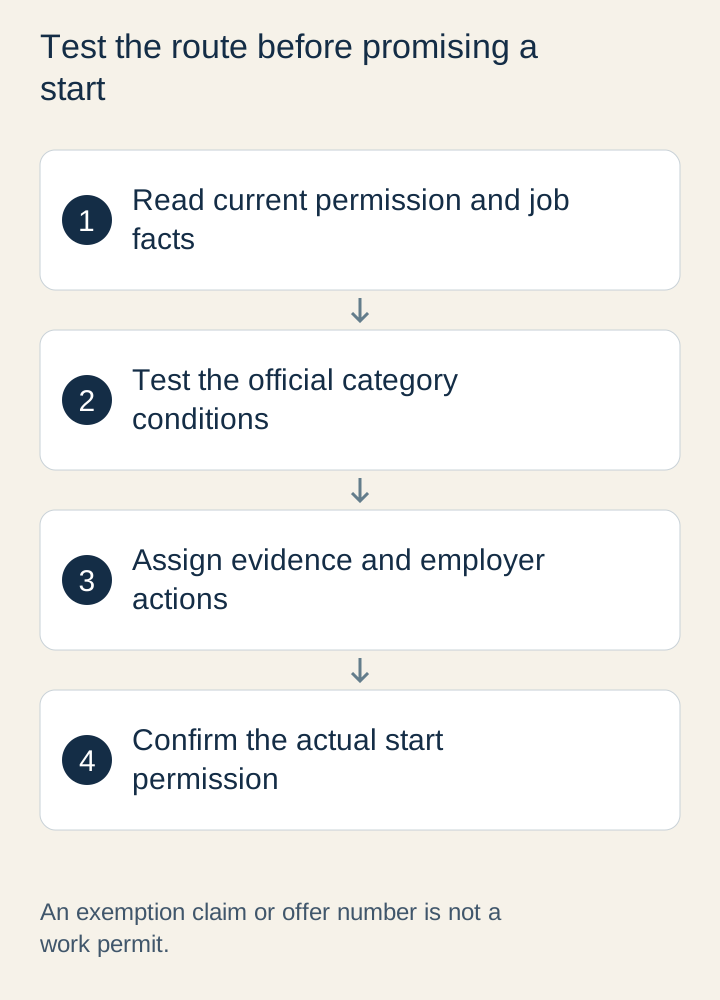
The official IMP hiring steps explain that most relevant hires require an Employer Portal offer submission and the applicable employer compliance fee. There are exceptions, including open-permit hires and other specific compliance exemptions. Check the actual route instead of telling every employer to follow the same portal process.
When a portal submission is required, assign the company owner and the person authorised to prepare accurate business, worker, job, wage and benefit information. Follow the current user guide. The agreement and attestations need real attention; the guide calls for the worker’s copy of an agreement signed by both parties in the worker’s preferred official language, English or French, with the relevant employment terms.
Check the employing entity, duties, location and terms across the agreement and the portal information. Do not use a generic attachment as a substitute for completing the required fields accurately. If something changes or an error is found, follow the official correction instructions rather than assuming that an already submitted offer can simply be overwritten.
After the required submission, provide the relevant offer number to the worker for the personal application. The offer number records an employer step; it is not the worker’s approved permit. A fee payment, signed contract or a screenshot showing submission likewise does not establish permission to start.
Application instructions vary with the worker’s circumstances and location. Do not promise that every person can obtain a permit at a border or travel as a visitor and begin immediately. Let the individual application assessment and the actual permission determine the start arrangements, not the company’s preferred recruitment calendar.
6. Carry the route decision into employment and future changes
The IRCC IMP employer-responsibilities page describes obligations after the relevant hiring and permit approval. These include checking the permit and expiry, respecting the applicable conditions and maintaining employment consistent with the offer, alongside relevant employment laws and other obligations. LMIA-exempt hiring does not mean employer obligations disappear.
Give the HR person managing the actual employment access to the final terms, appropriate permission evidence and record location. Record who will review changes to duties, site or terms. A recruitment contact’s earlier explanation is not a reason to ignore a later change in the facts supporting the arrangement.
The IMP responsibilities page describes keeping employment documents for six years from the date the work permit was issued, and notes that records may still be needed if the worker does not start or leaves early. Do not borrow a retention starting point from an LMIA recruitment article and apply it automatically to this different context. Use the appropriate official requirement for the actual route.
Maintain a clear handover between recruitment, employer filing and individual immigration assessment. Keep changes and unresolved questions visible to the responsible people. A tidy route record cannot guarantee approval, preserve eligibility after every change or replace an official decision about the person’s work.
For detailed immigration background, use PremierVisa Group’s Canada information and agree any individual service separately. If an LMIA route is being considered, our employer recruitment-preparation guide explains the earlier vacancy and evidence planning. This article remains focused on choosing what to investigate, not reproducing an immigration application manual.
7. Employer questions about LMIA and exemptions
Is an LMIA exemption the same as a work-permit exemption?
No. A worker may need an employer-specific work permit even when the position is LMIA-exempt. A claimed exemption from holding a work permit is a separate question with specific conditions. Record which requirement is being discussed.
Does an Employer Portal number prove the worker can start?
No. It is part of the employer-side process for the relevant application. The worker’s personal permission and conditions must be established separately. Do not use a submission receipt or fee payment as a substitute.
Does every open-permit hire require an Employer Portal offer?
The official IMP hiring steps say the employer does not need that offer submission or employer compliance fee when hiring a worker who has an open permit. Check that the person actually holds suitable valid permission; potential eligibility is different.
Can the employer choose whichever exemption sounds easier?
The proposed category must fit the actual worker, job and employer facts. Identify its official requirements and supporting evidence. If no relevant exemption applies and an LMIA is needed, investigate the TFW Program rather than changing the label.
Does an LMIA-exempt route guarantee permanent residence?
No. Recruitment, employer documents, temporary work permission and permanent residence are separate outcomes. Do not add an immigration guarantee to an offer because a temporary hiring route is being assessed.
Prepare the six-field record and list what still needs an answer. Submit your hiring requirements to discuss practical talent search, screening and interview arrangements. Confirm immigration assessment and service scope separately from the employment decision.