
Before a Canadian employer starts an LMIA recruitment campaign, it needs a genuine vacancy, a checked program route, defensible job and wage terms, and a way to preserve actual recruitment results. Buying advertisements alone is not the preparation. This guide helps HR and operations teams assemble a recruitment file and assign responsibilities before applying. It compares selected current high- and low-wage requirements; variations, other streams and individual eligibility still need their own checks.
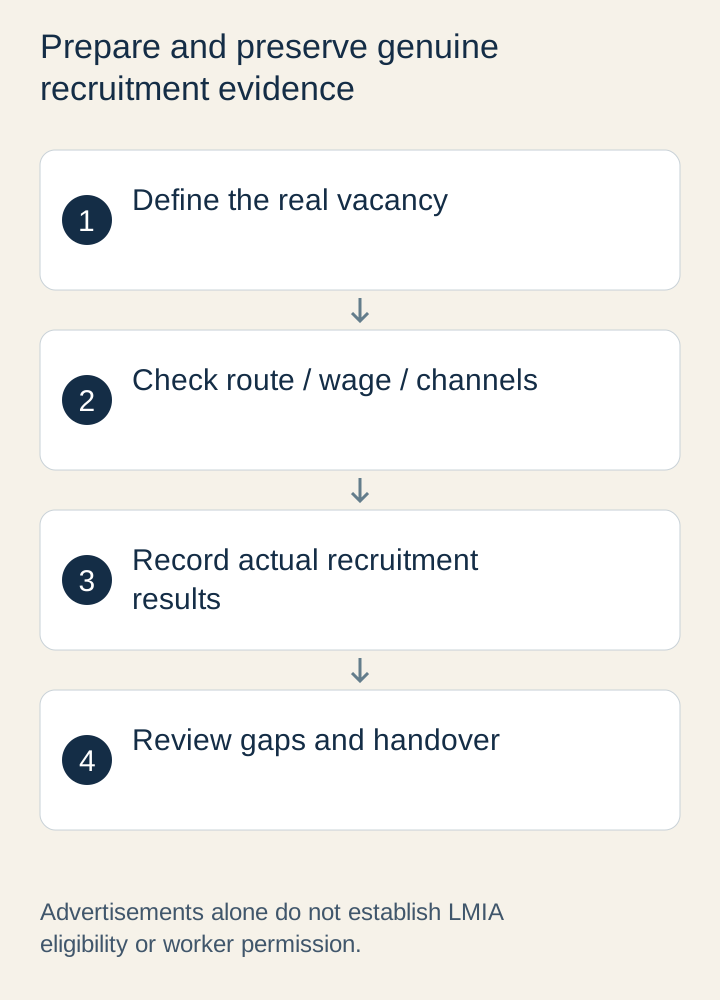
- 1. Define the real vacancy and the company that will employ the worker
- 2. Check the applicable route before choosing advertising dates
- 3. Design channels that reach suitable local applicants
- 4. Build a six-field evidence ledger while recruitment happens
- 5. Connect wage and business evidence to the actual offer
- 6. Arrange a genuine handover and keep the evidence after filing
- 7. Employer questions before launching an LMIA campaign
1. Define the real vacancy and the company that will employ the worker
Start with the business problem the position will solve. Write the duties actually needed, location, employment terms, supervision and proposed compensation. Ask the operational manager to explain the work using concrete tasks rather than a preferred candidate’s personal history. A genuine recruitment exercise should be able to explain why those requirements belong to the job.
Identify the employing entity and who controls the work and pay. A recruitment agency arranging introductions is not necessarily the employer. A trading name on an advertisement may also differ from the legal entity on company documents. Resolve that relationship before different names appear in the advertisement, offer and application material.
The official ESDC business-legitimacy guidance addresses the reality of the business and offer, including operating activities, reasonable employment need, ability to meet the terms and compliance considerations. A registered company or an available office address alone does not answer all those questions. Document what supports this particular vacancy.
Use an internal vacancy brief with an operational owner, a current document date and unresolved questions. If the business cannot yet describe the worksite or guaranteed pay, settle those points before launching advertisements. Changing the job after the campaign can create inconsistencies that a stack of screenshots will not explain away.
2. Check the applicable route before choosing advertising dates
Establish whether an LMIA is actually needed and which requirements apply to the proposed position. This article concerns preparation for selected general high- and low-wage requirements; it is not a checklist covering every Temporary Foreign Worker Program stream. Quebec requirements, refusal-to-process rules, applicable caps and variations may affect whether a campaign is appropriate at all.
The wage threshold used to identify a stream and the prevailing wage required for an occupation and location are separate checks. Do not choose a category from a stale salary chart or use an attractive total compensation figure without checking its components. Record the official source, worksite, wage basis and date used for the assessment, and assign a person to recheck if the job changes.
The following comparison was checked on 25 October 2026 against the official high-wage requirements and low-wage requirements. It is a planning comparison, not a finding that your application meets either category.
| Selected general requirement | High-wage page | Low-wage page |
|---|---|---|
| Minimum advertising period described | Four consecutive weeks within the three months before applying | Eight consecutive weeks within the three months before applying |
| Recruitment continuing during assessment | At least one of the three activities continues until a positive or negative LMIA decision | At least one of the three activities continues until a positive or negative LMIA decision |
| Additional recruitment emphasis | Appropriate additional methods, including national reach | Required youth outreach and additional methods reaching different underrepresented groups |
| Records of recruitment and advertising | Retain for at least six years | Retain for at least six years |
Check the live page again before placing advertisements and before filing. Do not infer that all streams use these periods, or attach an unverified commencement date to the comparison. If a variation is relevant, record its exact scope instead of silently replacing the general rule in the worksheet.
3. Design channels that reach suitable local applicants
For the general high-wage requirements, ESDC describes at least three recruitment activities: Job Bank or a justified alternative, and at least two appropriate additional methods, with national reach among the methods used. The audience must fit the education, experience or skills needed for the occupation. Several similar job boards do not automatically count as separate additional methods.
Low-wage recruitment has its own requirements, including youth outreach and additional methods reaching different underrepresented groups. Read those provisions together with the Job Bank feature requirements, including Job Match and Direct Apply. Do not disable an application route to avoid dealing with local candidates, or assume a national website automatically establishes the required audience.
For every channel, record its intended audience, why it suits the occupation, posting dates, advertisement version and where applications will arrive. If an external recruiter manages it, name the employer-side person who will obtain the evidence and review results. Outsourcing an activity is not a reason for the company to lose access to its own recruitment file.
Keep the job information consistent across channels. Check duties, wage, location, terms, skills, contact details and any other required advertisement information against the applicable official list. If an advertisement is corrected, preserve both versions and the actual dates. Do not backdate a correction or present a shortened run as uninterrupted advertising.
Plan who will monitor enquiries and assess suitable applicants while the campaign is live. A mailbox nobody checks is not a recruitment strategy. Agree how referrals, interviews and applicant questions reach the hiring manager, especially if operations and HR use different systems. Keep the assessment tied to the genuine job requirements.
4. Build a six-field evidence ledger while recruitment happens
Use a separate row for each vacancy and campaign version. The six fields are: duties, location and business need; applicable route, official source and variation check; channels, advertisement versions, dates and audience; applications and objective assessment actions; wage and business evidence with responsible owners; and gaps, next actions, rechecks and handover. Keep applicant information in a restricted record, not on a public worksheet.
An illustrative entry might say that an operations manager has confirmed a specific worksite, while HR is still checking whether two proposed channels reach different audiences. The next action is to choose and document suitable methods before launch. This is an invented planning example, not a participating employer or an approved LMIA case.
Record the real recruitment results. For applicants considered, retain the relevant assessment against genuine requirements, the action taken and any factual outcome. Do not manufacture rejection reasons, retrofit requirements around a preferred worker or describe every local applicant as unsuitable without an actual review. If someone meets the requirements, assess them fairly through the hiring process.
Evidence should show what happened, not merely that an invoice was paid. Keep dated advertisement copies and channel evidence, relevant application records, interview arrangements and results. Avoid collecting unrelated sensitive details; the point is to explain recruitment, not to create an unnecessary personal dossier. Store the private records securely with an appropriate access owner.
Employers needing practical recruitment support can submit their hiring requirements to discuss talent search, screening and interview arrangements. Scope and contracts need to be confirmed. This enquiry is not an LMIA submission or a guarantee that a suitable worker, positive assessment or permit will follow.
Before instructing a recruiter, ask: “Which channel reaches which relevant audience, who keeps each dated advertisement, who reviews applications, and how will you give us the actual results? Please identify the gaps before we approve the campaign.” Record the agreed responsibilities; this original briefing example is not an official application form.
5. Connect wage and business evidence to the actual offer
Assign someone to check the occupation and work location used for wage research. The high-wage page explains the prevailing-wage assessment, including the relevant Job Bank wage and the range paid to comparable current employees. Keep the reasoning and date, not just a copied salary number without its occupation or location.
Distinguish guaranteed wages from compensation components that do not count toward the offered wage-rate assessment. Do not rely on tips, possible bonuses or overtime to make a deficient guaranteed rate appear sufficient. Explain the actual terms consistently in the advertisement, offer and employer material. This guide supplies no hypothetical market salary or universal Canadian threshold.
Use the business-legitimacy page to identify which supporting documents apply to this employer. Requirements depend on the business, application history and circumstances; not every company needs to submit every tax document listed on the page. The responsible finance or authorized company contact should confirm accurate versions and the proper submission channel.
Keep tax, payroll and business records within an appropriate restricted process. Follow the official advice about unnecessary identifiers rather than circulating unredacted documents to everyone preparing an advertisement. The public vacancy brief and our blank worksheet should not contain private financial records, applicant identifiers or copies of a worker’s full immigration file.
Check any further obligations relevant to the chosen route, such as a transition plan where required for a high-wage application. Do not assume an exception without verifying it. Recruitment-fee responsibilities also matter: the requirements prohibit charging or recovering recruitment fees from temporary foreign workers. Do not ask a candidate to reimburse the employer’s recruitment bill as the price of selection.
6. Arrange a genuine handover and keep the evidence after filing
Before an application is prepared, review the campaign against the applicable duration and timing rules, channel requirements, actual advertisement content and results. Identify what remains incomplete and who must resolve it. A recruitment agency’s “ready” message does not replace the employer’s review of the actual file.
For any activity that must continue until a decision, assign an owner and a review reminder. Do not close all advertisements merely because the LMIA application was submitted. Continue to handle the applications the required channels receive and retain the actual evidence of what happens during that period.
ESDC’s employer-compliance guidance explains ongoing responsibilities and retention of relevant records for six years beginning on the first day of the employment period for which the work permit was issued. This is a different context from the recruitment pages’ minimum retention instruction; do not invent one universal starting date for every record category.
Give the person responsible for later employment compliance access to the final terms, relevant LMIA material and the record location. Set a procedure for reporting changes through the applicable channels. A successful recruitment campaign does not end the employer’s obligations, and a positive LMIA does not itself give the selected worker a work permit or immediate authorization to start.
For the worker-side sequence, share our offer, LMIA and permit guide rather than making immigration promises in the job advertisement. Detailed individual immigration questions can be assessed through an appropriate service arrangement; PremierVisa Group’s Canada information provides the related background. Keep recruitment decisions and personal permission decisions separate.
7. Employer questions before launching an LMIA campaign
Is buying three job-board postings enough?
No. The methods must meet the applicable audience and channel requirements, and similar sites may be counted together. You also need consistent job information, actual recruitment, results and dated evidence. Check the appropriate stream rather than buying a standard package blindly.
Is the advertising period always four weeks?
No. The selected high-wage page describes four consecutive weeks, while the selected low-wage page describes eight, within their stated pre-application window. Other streams and variations require separate checking. Use the live requirements for the actual job.
Can we stop every activity as soon as we file?
The cited general requirements say at least one of the three recruitment activities must continue until the positive or negative decision. Plan ownership and applicant handling for that period instead of treating filing as the end of recruitment.
Must every company provide every financial document on the list?
No. Follow the applicable business-legitimacy instructions for the employer’s circumstances and history. Assign an authorized document owner, use accurate records and protect unnecessary personal identifiers. Submission is not a certification of approval.
Can the successful applicant reimburse our recruitment costs?
The cited program requirements prohibit charging or recovering recruitment fees from temporary foreign workers. Do not make repayment a selection condition or disguise it as another deduction. Clarify responsibilities before signing service arrangements.
Complete the six-field ledger and identify the first unresolved requirement. Submit your hiring requirements to discuss talent search, screening and interviews. A real vacancy, fair recruitment and accurate evidence remain the employer’s preparation; support services do not guarantee an LMIA, a worker’s permit or permanent residence.