
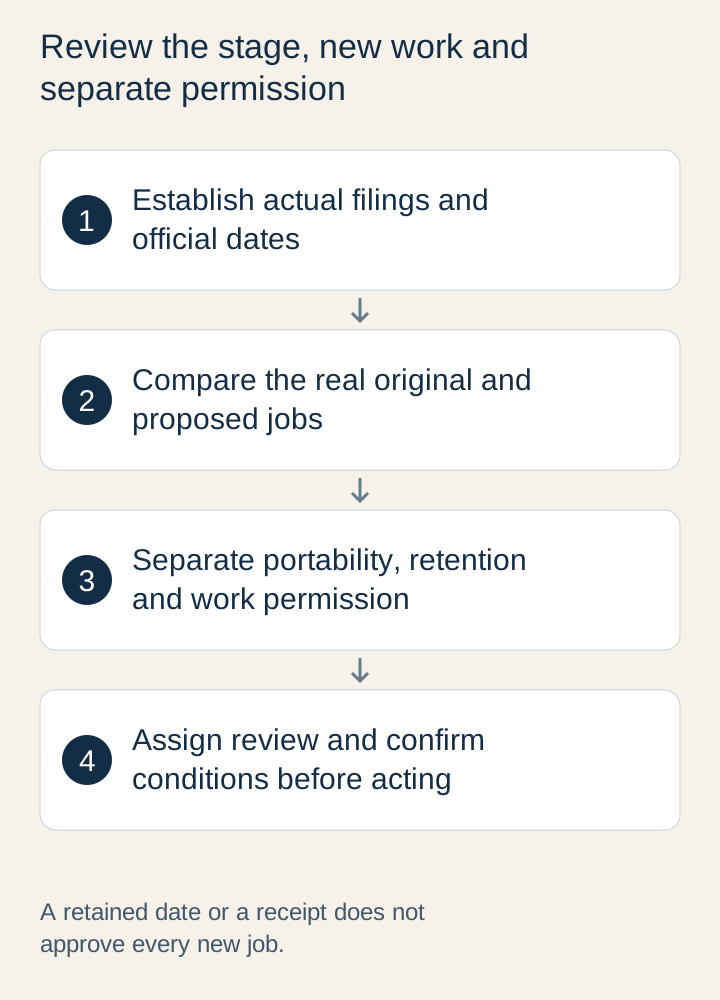
Before changing employers during an EB-3 process, identify the actual immigration stage, compare the original and proposed jobs, and check permission to take the new work. AC21 job portability is available only when its conditions are met; an approved I-140 or the passage of 180 days alone is not enough. Prepare a dated change review record for the appropriate professional assessment before promising a start date, resigning or treating a new offer as a replacement for the existing immigration case.
- 1. Establish what has actually been filed and decided
- 2. Distinguish the two 180-day questions
- 3. Compare the actual work in both jobs
- 4. Use the six-field change review record
- 5. Ask the new employer for verifiable support
- 6. Keep permission to start separate from portability
- 7. Questions about changing an EB-3 employer
1. Establish what has actually been filed and decided
Start with the documents, not the phrase “my EB-3 is in progress.” An employer discussion, labor certification application, I-140 petition and I-485 adjustment application are different events. Record which exists, which is pending and what the notices show. A priority date is not automatically the receipt date of every later application, and an agency’s service contract date is not a government filing date.
Ask whether the proposed change concerns an overseas consular case or an adjustment application in the United States. The job flexibility discussed here concerns qualifying employment-based adjustment applicants under INA 204(j), rather than a general permission for every overseas EB-3 candidate to replace an employer. Someone awaiting consular processing should ask what the new employer would actually need to undertake and whether any priority date may be retained; do not import adjustment portability conditions into a different procedure.
Keep original notices, relevant employer communications and the current role description together. If the employer has withdrawn something, the business has closed or a government notice questions the original case, record the exact event and obtain prompt assessment. Do not assume that a recruiter’s reassurance settles the legal effect, or that an employment dispute and an immigration consequence are the same question.
2. Distinguish the two 180-day questions
8 CFR 245.25 and the USCIS job portability chapter describe requirements including a properly filed adjustment application pending for at least 180 days when USCIS receives the portability request, an approved qualifying petition or a pending petition ultimately approved under the applicable conditions, a qualifying new job and a portability request. The adjustment waiting period is not counted from the first resume, PERM filing or I-140 approval.
A separate rule in 8 CFR 205.1(a)(3)(iii) addresses withdrawal and termination of the petitioning employer’s business. It includes timing related to petition approval and an associated adjustment application. Avoid turning a rule about whether an approval survives a particular event into a conclusion that any new job is acceptable. Substantive revocation and the need for a valid new employment basis still matter.
Likewise, priority date retention under 8 CFR 204.5(e) is a different question from continuing a case with another job. An approved petition may support retention subject to the rule and its exclusions; that does not by itself supply the new employer’s required process. Ask for separate answers on the priority date, petition position, portability eligibility and permission to start work.
| Evidence or event | Question it helps answer | What it does not establish alone |
|---|---|---|
| I-485 receipt and current pending position | Whether the adjustment waiting condition can be assessed | Every other portability condition |
| I-140 approval and withdrawal dates | Effect of particular withdrawal or business events | Automatic approval of a different job |
| Earlier priority date and petition history | Possible retention under the applicable rule | A transferable job offer or work permission |
| New employer’s offer and duties | Whether a genuine qualifying role exists | USCIS acceptance of a portability request |
3. Compare the actual work in both jobs
Create a side-by-side description of core duties, skills, education, training, required licences, responsibility, location and pay. Use employer-confirmed information for the original role and the proposed role. Do not compare only a job advertisement with the most flattering version of your resume. If an original document is unavailable, note what is missing and ask the appropriate representative how to obtain or explain the evidence.
USCIS evaluates the total circumstances when assessing whether jobs are in the same or similar occupational classification. Occupational codes can be relevant, but the policy chapter does not treat them as the sole or mandatory deciding factor. Matching titles do not make different responsibilities identical, and a different title is not a complete explanation of why work is unrelated. Describe the actual work and let the appropriate assessment address the classification.
Consider an invented teaching situation. Both offers say “operations coordinator,” but one is primarily organising a production schedule and the other primarily selling services. The common title leaves the central question unanswered. In a different hypothetical change, a person takes more responsibility for closely related functions. That also needs evidence of what has changed; do not call every promotion automatically acceptable or automatically disqualifying.
Explain salary and location differences factually instead of hiding them. Ask the employer to describe the genuine role, not to reuse an old title to make documents appear compatible. Where a local professional permission is involved, check the scope for the new duties and place separately. A job comparison is not authority to practise a regulated occupation, and editing a description cannot replace the real work or the necessary permission.
4. Use the six-field change review record
Prepare one dated record for the proposed change and keep each version. It is a handover tool, not an official eligibility decision. Mark evidence obtained, an explanation provided by another person, and unresolved questions separately. Avoid a single green “approved” label that merges employment, petition, work permission and the government’s decision.
| Field | What to preserve |
|---|---|
| Stage and official dates | Actual applications, receipt and decision notices, current pending position |
| Original employment basis | Employer, genuine duties, requirements and intention reflected in the existing case |
| Proposed employment | New entity, real offer, duties, requirements, location and intended timing |
| Same or similar comparison | Evidence of functions, qualifications, responsibility, codes and relevant differences |
| Permission and case changes | Work-authorization question, withdrawal or other notice, priority-date question |
| Review owner and action | Who assesses, outstanding records, request responsibility and conditions before starting |
Use the employer change worksheet to organise those facts. If you need help presenting your experience or preparing questions for a prospective employer, submit your background to HKJobHunt. The employment discussion and any immigration or legal review have different scopes; confirm the appropriate referral and engagement rather than assuming the enquiry certifies a transfer.
For example, the record might show a verified new offer but no reliable I-485 receipt information. The missing date is a real assessment gap, not an invitation to estimate from when an agency said it had begun work. Assign an owner to obtain the record and leave the conclusion open. The aim is to make the next professional conversation specific enough to resolve a question.
5. Ask the new employer for verifiable support
Begin with the role and the company’s actual intention: “Please confirm the employing entity, duties, qualifications, location and the conditions attached to the offer. Who is authorised to provide employment information for an immigration assessment?” A recruiter arranging interviews may not be authorised to commit the employer to an immigration process or sign employment confirmation documents.
Next explain the procedural position accurately: “My existing employment-based case needs review before I can confirm the proposed change or start conditions. I can provide relevant notices through an agreed secure channel to the appropriate reviewer.” Do not claim that an older approval makes the new employer’s participation unnecessary. Conversely, do not tell an employer that every change always requires an entirely new process without assessing the actual case.
Where AC21 portability is being requested, USCIS describes Form I-485 Supplement J and supporting evidence. The applicant’s and employer’s information should reflect the real offer and the current instructions. Ask who prepares and submits the request and how the applicant receives the relevant copy or notice. This guide does not reproduce a filing kit, choose a form edition or confirm that a particular submission has been made.
Keep job-search preparation factual. A new employer should not be asked to backdate an offer, invent duties or certify work it does not intend to provide. For role evidence use the qualification guide, and for the first employer conversation use the interview guide. The change record adds the existing-case evidence that an ordinary job application does not contain.
6. Keep permission to start separate from portability
Permission to work requires its own check. 8 CFR 274a.12 distinguishes different authorization bases, including categories that require an application. A portability discussion, an employment offer or a request receipt does not independently grant permission for the new job. Existing employer-specific permission, an EAD and any applicable continuation rule have to be assessed on their own terms.
Before acting, ask the reviewer to identify what can be concluded, what remains conditional and what evidence will resolve it. Record separate answers: eligibility to request portability, whether a request was submitted, any government decision, and the basis for starting work. Do not collapse all four into “the transfer is done.” If a new notice or employer event arrives, update the record and ask whether the earlier advice needs reconsideration.
Resignation, notice obligations, disputed deductions and employment contract issues also need their appropriate review. This article does not promise that leaving at a particular date avoids every consequence, or suggest that an EB-3 case obliges someone to remain with an employer forever. Preserve the actual agreement and facts. Do not change the employment history or original intention in your records to fit a later opportunity.
For wider background, see PremierVisa Group’s U.S. immigration overview. Bring the original case and proposed role to individual assessment, then submit your job-search background if you need to discuss resume, interview and realistic employer-contact directions. No new employer, retained priority date, portability result or start date is guaranteed.
7. Questions about changing an EB-3 employer
Is an I-140 approved for 180 days enough to change jobs?
No. That timing can be relevant to particular withdrawal rules, but it is not the complete AC21 portability test. Identify whether there is a properly filed pending adjustment application and assess every applicable condition, the new role and work permission separately.
Can an overseas consular applicant use the same rule?
Do not assume so. This portability framework concerns qualifying adjustment applicants. An overseas employer change needs assessment of the actual new employment basis, necessary filings and any priority-date retention; time spent waiting overseas does not itself satisfy an I-485 pending condition.
Must the new title and occupational code be identical?
The assessment concerns same or similar occupational classification in the total circumstances. Duties, qualifications, responsibility and other evidence matter. A code or title alone does not settle the outcome, so preserve the real descriptions and obtain an appropriate comparison.
Does retaining a priority date preserve the whole case?
No. Date retention, petition validity and eligibility based on a new employment offer are distinct. Ask what the new employer must do and what exclusions or events affect the existing approval. Do not treat a retained place in the queue as a transferable job or work permit.
Can I start as soon as Supplement J is submitted?
Submission is not, by itself, work authorization. Confirm the actual permission for the new role and its conditions before agreeing a start. Keep any request receipt, government decision and employment-authorization evidence recorded as different events.