
You can organize a Hong Kong job search from outside the city by using genuine recruitment channels, confirming remote-interview arrangements and keeping any relocation or start conditional on the actual offer and permission requirements. An online interview is not a promise of sponsorship, and being available to travel does not establish a right to work. This guide gives overseas candidates a six-field interview-and-start board, scheduling examples and document questions, without promising that every employer accepts offshore applicants or that an application will succeed.
- 1. Search for work the employer actually needs
- 2. Clarify the permission question without promising a route
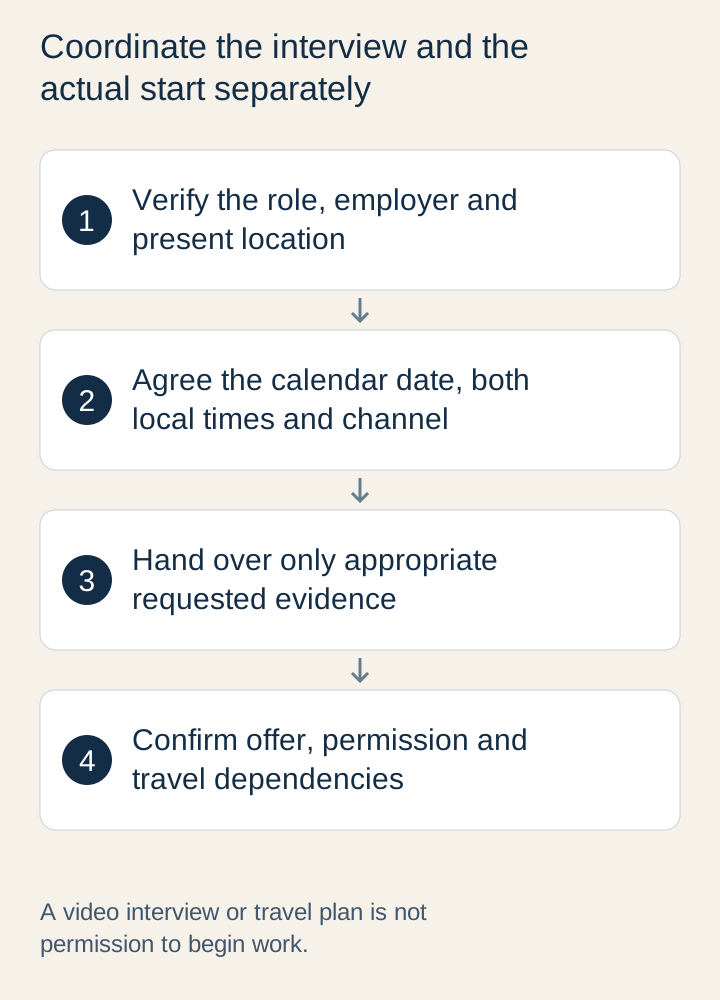
- 3. Confirm the interview in both places, not just in your head
- 4. Keep an offshore interview-and-start board
- 5. Prepare evidence for the right recipient and stage
- 6. Separate a successful interview from a lawful first day
- 7. Questions before an overseas Hong Kong job search
1. Search for work the employer actually needs
Start with duties, relevant experience, location and the employer's published recruitment instructions. Record whether the advertisement addresses overseas applicants or asks for current permission. If it is silent, ask the actual hiring contact rather than assuming silence means sponsorship is offered or refused. This guide lists no live vacancies or cooperating employers.
Use a manageable shortlist based on the role. A candidate with reporting experience might compare the reporting outputs, stakeholder responsibilities and required software across genuine advertisements. Keep each source and observation date. A copied advertisement appearing on several platforms is not necessarily several separate opportunities, and a new posting date does not prove the role is still open.
Separate the employer's identity from the recruitment intermediary and the entity that would employ you. Verify a contact through the company's actual published process before sharing sensitive documents. A logo, a familiar name or a video-call invitation alone does not establish that the sender represents that employer.
Make the location statement accurate: where you are now, how you can attend a discussion and which commencement conditions remain unresolved. Do not place a Hong Kong address on your CV merely to look local. If you have a genuine future relocation plan, describe it as a plan rather than claiming you already reside or have permission to work there.
2. Clarify the permission question without promising a route
The Immigration Department's visa FAQ gives the general employment-visa requirement, subject to the stated right-of-abode or right-to-land position. Your location outside Hong Kong and your nationality do not by themselves answer whether this particular employment is covered by your current circumstances.
For professional employment, the GEP page describes a genuine vacancy, relevant background, confirmed offer and remuneration conditions, alongside other requirements. It also distinguishes Mainland professional admission and qualifying overseas Chinese circumstances. Do not treat “overseas applicant” as the name of a visa category.
Mainland Chinese residents may need the applicable ASMTP assessment, while qualifying graduates or people with effective existing permission may have a different question. Taiwan applicants should not assume that using Chinese makes ASMTP their route. This article does not assess Technical Professionals Streams, imported labour or every existing-permission category.
If a route has not been assessed, say so. An original enquiry could read: “I am currently outside Hong Kong and can attend a video interview. If the role is a suitable match, could your team confirm the appropriate contact for reviewing the employment-permission question?” That asks for a responsible next step without saying the company has already agreed to sponsor.
For detailed route background, use the GEP and ASMTP job guide. Mainland applicants needing help connecting local job terms and their experience can use the Mainland employer-approach guide. This article concentrates on the overseas handover between recruitment, documents, travel and commencement.
3. Confirm the interview in both places, not just in your head
An invitation saying “Monday morning” is incomplete when people are in different locations. Confirm the actual calendar date, the Hong Kong time, the corresponding time at your current location, the time-zone identifier used and the meeting channel. Do not silently assume your home-country time zone if you are travelling or studying elsewhere.
Use a dated calendar conversion and check that both parties understand the same appointment. Local clock rules can change seasonally in some places, so do not carry an old time difference into a new date. This guide supplies no fixed international offset table. The useful output is one agreed appointment, not a guessed rule for every country.
| Interview item | Confirm in writing | Common gap |
|---|---|---|
| Date and time | Calendar date and corresponding time in both locations | “Tomorrow” means different dates |
| Time-zone basis | The location or identifier used for that date | Reusing an old offset while travelling |
| Host and channel | Responsible recruiter and verified invitation | Joining an unverified personal link |
| Format and language | Participants, exercise and expected language | Preparing for a different discussion |
| Connection fallback | How to contact the organizer if the call fails | Treating a disconnected call as rejection |
| Rescheduling | Who confirms a revised date and invitation | Keeping two inconsistent calendar entries |
An original confirmation message could say: “I have recorded the interview for the stated Hong Kong date and time, with the corresponding local time shown in my calendar. Please confirm the meeting channel, expected language and contact if the connection fails.” Fill in the actual details; this is a teaching sentence, not a real appointment or a message sent on your behalf.
Test your camera, microphone, connection and the document you are allowed to share. Use a neutral background and disable unrelated notifications. If an exercise is proposed, clarify its scope and confidentiality. A recruitment exercise, productive work and paid onboarding are not automatically the same activity, and the activity's real nature matters more than its label.
4. Keep an offshore interview-and-start board
Use one private row per serious opportunity. This original board is a coordination aid, not a government checklist, a verified employer list or a guarantee that travel is appropriate. It makes the dependency visible when an interview goes well but the actual start remains unresolved.
| Board field | What to record |
|---|---|
| Vacancy and employer | Role version, employing entity, source and observation date |
| Present circumstances | Actual location, relevant current permission and assessment question |
| Interview agreement | Date, both local times, host, channel and rescheduling contact |
| Evidence handover | Requested CV or qualification item, responsible recipient and safe file location |
| Offer, permission and travel | Confirmed facts, unresolved conditions and the person responsible for each |
| Update and start decision | Next agreed update, change event and evidence needed before commencement |
Consider a fictional candidate who receives positive interview feedback but no written offer. The employer plans another discussion and has not assessed the permission question. The board should show those facts, not “visa in progress.” The candidate may continue preparing evidence without describing a government application that does not exist.
Give each unresolved issue an owner and an update event. “Waiting” is too vague if nobody knows whether HR is checking role details, the candidate is locating a certificate or a professional reviewer is considering the route. Do not invent a deadline imposed by government when the date is only a personal reminder.
If you need support organizing the evidence or preparing the interview, submit your job-search background to discuss your CV, interviews and practical employer-contact directions with HKJobHunt. Confirm the actual engagement scope; an initial conversation does not establish an employer connection, a visa decision or permission to start.
5. Prepare evidence for the right recipient and stage
Begin with a current CV and a role-specific explanation of your own contribution. Keep qualification and experience evidence available for a verified request, but do not send a full travel-document or family archive to every recruiter. Ask what is needed, why, who receives it and which secure process applies. Record the document version and any unresolved discrepancy.
The GEP supporting-document section distinguishes applicant evidence from employer information and notes facilitation measures. It also includes background-specific documents and translation requirements. Use the applicable current instructions; do not assume every person outside Hong Kong supplies the same bundle or that a recruiter can replace company evidence with a generic form.
The main professional-employment pages provide an online-submission route and describe the roles of the applicant and employer. This does not mean every application is suitable or that a particular person may ignore their current immigration circumstances. An employment-linked offer, evidence preparation, submission and approval are different stages.
If a document is not in Chinese or English, consult the relevant official translation requirements before arranging it. Do not change dates, names or responsibilities to make a discrepancy disappear. Explain what needs correction and keep the responsible reviewer involved. A clearer file name helps coordination but does not repair an inaccurate document.
Prepare the interview example in a shareable form. A redacted workflow explanation may demonstrate your contribution without exposing a previous employer's customer list or internal credentials. Do not upload working access keys or a live confidential system to prove experience during a remote call.
6. Separate a successful interview from a lawful first day
After the interview, confirm the actual recruitment outcome and what the employer wants next. A teaching follow-up is: “Thank you for the discussion. Please confirm whether the next step is a further interview, an offer discussion or document review, and who will coordinate it. My relocation and commencement remain subject to the relevant employment and permission conditions.” Replace the general sentence with your true circumstances.
If an offer arrives, compare the employing entity, duties, remuneration, contract period and start conditions with the information previously discussed. Use the Hong Kong offer-review guide for that document comparison. Do not equate an accepted offer with a completed application or an approved immigration decision.
The official visitor guidance prohibits visitors from paid or unpaid employment. Travelling to Hong Kong early does not create work rights, and a pending application is not a general extension or employment entitlement. Do not promise to “help out” in the office while waiting without the actual activity and permission being properly addressed.
If the employer proposes that you start remotely from your current country before relocation, treat that as a separate proposed work arrangement. Clarify the employing entity, duties, location, pay and applicable legal responsibilities through the appropriate process. This guide does not declare cross-border work, payroll, tax or local work authorization lawful merely because the employer is in Hong Kong.
Prepare a conditional travel plan with the documents, decision and arrival requirements that apply to your actual route. Avoid irreversible arrangements based only on enthusiasm or a tentative start. The professional-employment guidance distinguishes a successful visa or entry-permit application and the documents presented during arrival clearance; an interview, electronic approval document and actual admission are not identical events.
Immigration details can be discussed through PremierVisa Group's Hong Kong professional-employment information, with the actual professional and engagement scope confirmed. Public guidance, recruitment coordination and individual advice each have their place; do not describe one as evidence that another has been completed.
7. Questions before an overseas Hong Kong job search
Must I move to Hong Kong before applying?
This guide provides no universal relocation requirement. Check the employer's actual application and interview arrangements and explain your real location. Many preparation and communication steps can be organized remotely when the employer accepts that process; this does not promise that every vacancy accepts overseas applicants.
Can I write that I am locally available if I can fly quickly?
State your present location accurately. Travel availability, relocation readiness and employment permission answer different questions. A short flight or a flexible diary does not establish a legal first day, and an address should not be used to imply permission you do not have.
Does a video interview mean the company will sponsor me?
No. It shows that a recruitment discussion was arranged. Ask what the next stage is and who will consider any permission question. Keep a further interview, offer, employer coordination and government decision as separate entries on the board.
What if the interviewer and I record different times?
Resolve the calendar date, both locations' times and the time-zone basis before the meeting. Ask the organizer to confirm one consistent invitation. If the date changes or you travel, reconfirm the conversion rather than relying on an old difference or a vague “same time.”
May I start online while the Hong Kong application is pending?
Do not infer permission from the word online. A proposed start outside Hong Kong raises its own location, employment and legal questions; working in Hong Kong as a visitor has separate restrictions. Clarify the actual arrangement with the responsible parties before beginning productive work.
Submit your job-search background to discuss your CV, remote-interview preparation and practical employer-contact directions. Bring the board with confirmed facts and unresolved dependencies, so the next conversation supports a realistic decision without promising a job, approval or relocation date.