Finance and accounting candidates should approach Hong Kong employers with evidence for the actual duties, an accurate account of their qualifications and clear questions about any regulated responsibilities. A familiar job title, overseas credential or sponsorship label does not establish local professional authority or work permission. This guide provides a six-field duties-and-authority evidence sheet, original CV examples and practical employer questions. It helps you separate recruitment suitability, professional recognition, licensing and immigration before treating an opportunity as ready to accept.
- 1. Identify the work behind the finance or accounting title
- 2. Separate credentials, professional status and authority to perform a task
- 3. Rewrite achievements around an action you can support
- 4. Build a duties-and-authority evidence sheet
- 5. Ask focused employer questions and prepare for the interview
- 6. Keep the offer and work-permission assessment distinct
- 7. Questions finance and accounting candidates should resolve
1. Identify the work behind the finance or accounting title
Start with the deliverable rather than the title. A vacancy may involve management reporting, account reconciliation, audit work, investment operations, client activity or another responsibility. Those labels are directions for investigation, not evidence that every role has the same qualification or licensing requirement. Save the original advertisement, date, hiring entity and description of what the successful person will actually produce.
Ask who uses the output and who reviews or approves it. Preparing an internal analysis, assisting a review and holding responsibility for a regulated activity are different propositions. Your CV should show the work you did and the authority you actually held. Do not convert participation in a team process into personal responsibility for every decision or regulatory submission.
For example, imagine a fictional role described as finance analyst. It could concern budget explanations, operational controls or client-facing work. Your next step is to clarify the actual duties, not to assume that one qualification or licence settles all three possibilities. A company operating in financial services can employ people with different functions; the employer's business label does not answer every individual's question.
Keep the role and entity consistent throughout the enquiry. If a recruiter uses a group brand while the offer names another company, ask who will employ and supervise you. A well-known name in an advertisement does not establish an HKJobHunt partnership, a particular vacancy's authenticity or an employer's willingness to discuss your work-permission needs.
2. Separate credentials, professional status and authority to perform a task
List each qualification by its actual issuing body, jurisdiction and present status. Distinguish completed examinations, student registration, membership and any practising or licensing status. These can be valuable but different pieces of evidence. Do not present an exam pass as membership or an overseas designation as a Hong Kong entitlement that has not been confirmed.
The HKICPA registration page distinguishes its membership-registration role from functions assumed by the Accounting and Financial Reporting Council. The AFRC practising-certificate page explains the practising-certificate requirement for a CPA intending to perform statutory audits in Hong Kong. This is a reason to identify the actual responsibility, not to say that every internal accounting vacancy requires the same certificate.
Similarly, the SFC licensing guidance relates licensing to regulated activities, functions and institutional arrangements. It distinguishes licensed-corporation and registered-institution contexts. Do not tell every finance applicant to obtain the same SFC licence, or assume that a firm's status automatically establishes the individual's authority.
The following original comparison is a job-enquiry aid, not an individual recognition or licensing decision.
| Item in a CV or advertisement | What it can help establish | What still needs clarification |
|---|---|---|
| Degree or professional examination | Academic or examination background | Relevance to the duties and exact status |
| Professional membership | Membership of the named body | Any local recognition and practising conditions |
| Practising certificate | The actual stated practising status | Scope, validity and the responsibility concerned |
| Employer's regulatory status | Information about the institution | Individual role, function and applicable requirements |
| Employment offer | Proposed duties and terms | Professional conditions and work permission before starting |
If a role's regulatory boundary is unclear, ask the employer's appropriate compliance or professional contact. Record the question and the basis of the response. This guide does not decide whether a particular exemption applies or provide a complete map of every financial-services regulator; another sector or activity may need its own assessment.
3. Rewrite achievements around an action you can support
Choose one responsibility from the vacancy and match it to a true example. Explain the issue, your action, the output and the limit of your contribution. This makes the claim easier to assess than a list of software, acronyms or prestigious client categories. Use the actual terminology you can explain, rather than copying words from another person's role.
An original rewrite could change “Responsible for monthly reporting” to “Reconciled assigned reporting inputs, investigated differences with the relevant teams and documented explanations for the reviewer.” Use it only if it describes your work. It does not invent a faster close, a monetary saving or sole responsibility for approving the final accounts.
If you have a genuine measurement, retain its period, unit, method and comparison conditions. State whether the result belongs to you or the team. If the underlying figure cannot be supported or shared, explain the qualitative contribution accurately. Do not manufacture a percentage because a CV template asks for a number in every bullet.
Prepare a non-confidential example of how you resolved an inconsistency or improved a review handover. You can describe your reasoning without disclosing client balances, transaction-level data, employer forecasts or restricted working papers. Removing a name does not automatically make the rest of a document suitable to share. Use only material you are entitled to disclose, and label any self-created practice exercise as practice.
For Taiwan candidates, describe the original credential and practical work rather than translating every designation into Hong Kong CPA terminology. For Mainland candidates, distinguish a professional qualification, an employer's internal title and the actual duties. International candidates should also preserve the issuing jurisdiction. A clear explanation of a difference is more credible than a familiar but inaccurate local label.
If you want help with this presentation, share your job-search background with HKJobHunt. Bring a genuine role description and an appropriate summary of your contribution. Preparation support does not certify a qualification, determine a licensing exemption or guarantee an employer introduction.
4. Build a duties-and-authority evidence sheet
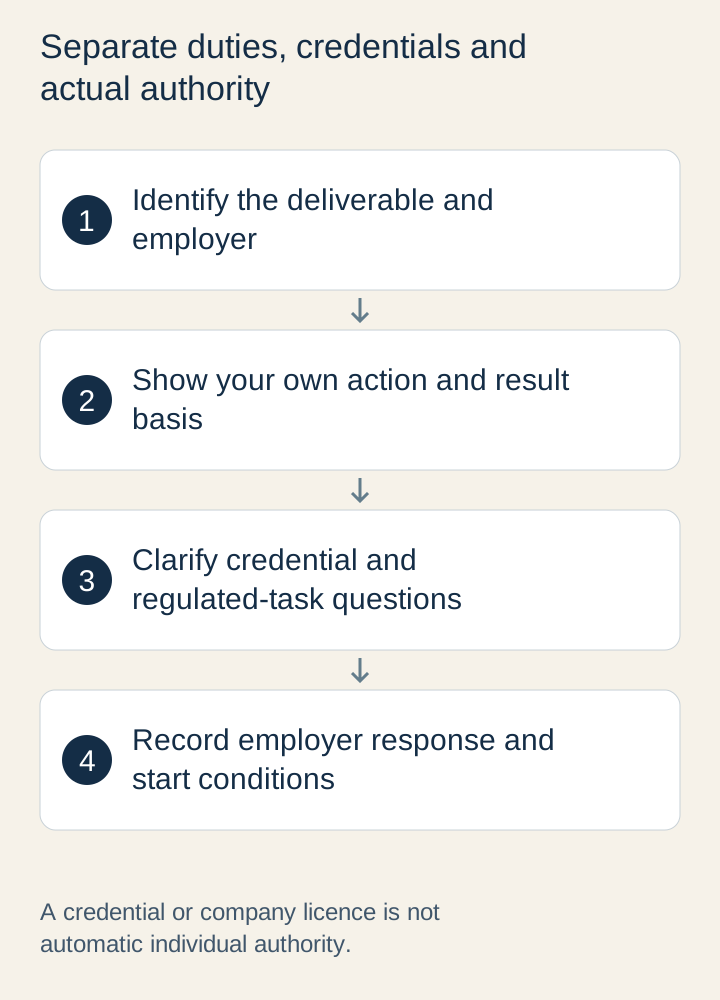
The accompanying finance duties-and-authority worksheet connects six pieces of an employer enquiry: the role and deliverable; your action and result basis; the qualification issuer and status; the regulated-task question and responsible decision-maker; the verified employer response; and the remaining conditions before starting. It is an original preparation tool, not an official application form or an eligibility score.
Complete the role field from the saved advertisement. In the contribution field, use one example that answers that duty. In the qualification field, record what you actually hold and any unresolved recognition question. Keep the regulatory question separate so a strong skill example does not quietly become evidence of authority to perform a different activity.
For a fictional reporting vacancy, you might have relevant reconciliation experience but still need to ask whether the position prepares an internal pack or holds another specified responsibility. Write that question explicitly. If the employer confirms a narrower task, update the evidence selection. If it describes additional responsibilities, do not simply carry over the earlier conclusion.
The response field should record who answered, when and what was actually said. “Recruiter will ask the compliance team” is a next step, not confirmation. A positive technical interview is also different from the employer's decision about hiring or any professional conditions. Keep each status tied to evidence rather than making the sheet look more complete than the enquiry is.
Use the Hong Kong CV guide for wider experience wording and the language-task guide for communication requirements. This article adds the relationship between duties, credentials and authority; it should not replace every job-search question with a generic visa overview.
5. Ask focused employer questions and prepare for the interview
Use the employer's genuine recruitment channel where available, or verify the intermediary's relationship to the role. Confirm the hiring entity before supplying sensitive identity or professional documents. A platform category or copied vacancy is a lead to investigate, not official evidence of licensing, recruitment approval or an available sponsorship place.
An original enquiry could say: “Your role describes reviewing reporting inputs and coordinating explanations. I have relevant experience and can discuss a permitted example of my contribution. Could you clarify the deliverables, who holds the final approval responsibility, and which professional or licensing conditions apply to this role?” Add an accurate question about your work-permission assessment when it becomes relevant.
For the interview, prepare one example of finding a discrepancy, investigating it, documenting the basis and handing the issue to the appropriate reviewer. Explain what you did not decide. A responsible account of escalation can show judgement without claiming authority you did not have. Do not disclose a real client's records to make the example sound more substantial.
Ask about language tasks, reporting systems, review arrangements and the evidence the employer wants next. If there is a case exercise, clarify its scope, assessment purpose, permitted tools and handling of the output. Do not assume that every exercise is the same as employment, but clarify any request that turns into productive work or client delivery before agreeing to the arrangement.
After the interview, compare the written duties with the conversation and update the sheet. A new client-facing task or approval responsibility may need another professional-status question. Do not treat the employer's silence on a point as a waiver, or a request for documents as proof that recruitment and permission have both been approved.
6. Keep the offer and work-permission assessment distinct
The General Employment Policy and ASMTP have different scopes and consider the actual professional job, relevant background, offer and applicable conditions. A finance title or professional certificate does not independently establish eligibility. Taiwan applicants should not copy Mainland-specific assumptions, and overseas location alone does not resolve every candidate's route.
State your existing permission and background accurately, then identify the appropriate assessment question. Where a qualifying graduate arrangement or another stream is proposed, check that arrangement separately. An employer willing to discuss support is not the same as an application prepared, submitted or approved, and professional recognition does not replace immigration permission.
The visitor guidance prohibits paid or unpaid employment by visitors. Do not begin a reporting assignment because an offer is conditional or documents are being assembled. This guide does not classify every interview exercise or cross-border activity, and a proposed arrangement may require specific assessment before work begins.
Compare the final offer using the duties and remuneration guide. Keep fixed and variable remuneration separate, and confirm any remaining start conditions. This article quotes no market salary, fee, processing period or guaranteed outcome. A competitive package still needs to be understood alongside the actual duties and permissions.
For immigration background, use PremierVisa Group's Hong Kong professional-employment information, with individual service scope and responsibility confirmed. Recruitment suitability, professional authority, work permission and any later residence question remain separate decisions.
7. Questions finance and accounting candidates should resolve
Does an overseas accounting qualification automatically make me a Hong Kong CPA?
Do not assume that. State the issuing body and exact status, then investigate the relevant recognition or admission requirements. Recruitment value and local professional entitlement are different questions, and an exam pass should not be presented as a status you do not hold.
Does every accounting job require an AFRC practising certificate?
Do not infer a universal requirement from the sector label. Identify the actual duties. The AFRC explains practising-certificate requirements for statutory-audit responsibilities; an employer should clarify the relevant professional conditions for the particular role rather than applying that description to every internal accounting task.
If the employer is licensed, am I automatically covered?
No automatic conclusion should be drawn. Ask about the individual's actual functions and the applicable institutional arrangement. The SFC guidance distinguishes different contexts and requirements; this guide does not decide an exemption or authorise a person to begin regulated work.
Can I use confidential working papers as a portfolio?
Use only material you are permitted to disclose. Prepare a non-confidential explanation or clearly labelled original practice exercise when appropriate. A redacted name alone does not prove that all remaining information is suitable for a recruitment channel.
Is a positive interview enough to start?
No. Clarify the offer, professional conditions and immigration position separately. Record actual decisions and unresolved dependencies, not assumed approvals. Do not begin work merely because the employer is interested or requests supporting documents.
Submit your job-search background to discuss CV preparation, interviews and practical employer-contact directions. Bring the duties-and-authority sheet and one precise unresolved question so the next step addresses the actual role.