Engineering and project candidates should connect the employer's actual problem to evidence of their own contribution, while keeping professional registration and decision authority clear. A large project's name, an overseas title or an interview invitation does not establish Hong Kong registration or work permission. This guide provides a six-field engineering decision record, original CV examples and employer questions. It helps you explain constraints, reviews and results without claiming another person's sign-off or treating every engineering vacancy as the same regulated role.
- 1. Identify the discipline, work package and responsibility
- 2. Separate membership, registration and a particular statutory function
- 3. Turn a project history into a clear decision record
- 4. Use a six-field engineering decision record
- 5. Prepare an employer conversation that tests the actual match
- 6. Compare the written role and keep permission separate
- 7. Questions engineering and project candidates should resolve
1. Identify the discipline, work package and responsibility
Save the original vacancy, employing entity, date and role version. Then identify the engineering discipline and the work package: design support, coordination, testing, delivery, maintenance or another activity. These descriptions can overlap, but they do not show who has final authority. Ask what the person is expected to decide, what they prepare for review and who accepts the output.
A project manager title is also incomplete information. It could involve programme coordination, technical interfaces, procurement or a defined professional responsibility. Do not assume that the title from your home market maps exactly to the Hong Kong role. Explain your actual responsibility rather than upgrading it to match the advertisement's seniority.
For a fictional building-services coordination vacancy, your useful example might concern resolving a drawing-interface question and documenting the agreed next step. For a manufacturing project role, it might concern an equipment-test issue. These are original teaching examples, not current vacancies or a claim about the licensing requirements of every project in those sectors.
Ask who employs and supervises the candidate, especially where the advertisement names a client or project brand. The organisation whose project appears on your CV is not necessarily the entity that would employ you. Keep the hiring entity, reporting relationship and actual work consistent before investing in a detailed portfolio or making relocation plans.
2. Separate membership, registration and a particular statutory function
State each qualification accurately: issuing body, jurisdiction, discipline, grade and current status. A degree, professional membership, registration application and approved registration are different facts. Do not translate an overseas designation into a Hong Kong title that you do not hold, or present a pending application as a completed recognition decision.
The Engineers Registration Board FAQ explicitly says that corporate membership of the HKIE does not automatically qualify a person for R.P.E. registration. A separate application and the applicable criteria are required. This guide does not assess those criteria for an individual, quote a processing period or promise recognition of an overseas credential.
The HKIE professional-assessment page explains assessment of technical and responsible experience, with reports, drawings and documents supporting the evidence. That is useful background for distinguishing an evidenced contribution from a title alone. A job interview and an HKIE assessment remain different processes; this article does not reproduce or certify the professional-assessment requirements.
The Buildings Department registration guide also distinguishes AP, RSE, RGE and RI registrations and their prescribed qualifications and experience. Do not assume that membership, R.P.E. status or a generic engineering role establishes every statutory appointment. If the vacancy involves a particular function, ask the employer which requirement applies and who will confirm it.
The comparison below is an original job-enquiry aid, not a complete registration guide.
| Information presented | What to record | Question before relying on it |
|---|---|---|
| Academic qualification | Exact award and institution | How does it relate to this work package? |
| Professional membership | Body, grade and discipline | Is any separate local registration relevant? |
| Registration status | Actual category, scope and validity | Does the role require this status or another appointment? |
| Project participation | Your task and reviewer | What did you decide and what did others approve? |
| Employer's title | Actual duties and reporting line | Which responsibilities must the employee hold personally? |
3. Turn a project history into a clear decision record
Choose one project that relates to the vacancy and that you are permitted to discuss. Start with the work package and the constraint: an interface, a programme dependency, a performance question or another issue you genuinely handled. Explain the information available at the time, your assigned responsibility and what decision or recommendation you personally made.
An original CV rewrite could change “Managed a major engineering project” to “Coordinated the assigned interface log, compared drawing revisions and documented unresolved items for the responsible technical reviewer.” Use it only if it describes your actions. It avoids claiming the entire project's delivery, design approval or commercial value as your own achievement.
Then explain the checking and review. Which version did you use? What evidence supported the recommendation? Who reviewed or accepted it? What remained outside your authority? Being able to describe a proper handover and its limits can show judgement. It should not be weakened by an inflated claim that you signed off work you only prepared.
If you genuinely measured a result, keep the unit, period and basis. Distinguish a local work-package improvement from the project's total outcome. If the number cannot be supported, describe the result qualitatively and state the limitation. Do not invent savings, accident-free hours, programme reductions or a budget merely to make a CV bullet appear substantial.
Protect restricted material. Use an authorised non-confidential account, a permitted redacted extract or an original practice diagram where appropriate. Removing a project name does not necessarily make drawings, security details, pricing or a client's information suitable to share. A practice model should be identified as practice and should not be presented as an approved live design.
If you need help structuring the account, share your job-search background with HKJobHunt. Bring the vacancy and a non-confidential summary of your role. A preparation discussion can help with CV and interview clarity; it does not provide an engineering endorsement, registration decision or guaranteed introduction.
4. Use a six-field engineering decision record
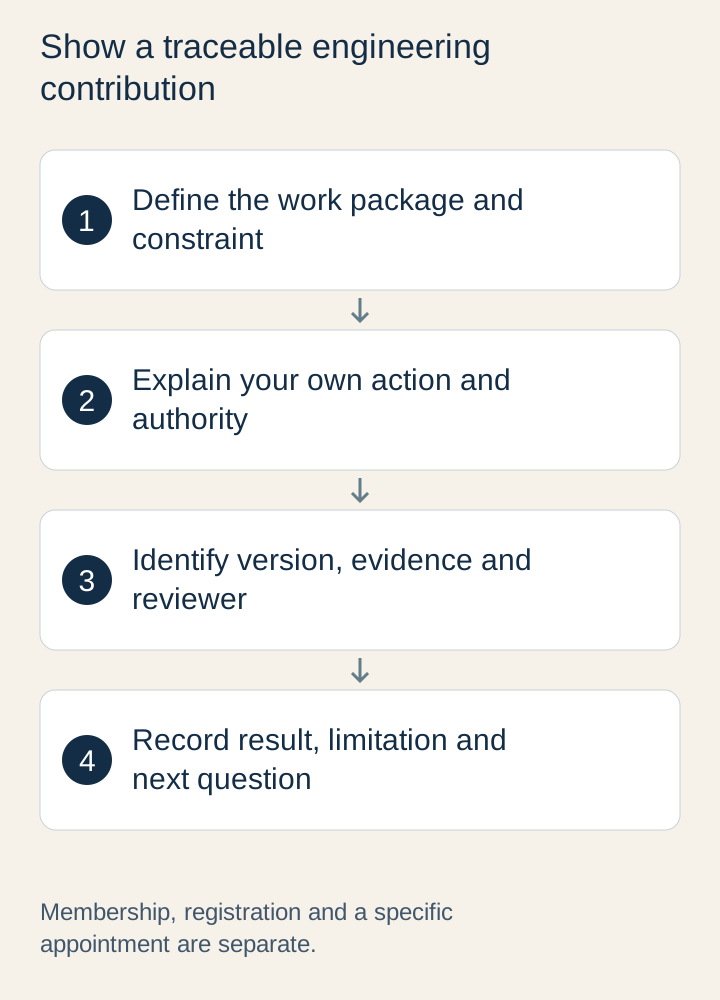
The accompanying engineering contribution worksheet connects the role to six evidence fields: the project package and interface; the constraint and available information; your action and authority; the document version, checking evidence and disclosure limit; the result and remaining limitation; and the reviewer, unresolved question and next step. It is not an official registration form or a substitute for a professional assessment.
Complete one record for the example you want to discuss. Keep the information short enough that a hiring manager can identify the chain of reasoning. A long list of project names may obscure what you actually contributed. Conversely, a precise small example can show why your experience is relevant without implying ownership of an entire programme.
Imagine a fictional coordination issue where two drawing revisions describe an interface differently. Your contribution might be identifying the difference, checking the applicable version and preparing a question for the responsible reviewer. Record the recommendation separately from the reviewer's decision. The useful evidence is the traceable handover, not a claim that you independently authorised the final design.
If the employer asks about a larger responsibility than your example supports, explain the boundary and choose another truthful example if available. Do not stretch the same record until it implies duties you did not perform. An identified gap can guide a training or recruitment conversation without being disguised as established competence.
Use the Hong Kong CV guide for general experience wording and the technology evidence guide for software or product demonstrations where relevant. This article focuses on engineering responsibility, document versions and review authority rather than repeating a general portfolio checklist.
5. Prepare an employer conversation that tests the actual match
Use a genuine recruitment channel and confirm the intermediary's relationship to the vacancy where relevant. Ask about the employing company, discipline, work location and reporting arrangement. A contractor's logo or a famous infrastructure project is not evidence that a particular overseas role is available or that an HKJobHunt partnership exists.
An original first message could say: “Your role describes coordinating technical interfaces and maintaining the review record. I handled a related work package and can explain an authorised example of my contribution. Could you clarify the decisions the role owns, who provides technical approval, and whether any specific local registration or appointment is required?” Adapt the message to the actual duties and your background.
For the interview, prepare the problem, the evidence, your action, the review and the outcome in a coherent sequence. Expect questions about an alternative you considered or information that was missing. Do not claim certainty that the original record did not support. A thoughtful explanation of why you escalated an issue can be more useful than a memorised claim of leadership.
Ask about communication tasks and the assessment format. A technical discussion, a drawing review and client coordination can require different language abilities. Describe what you can do now, not a vague bilingual label. If an exercise is proposed, clarify its scope, permitted tools, purpose and handling of the output before sharing material or beginning work.
A visit or interview invitation is not permission to perform site work. Ask about any proposed visit's purpose, access requirements and activity, without assuming that every observation or exercise has the same legal character. Recruitment assessment, productive work and professional responsibility need to be understood in the actual circumstances.
6. Compare the written role and keep permission separate
Before accepting, compare the offer with the role you discussed: employing entity, discipline, duties, location, review arrangements and any registration condition. If the scope changes, update the decision record and ask the relevant question again. Do not assume that an earlier positive conversation covers a new responsibility or a different company.
Use the offer and duties guide for remuneration and written conditions. This article supplies no market salary, guaranteed start date or processing period. A desirable project or competitive package does not answer whether the person can hold the relevant responsibility or begin work under their current permission.
The General Employment Policy and ASMTP have different applicant scopes and professional-employment conditions. A degree, engineering title, membership or employer interest does not itself establish eligibility. Mainland and Taiwan candidates should not copy each other's route assumptions, and overseas residence alone does not settle every case.
If a qualifying graduate arrangement, Technical Professionals Stream or another route is proposed, examine its actual scope separately. Do not use “technical” as a general synonym for every engineer or project manager. Record the employer's willingness to discuss support separately from a prepared application, a submission and an actual immigration decision.
The visitor rules prohibit paid or unpaid employment by visitors. A portfolio review, site invitation or pending application does not create general work permission. For immigration background, use PremierVisa Group's Hong Kong professional-employment information, with individual scope and responsibility confirmed. Professional status, employment and immigration remain distinct workstreams.
7. Questions engineering and project candidates should resolve
Does HKIE membership automatically make me an R.P.E.?
No. The ERB FAQ explicitly distinguishes membership from the separate registration application and conditions. State your actual status and discipline accurately. Do not add R.P.E. to a CV because you expect an application to succeed or because another title sounds equivalent.
Does R.P.E. status establish every building-professional appointment?
Do not assume that. The Buildings Department describes distinct registrations and requirements for specified building-professional roles. Identify the function in the vacancy and ask which status or appointment is required. This guide does not certify an individual's authority for a project.
Can I claim a project's whole value as my achievement?
Explain the scope and your actual contribution. A project's overall size is context, not proof that you controlled the full budget or delivered every result. Use supported measurements for your part and distinguish the work of reviewers, managers and the wider team.
Should I send real drawings to prove my experience?
Only share material you are permitted to disclose through an appropriate channel. A non-confidential account or clearly labelled original practice diagram may be suitable. Removing a project name alone does not resolve confidentiality or demonstrate permission to share the remaining details.
Is a technical interview or site invitation enough to start?
No automatic permission follows. Clarify the activity, professional responsibility and immigration position before work begins. A positive assessment, an offer and a government decision are separate stages, and unresolved conditions should remain visible.
Submit your job-search background to discuss CV preparation, interviews and practical employer-contact directions. Bring the engineering decision record and one question about the actual role so the next step addresses evidence rather than an inflated title.